
Lophodermella needle cast of Himalayan pine
Lophodermella himalayense
Description
Symptoms
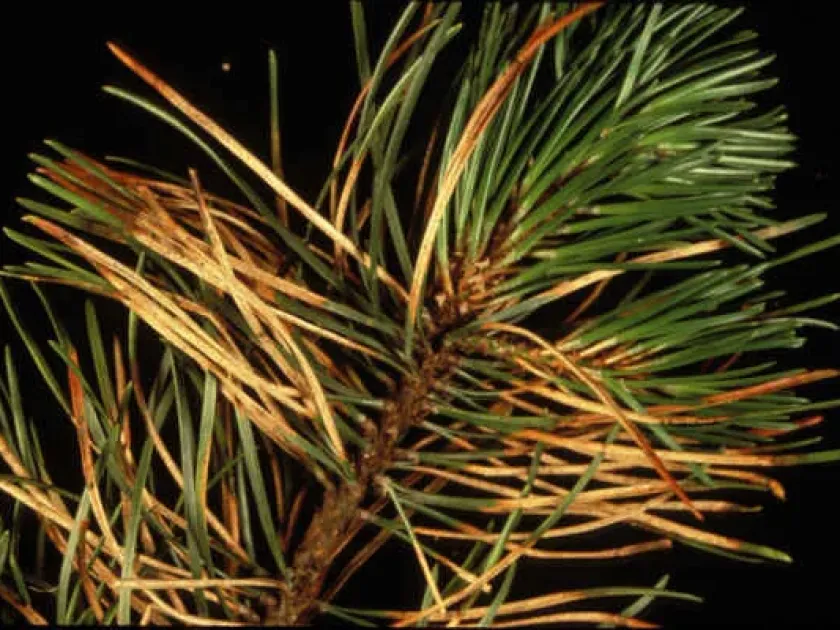
The primary symptom of this disease is the premature yellowing and subsequent browning of needles on Himalayan pine (Pinus wallichiana) in late spring and early summer.
Unlike normal shedding, infected needles tend to remain attached to the branches for a significant duration, displaying a dull, straw-colored appearance.
Fine black transverse lines or distinct spots often become visible on the surface of the affected needles, marking the presence of fungal fruiting structures.
Small, elongated apothecia eventually emerge on the lower surfaces of the needles, which serve as the exit point for the fungus's spores.
Severe infections lead to significant needle drop, which drastically thins the tree's foliage and leaves it looking sparse and unhealthy.
Pathogen
The disease is caused by the ascomycete fungus Lophodermella himalayense, a specialized pathogen targeting Pinus species.
The life cycle is closely synchronized with the host's growth stages, with fungal activity peaking during periods of high moisture and moderate temperatures.
The pathogen overwinters primarily in fallen needles on the forest floor, which harbor the fungus until the next favorable season.
Spore dissemination is primarily driven by wind and splashing rainwater, facilitating the spread of the disease within the stand.
Infection occurs when spores land on healthy needles and penetrate the plant tissues, initiating the colonization process that leads to needle death.
Conditions for development
High relative humidity, frequent rainfall, and mild spring temperatures create the optimal environment for spore germination and fungal growth.
Dense, overcrowded plantations restrict air movement, keeping the foliage damp for longer periods and promoting the rapid spread of the disease.
Trees suffering from site-related stress, such as improper drainage or nutrient deficiencies, show increased susceptibility to Lophodermella infections.
Prolonged foggy weather is a major risk factor, as it prevents needles from drying out, allowing the fungus more time to penetrate the tissue.
Inadequate sanitation practices, such as leaving infected debris beneath the trees, significantly increase the inoculum load for subsequent years.
Why it matters
The fungus significantly impairs the ornamental value of Himalayan pines, often rendering them unattractive for landscapes or residential use.
Repeated annual infections cause substantial stress to the tree, reducing its vigor and limiting the growth of new shoots and branches.
Trees weakened by this needle cast are prone to secondary attacks by wood-boring insects and other pests that exploit the stressed host.
In nurseries, this disease can cause high mortality rates among seedlings, representing a serious economic threat to growers.
Continuous loss of foliage over several years can ultimately lead to tree decline and mortality if the disease remains unmanaged.
Protection
The most effective strategy for managing this fungus is sanitation, which involves collecting and destroying all fallen needles to reduce the inoculum.
Pruning and removal of severely infected branches can help lower the fungal pressure within the canopy of an individual tree.
Fungicide applications, specifically those containing copper or systemic triazoles, are effective when timed correctly during the early growth phase.
- Applying protective fungicide sprays as new needles begin to emerge.
- Maintaining proper spacing between trees to encourage good canopy airflow.
- Providing adequate fertilization to boost the tree's natural resistance.
Ensuring that the site is well-drained and that there is adequate spacing between trees helps reduce the moisture levels required for fungal proliferation.
Discussion
No discussions yet — be the first.