
Lirula needle cast of white fir
Lirula abietis-concoloris
Description
Symptoms
The primary symptom of Lirula needle cast on white fir is the discoloration of needles during the late winter and spring. Infected needles turn a dull brown or yellowish-brown, eventually drying out but remaining attached to the branches for a prolonged period.
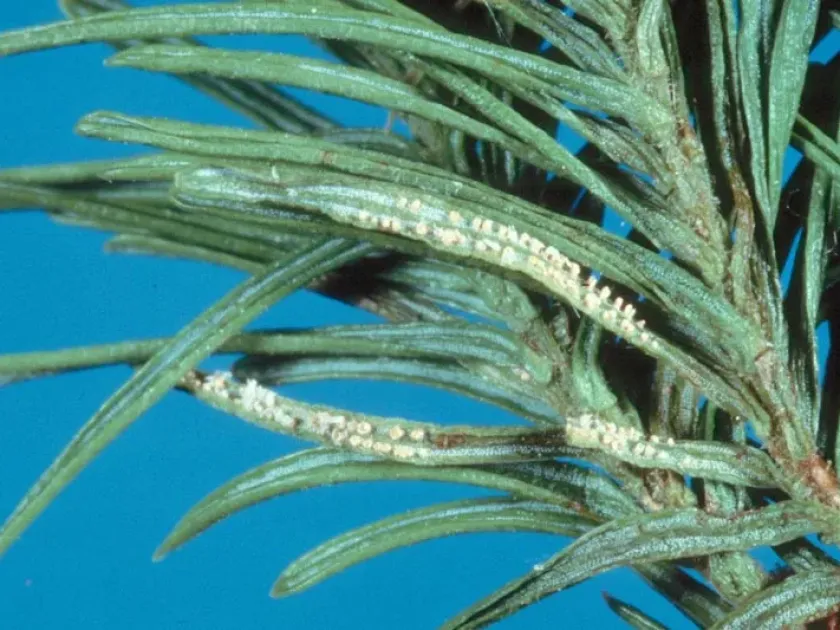
On the undersides of the needles, the fungus forms characteristic fruiting bodies that appear as narrow, long, and shiny black lines. These lines run parallel to the midrib and break through the epidermis as the spores mature.
During the sporulation phase, these lines become clearly visible, resembling fine hatching marks. This feature is a key diagnostic indicator for identifying this specific fungal infection on white fir foliage.
Infection often occurs in clusters, affecting specific branches or parts of the crown rather than the entire tree uniformly. Severe cases lead to premature needle drop, particularly in the lower and middle sections of the canopy.
Advanced infections result in sparse foliage, giving the tree a stunted or sickly appearance. Over time, the overall density of the needles significantly decreases compared to healthy specimens of the same age.
Pathogen
The disease is caused by the specialized ascomycete fungus Lirula abietis-concoloris. This pathogen belongs to the group of fungi responsible for needle cast diseases specifically affecting the Abies genus.
The fungus maintains a life cycle tightly integrated with the tree's phenology. It overwinters within the infected needle tissues, remaining capable of development even through harsh winter conditions.
Spores are primarily disseminated by wind and rain splashes during the summer months. These spores land on the current season's needles, which act as the host for infection, though symptoms usually manifest the following year.
Once established, the fungal mycelium colonizes the interior of the needle, gradually breaking down internal structures. This disrupts the tree's photosynthetic capability and eventually causes localized tissue necrosis.
The fruiting bodies, known as apothecia, mature over the course of a year, releasing spores that sustain the infection cycle within the host plant and facilitate spread to neighboring trees in favorable environments.
Conditions for development
High humidity, frequent fog, and poor air circulation within the tree canopy are the primary drivers of Lirula needle cast. Prolonged wetness on the needle surface provides the necessary moisture for spore germination.
Dense plantings restrict airflow, creating a microclimate with persistently high humidity levels around the foliage, which significantly accelerates the rate of infection and secondary spread.
Warm and rainy weather during the late spring and early summer represents a critical infection window. This is when the fungus releases its spores, making the young, succulent needles of the current season particularly vulnerable.
Trees experiencing physiological stress due to poor soil fertility, drought, or inadequate nutrient uptake show reduced natural resistance, making them significantly more susceptible to infection by the pathogen.
Accumulated needle litter beneath the tree serves as a persistent reservoir of inoculum. If this debris is not cleared, it facilitates the annual re-infection of the host, perpetuating the cycle of the disease.
Why it matters
The most significant impact of this disease is the degradation of the aesthetic value of white fir, which is widely prized in ornamental landscaping for its thick, vibrant, and healthy needle cover.
Chronic infection results in a weakened physiological state. This makes the host tree significantly more susceptible to secondary attacks by opportunistic pests, such as bark beetles or wood-boring insects.
The loss of photosynthetic surface area due to premature needle shedding leads to reduced annual shoot growth. Over several growing seasons, this energy deficit compromises the overall vigor and health of the tree.
In nursery settings, Lirula needle cast can cause high rates of plant mortality or rejection, resulting in substantial financial losses for commercial growers of fir seedlings and ornamental conifers.
In forestry and park environments, systematic annual infection can lead to the gradual decline and eventual mortality of individual trees, especially when underlying health issues go unaddressed.
Protection
The foundation of management is rigorous sanitation. This involves the timely pruning of heavily infected branches and the complete removal of fallen needles to eliminate the primary source of fungal inoculum.
Improving air circulation is vital. Proper spacing between trees prevents the creation of stagnant, humid microclimates within the canopy, which is essential to discourage the establishment of the fungus.
During the growing season, preventive fungicide applications, particularly those containing copper, can be effective in inhibiting spore germination and protecting healthy needle tissue during high-risk periods.
Systemic fungicides, when applied during the bud-break and early needle development stage, can prevent the fungus from establishing a foothold, effectively breaking the infection cycle early on.
- Regular monitoring of tree health;
- Gathering and disposing of all infected needle debris;
- Applying copper-based or Bordeaux mixture fungicides;
- Optimizing tree nutrition to boost natural resistance;
- Selecting well-drained planting sites with adequate space.
Discussion
No discussions yet — be the first.