
Description
Symptoms
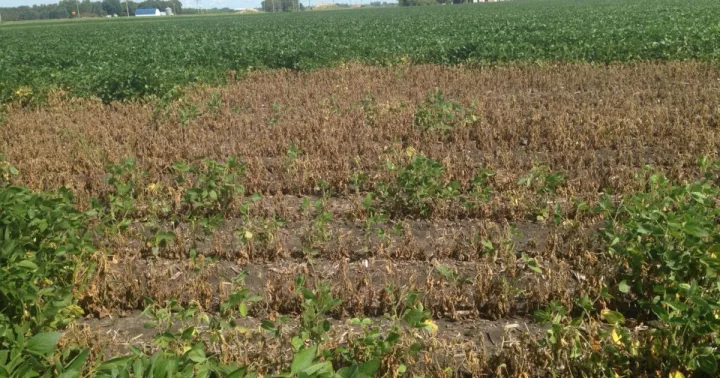
A lightning strike in a field typically presents as distinct circular or elliptical patches where the plants have been abruptly damaged or killed.
In the center of the affected area, plants may be completely destroyed, blackened, or show clear signs of scorching. Moving towards the perimeter, the severity of damage gradually decreases.
Plants at the edge of the affected zone often exhibit wilting, stem necrosis, and loss of turgor. In crops like soybeans, the vascular tissue in the lower stem often turns dark or collapses.
These patches contrast sharply with the healthy, growing canopy, making them easily identifiable during field scouting. The size of these spots can range from a few meters to large areas depending on the electrical discharge intensity.
Over time, the affected plants become brittle and dry. While the center remains empty, the margins may show secondary fungal growth as the dead plant tissue begins to decompose.
Pathogen
A lightning strike is not a disease in the biological sense; it is a severe abiotic stress caused by a high-voltage electrical discharge from a thunderstorm.
There is no infectious pathogen involved. The damage is purely physical and thermal, resulting from the electricity traveling through the plants and the moist soil.
The electrical current causes instant overheating, the rupture of cell membranes, and the denaturation of proteins within the plant's vascular system, leading to rapid death.
Because there is no biological agent, the strike cannot spread from plant to plant through wind, rain, or insect vectors. It is a localized incident occurring at the point of contact.
However, the damaged tissue can become a host for saprophytic fungi or opportunistic pathogens, which may appear after the strike but are not the cause of the initial plant mortality.
Conditions for development
The primary conditions for this damage are thunderstorm events accompanied by lightning during the growing season when crops are most active.
High soil moisture significantly increases the conductivity of the ground, which allows the electrical discharge to spread further through the root zones of adjacent plants, expanding the size of the circular patch.
Flat, open fields with little tree cover or natural protection are the most vulnerable sites, as the crop itself becomes the most conductive path for the electricity.
The time of year is critical; for soybeans and other summer crops, mid-summer storms often coincide with rapid biomass accumulation, making them prime targets for strikes.
Soil composition also plays a role. Heavier, clay-based, or saline soils can be more conductive, potentially increasing the radius of the electrical discharge compared to drier, sandier soils.
Why it matters
The most immediate harm is the total loss of yield within the affected area. Plants within the epicenter are usually destroyed beyond recovery.
In the peripheral areas, plants may survive but suffer from severely impaired nutrient transport due to vascular damage, leading to reduced pod fill and stunted growth in soybeans.
Large patches of dead crops can become breeding grounds for weeds, as they eliminate competition for sunlight and space, necessitating additional weed control efforts.
The dead plant material creates a bridge for secondary infections. In high-humidity conditions, rot can develop in the strike zone and potentially spread to the edges of the healthy crop.
Logistical and operational losses occur as the gaps in the canopy create uneven field conditions, which can complicate mechanical harvesting and machinery navigation.
Protection
There are no practical "controls" for lightning strikes as they are unpredictable meteorological events. Management focuses on diagnostics and field assessment.
It is vital for farmers to correctly identify lightning damage to avoid unnecessary and costly applications of fungicides or insecticides, which are ineffective against abiotic electrical damage.
If the affected patch is small, it is best to leave it alone. In some cases, if the strike occurs early in the season, growers may consider reseeding, though this is rarely economically viable.
Clearing away the severely damaged or dead debris in the center of the patch can help reduce the potential for secondary pathogen buildup and improve the uniformity of the field for harvest.
Regular scouting and documenting these events help the farm team understand field vulnerability and distinguish these incidents from developing epidemics of diseases or pest outbreaks.
Pathogens and affected parts
Affects crops · 1
Discussion
No discussions yet — be the first.