
Leptosphaeria leaf spot
Leptosphaeria errabunda
Description
Symptoms
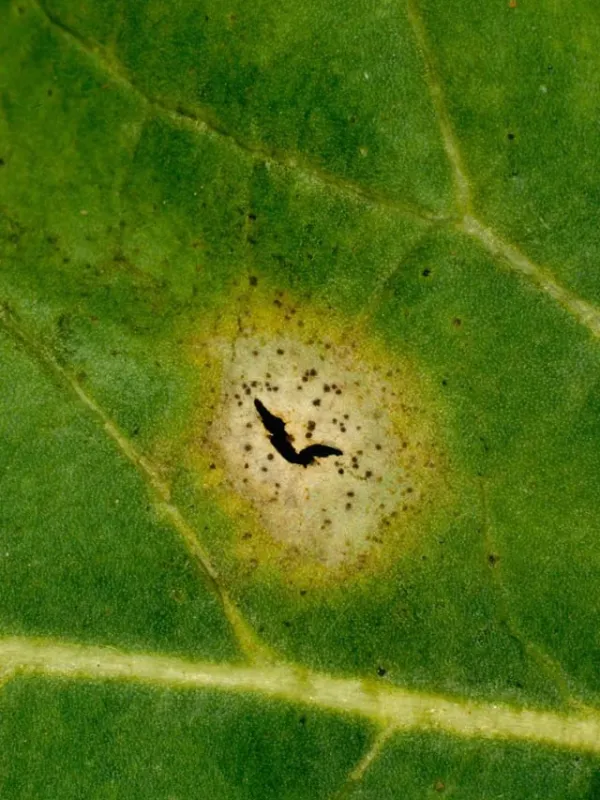
The primary symptom of the disease is the appearance of small, irregular spots on leaves and stems, which eventually turn brown or grey. Often, a distinct dark margin forms around these lesions.
On the affected areas, fungal fruiting bodies known as pycnidia often develop, appearing as tiny black dots visible to the naked eye. As the disease progresses, these spots coalesce, causing necrosis of the leaf tissue.
When stems are affected, cracking or deformation may occur, disrupting the plant's nutrient and water transport systems. In severe cases, affected parts of the plant may dry out and fall prematurely.
Symptoms can vary depending on environmental humidity: in high-moisture conditions, a light mycelial growth often appears on the spots. The intensity of the symptoms also depends on the physiological state of the host plant.
Early diagnosis can be difficult because the symptoms may resemble other fungal infections. It is important to monitor the lower canopy of the plants, as this is where the infection usually starts before spreading upwards.
Pathogen
The causal agent of this disease is the fungus Leptosphaeria errabunda, which is classified as an ascomycete. The pathogen can survive for long periods in infected plant debris, overwintering as mycelium or pseudothecia.
The life cycle of the fungus is closely linked to humid conditions, which facilitate the release of spores. The infection spreads through both ascospores and conidia, ensuring both primary and secondary infection of crops throughout the growing season.
Scientific analysis shows that the fungus possesses high enzymatic activity, allowing it to degrade the cell walls of host plants. This makes it an aggressive pathogen capable of rapidly colonizing susceptible plant species.
The fungus shows a specialized nature, primarily affecting herbaceous plants and certain shrub species. Understanding its biology is essential for maintaining efficient field monitoring and disease management.
Accurate identification of L. errabunda often requires laboratory analysis, as its symptoms may overlap with those of other Leptosphaeria species. Knowing its life cycle is the key to timing fungicide applications effectively.
Conditions for development
Leptosphaeria leaf spot thrives in conditions characterized by moderate temperatures and high relative humidity. The ideal temperature range for spore germination is between 15 and 22 degrees Celsius.
Prolonged rainfall and frequent fog create an optimal environment for disease spread within agroecosystems. Moisture lingering on leaf surfaces is a critical factor for spore germination and infection.
Poor agricultural practices, such as high-density sowing, lead to reduced airflow and create a microclimate favorable to the pathogen. This significantly accelerates the rate of disease development in the field.
Inadequate crop rotation, where susceptible plants are grown in the same field for multiple years, leads to an accumulation of inoculum in the soil. Plant debris acts as a reservoir for the fungus to reinfect future crops.
Stress factors such as nutrient deficiencies or mechanical damage weaken the plant's natural immunity, making the crops more susceptible to infection by Leptosphaeria errabunda.
Why it matters
The main damage caused by Leptosphaeria leaf spot is the premature loss of photosynthetic leaf area. This leads to stunted growth, reduced biomass, and significant decreases in overall yield.
Infection of the stems can reduce the plant's structural integrity, leading to lodging. This creates severe difficulties during harvesting and results in mechanical losses of marketable produce.
The disease negatively impacts product quality by reducing sugar, protein, and vitamin content in fruits or edible parts of the crop. Storage life and market appeal are also significantly compromised.
Infection of reproductive organs can result in pollen sterility, leading to a shortage of grains or fruits. In unfavorable years, farmers can lose 15 to 30 percent of their potential harvest.
Chronic exposure to the pathogen drains the plant's energy reserves, making it less winter-hardy and more susceptible to secondary infections, creating a complex problem for producers.
Protection
The foundation of effective control is the use of high-quality, disease-free seed and strict adherence to crop rotation. Susceptible crops should not be returned to the same field more often than every 3–4 years.
Agronomic control measures include the thorough destruction of post-harvest debris where the fungus overwinters. Deep plowing helps to reduce the inoculum load by burying infected material and accelerating decomposition.
To prevent disease spread, preventive and curative applications of systemic fungicides are recommended. Following label instructions and rotating active ingredients is crucial to prevent the development of fungicide resistance.
- Utilization of resistant cultivars and hybrids.
- Balanced fertilization, particularly with phosphorus and potassium, to boost plant immunity.
- Ensuring optimal planting density to improve airflow.
- Systematic field monitoring for the first appearance of leaf spots.
Biological control agents, such as beneficial bacterial antagonists, show promise in integrated pest management programs, helping to reduce chemical input and environmental impact.
Discussion
No discussions yet — be the first.