
Leptorhaphis oxyspora
Leptorhaphis oxyspora
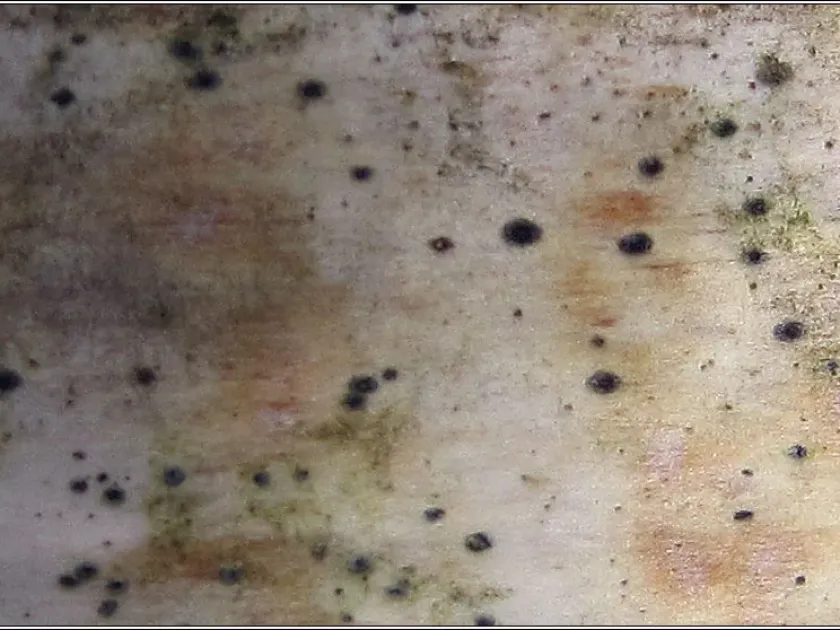
Description
Symptoms
The main sign of Leptorhaphis oxyspora presence is the change in the appearance of lichens growing on tree bark. Affected areas of the thallus begin to change color, losing their natural pigmentation and acquiring a yellowish or gray tint.
In the early stages of infestation, microscopic black dots may appear on the lichen surface. These dots are the perithecia of the fungus, which break through the lichen surface during the spore maturation process.
In areas where the fungus accumulates, necrotic death of lichen tissues is observed. The thallus becomes brittle, starts to crack, and peels off the tree bark, exposing the plant epidermis that was previously hidden under the lichen layer.
As the disease progresses, the infested lichen colonies look stunted and pitted. Often, empty patches form around these foci where the lichen cover has completely degraded and fallen off, leaving the tree without its epiphytic protection.
Identification of the pathogen requires laboratory analysis, as visual symptoms can resemble those of other lichenicolous fungi. Microscopy is necessary to identify the characteristic spores, which allows for precise diagnosis of the species.
Pathogen
Leptorhaphis oxyspora is a specialized ascomycete fungus belonging to the group of lichenized or lichenicolous fungi. In scientific literature, it is described as a parasite that inhabits the thalli of lichens found on the bark of woody plants.
Biologically, this pathogen is classified as a mycoparasite. Its life cycle is closely linked to the colonization of the lichen surface. The fungus penetrates the tissues of the host lichen, causing degradation and eventual necrosis of the lichen organism.
The type of disease can be characterized as an epiphytic bark infection. Although the fungus itself is not a primary pathogen of the tree's own tissues, its activity alters the bark microbiome and creates a favorable environment for secondary infections.
From a biological perspective, Leptorhaphis oxyspora is characterized by the formation of perithecia-type fruiting bodies. These structures are embedded within the substrate (the lichen thallus), making them difficult to detect with the naked eye without specialized equipment.
This fungus is a highly specialized organism whose ecological niche is limited to interaction with specific lichen species. It does not directly affect the wood or leaves, but acts as an indicator of specific micro-environmental conditions on the bark surface.
Conditions for development
The development of this fungus is directly dependent on environmental humidity levels. Since the pathogen resides on the bark surface, high atmospheric humidity and frequent fog create ideal conditions for spore germination.
Temperature regimes also play a critical role. The fungus is active during periods of moderate temperature, typically in the spring and autumn seasons. In hot, dry periods, the pathogen's activity slows down, and it enters a state of dormancy.
Spore dispersal occurs via wind or raindrops. This ensures rapid infection of neighboring trees within an orchard or plantation, provided that conditions are favorable for the spores to settle and attach to the lichen surface.
Plant density is an indirect factor in disease development. In dense orchards where air circulation is restricted, humidity on the bark surface remains high for longer periods, which facilitates the mass reproduction of Leptorhaphis oxyspora.
The presence of a well-developed lichen cover on older trees is a prerequisite for the survival of the species. On young trees with smooth bark, where lichens have not yet formed dense colonies, this pathogen is rarely encountered.
Why it matters
The primary damage lies in the disruption of the natural balance of the epiphytic flora on the tree bark. While lichens are sometimes criticized for retaining moisture, they also protect the bark from direct sunburn and sharp temperature fluctuations.
Mass infestation of lichens by Leptorhaphis oxyspora leads to the premature exposure of the bark. This makes the tree vulnerable to adverse environmental factors and can provoke the formation of cracks and frost-related injuries.
Breaching the integrity of the bark due to fungal activity creates entry points for more dangerous pathogens, such as black rot or wood-rotting fungi. Thus, the pathogen acts as a risk factor for tree health.
In commercial orchards, the presence of the pathogen indirectly points to insufficient tree care. While damage to lichens rarely kills a tree directly, it signals a need for improved sanitary measures.
Aesthetic damage is also significant, especially in decorative gardening. Affected bark patches look unkempt, which reduces the value of parkland and ornamental plantings that require high visual standards.
Protection
Prevention begins with ensuring optimal horticultural practices. Regular pruning, which promotes better aeration of the canopy and trunks, significantly lowers bark humidity, making the environment unsuitable for lichenicolous fungi.
In cases of significant infestation, mechanical cleaning of the bark to remove lichens is recommended. Using special brushes allows for the removal of both the lichens and the fungal fruiting bodies, lowering the infectious load in the orchard.
The use of lime wash on trunks is a traditional and effective protection method. The lime alters the pH level on the bark surface, creating an unfavorable environment for the development of fungal pathogens and spores.
The use of copper-based fungicides (such as Bordeaux mixture or copper sulfate) allows for effective control of fungal infections. Bark treatment should be conducted during the tree's dormant period to avoid damaging young shoots and foliage.
Monitoring the condition of the bark allows for the timely detection of the fungus's expansion. It is important to remove heavily infested branches during sanitary pruning to prevent the further spread of the pathogen throughout the orchard.
Discussion
No discussions yet — be the first.