
Leptographium root disease
Leptographium lundbergii
Description
Symptoms
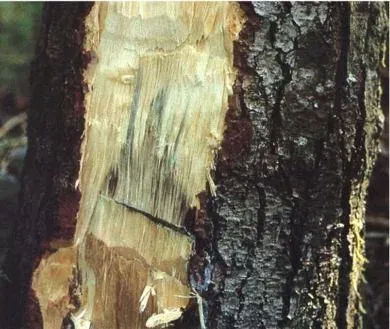
The most visible symptom of the disease is the blue-grey or black discoloration of the wood, which is best observed on fresh logs or stump cross-sections. This staining is deeply embedded in the xylem.
Trees affected by the fungus often show signs of crown thinning, followed by chlorosis and eventual necrosis of the needles. This leaf discoloration is a direct result of the interrupted supply of water and nutrients.
Evidence of resin flow is frequently seen on the outer bark, particularly near beetle entry points. However, this defensive reaction is usually insufficient to stop the fungal colonization once it becomes established.
Bark removal reveals dark, irregular necrotic lesions on the phloem and cambium layers. These areas represent the active front of the fungal attack and can eventually girdle the stem, killing the tree.
In humid conditions, the fungus may produce small, dark, hair-like conidiophores on the surface of insect galleries. These fruiting structures are microscopic but can appear as a fuzzy coating under magnification.
Pathogen
The causal agent of this disease is the ascomycete fungus Leptographium lundbergii. It is widely recognized as a primary blue-stain fungus associated with various conifer species, particularly pines.
The fungus is transmitted through the galleries and tunnels created by bark beetles and wood-boring insects. These pests serve as the primary vectors, introducing fungal spores directly into the tree's vascular system.
Once inside, the fungus colonizes the sapwood, spreading its mycelium through the tracheids and parenchyma cells. This process disrupts the tree's internal water transport system, leading to rapid physiological decline.
The fungus produces melanin in its hyphae, which causes the characteristic deep blue or black staining of the sapwood. This discoloration is a diagnostic feature used to identify the presence of the pathogen.
While often considered an associate of bark beetles, Leptographium lundbergii can act as an aggressive pathogen in stressed or overcrowded forest stands, contributing significantly to tree mortality.
Conditions for development
Favorable conditions for Leptographium lundbergii include warm temperatures and high humidity, which promote rapid fungal growth. These conditions often coincide with summer months when bark beetle activity is highest.
Drought stress, soil compaction, and root damage significantly increase the susceptibility of conifers to the disease. Stressed trees produce less defensive resin, making them easier targets for both beetles and fungi.
Overstocked and stagnant forest stands provide an ideal environment for the spread of the disease. In these dense environments, the proximity of trees allows for easier transmission of beetles and their associated fungal load.
Poor forest hygiene, such as leaving diseased logs or slash in the forest, creates breeding grounds for insect vectors. This leads to an increase in the spore density within the local ecosystem.
Environmental changes, including climate warming, may alter the distribution and frequency of insect vectors, potentially expanding the impact of the disease to new regions or higher altitudes.
Why it matters
The primary economic impact of Leptographium lundbergii is the significant degradation of timber quality. The blue stain significantly lowers the grade of lumber, making it unsuitable for high-value aesthetic applications.
The disease causes increased tree mortality in managed forests, leading to inventory losses. This necessitates expensive salvage logging and disrupts sustainable forest management planning.
By compromising the structural integrity of the wood, the fungus makes trees more susceptible to windthrow and secondary pest attacks. This increases the overall risk of catastrophic loss in forest stands.
In nurseries, the pathogen can cause significant losses in seedling stocks, resulting in financial damage and delays in reforestation efforts. Young plants lack the defensive capacity of mature trees.
Beyond the timber industry, the disease affects the ecological health of forest ecosystems by creating gaps in the canopy, which can lead to shifts in the local biodiversity and plant community composition.
Protection
Effective management begins with strict sanitation practices. Prompt removal and processing of infested or wind-thrown trees are essential to eliminate the primary sources of both insects and the fungus.
Integrated Pest Management (IPM) strategies, including the use of pheromone traps, should be employed to monitor and suppress the populations of bark beetles within the stand.
Minimizing mechanical injuries during silvicultural operations and timber harvesting is crucial to preventing new infection sites. Tools should be regularly cleaned and disinfected.
Promoting tree vigor through appropriate thinning and silvicultural care enhances the natural resistance of the stand. Healthy, vigorously growing trees are better able to defend against infection.
- Regular forest surveys to detect early symptoms of infection.
- Rapid sanitation harvesting of infested material.
- Treatment of logs with fungicides if immediate processing is not possible.
- Managing stand density to reduce stress.
- Biological control through the encouragement of natural insect predators.
Discussion
No discussions yet — be the first.