
Lepraria incana
Lepraria incana
Description
Symptoms
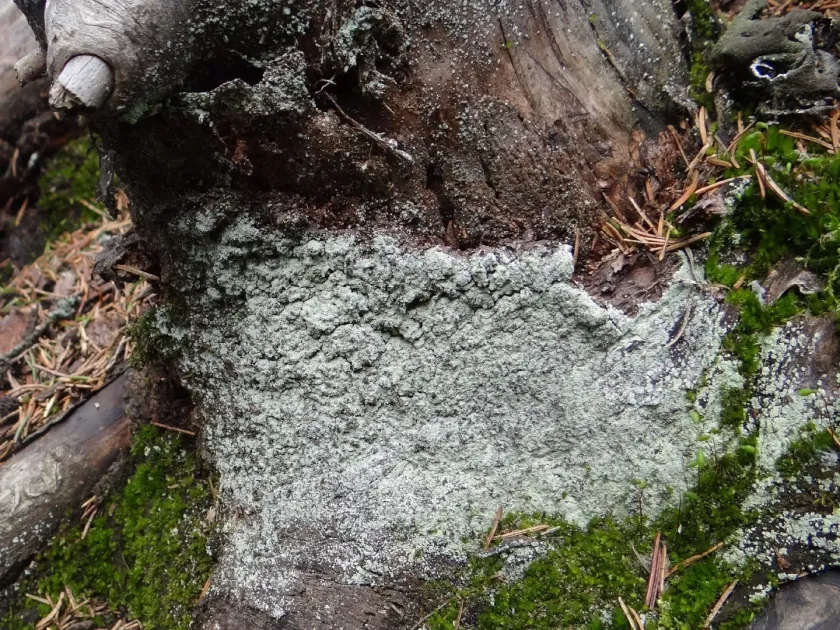
The primary symptom of the presence of Lepraria incana is the appearance of a specific grayish-green or whitish coating on the trunks and skeletal branches of trees.
The coating has a characteristic powdery or granular texture that is easily rubbed off with fingers, resembling dust or a thin, fine powder.
Unlike brightly colored lichens, Lepraria incana often mimics the color of old bark, which is why gardeners may not notice the colonization of the tree for a long time.
As the colony grows, patches can merge, covering a significant part of the bark's surface, especially on the northern side of the tree.
When infested with lichen, the bark in the areas of its localization may become denser and rougher, which is often accompanied by a general suppression of the tree's growth.
Pathogen
Lepraria incana is not a pathogenic fungus in the traditional sense that causes decay. It is a leprose lichen, a symbiotic organism consisting of fungi and algae.
Unlike parasitic fungi, Lepraria incana does not penetrate deep into the host plant tissues but uses the tree bark exclusively as a substrate to anchor its thallus.
This organism belongs to the group of crustose lichens, which do not have distinct leafy forms but appear as a granular or dusty coating on the surface of the bark.
The biology of the organism involves development in conditions of high humidity and shade, making it a typical inhabitant of old orchards and woodland areas.
The spread of Lepraria incana occurs vegetatively through the dispersal of thallus particles (soredia) by wind, water, or insects onto weakened areas of tree bark.
Conditions for development
The key factor for the development of Lepraria incana is high air humidity, which is critical for the metabolism of this lichen.
Dense crowns and the lack of regular sanitary pruning create an ideal microclimate with reduced air circulation, which facilitates the growth of colonies.
Trees with damaged bark, old orchards with slow bark renewal processes, and low light levels are the main stimuli for the expansion of the lichen.
Lepraria incana is extremely sensitive to air purity: its mass development in a garden often indicates a favorable ecological environment, but it also points to insufficient maintenance of tree health.
The lack of periodic cleaning of trunks from dead bark creates a favorable nutrient medium for spore fixation and the formation of new infestation centers.
Why it matters
Although Lepraria incana is not a direct parasite, it causes indirect damage by hindering the normal gas exchange of the tree bark through lenticels.
The mass covering of the trunk with lichen creates a physical barrier that promotes bark waterlogging, which provokes the development of secondary fungal infections and rot.
Under the layer of Lepraria incana, various pests such as scale insects, mites, and caterpillars often find shelter, causing direct damage to the health of fruit crops.
Trees covered with lichens look weakened, leading to reduced yields, decreased cold hardiness, and premature aging of the wood.
In commercial orchard conditions, the presence of lichens is a sign of poor agrotechnical practices, requiring immediate intervention to maintain the productive longevity of the plantations.
Protection
The primary control measure is the mechanical cleaning of trunks and skeletal branches using stiff brushes or wooden scrapers during the tree's dormant period.
To prevent re-colonization, trunks should be whitewashed with high-quality lime solution mixed with copper sulfate to disinfect bark micro-cracks.
An effective technique is spraying trees with a 3–5% iron sulfate solution in early spring or late autumn, which causes the death of the lichen colonies.
Regular sanitary and thinning pruning of the crown allows for improved aeration, making the surface conditions of the bark unsuitable for the life of Lepraria incana.
- Ensuring optimal tree nutrition levels for active bark growth.
- Regular inspection of bark condition during seasonal garden work.
- Timely removal of dead bark sections to promote tissue renewal.
Discussion
No discussions yet — be the first.