
Lepiota grangei
Lepiota grangei
Description
Symptoms
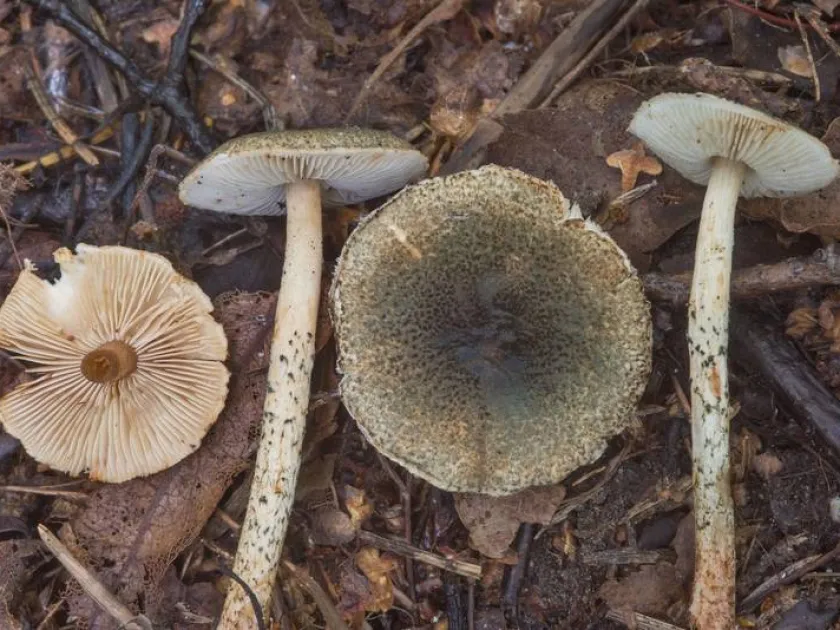
Lepiota grangei is a species of gilled mushroom in the family Agaricaceae. It is distinguished by its unique cap, which is adorned with distinct greenish-black or dark grey scales on a lighter surface.
The gills are typically white or pale cream, providing a visible contrast to the darker scales on the cap. A prominent ring on the stalk serves as a key morphological feature for field identification.
Importantly, this fungus is a saprotroph, meaning it gains its nutrients from decaying organic matter. It does not infect living plant tissues, and thus it is not a plant pathogen.
In agricultural settings, the appearance of these mushrooms is often associated with the presence of leaf litter, mulch, or high organic content in the soil rather than crop disease.
Agronomists recognize this species as part of the natural soil biota rather than a concern for plant health or crop production.
Pathogen
The biological nature of Lepiota grangei is that of a basidiomycete fungus. Its life cycle involves decomposing dead plant material and organic matter in the soil.
As a saprotroph, it secretes specialized enzymes to break down complex compounds like cellulose and lignin, returning nutrients to the soil. It lacks the ability to parasitize living hosts.
The fungus reproduces via spores, which are distributed by wind or water, leading to the development of mycelium in organic-rich substrates.
Because it lacks structures like haustoria, it cannot penetrate the cells of crops or inhibit their physiological processes, differentiating it from true plant pathogens.
Consequently, Lepiota grangei is not a disease agent. It is a beneficial or neutral component of the soil ecosystem that assists in organic matter cycling.
Conditions for development
Lepiota grangei thrives in environments with high soil humidity and significant organic accumulation. It prefers moist, shaded areas with plenty of decaying matter.
Development is most common during warm, wet seasons when moisture levels remain consistent. It is frequently observed in fields with high mulch levels or un-decomposed organic fertilizers.
The fungus requires specific temperature conditions, typically favoring mild weather without extreme drought or flooding, to produce its fruit bodies.
There are no specific 'conditions for spread' that an agronomist needs to control, as the fungus poses no risk to agricultural stability or production yield.
Soil aeration and moisture management are the primary drivers of its presence, but these are standard agricultural practices for maintaining soil quality.
Why it matters
Lepiota grangei poses no harm to agricultural crops. It does not damage roots, stems, or leaves and does not compete for resources with cultivated plants.
There is no economic damage associated with this fungus. Its presence in a field does not necessitate any intervention or curative measures.
Unlike parasitic fungi, this species does not produce toxins that could inhibit plant growth or reduce the quality of the harvested product.
Misidentifying this fungus as a plant disease can lead to unnecessary costs and improper use of fungicides, which could potentially harm beneficial soil microbes.
It is classified as an innocuous component of the field environment, functioning to improve soil health by breaking down organic residue.
Protection
No protective or control measures are required for Lepiota grangei. Because it is not a plant pathogen, chemical control is completely unnecessary.
If mushroom clusters become an obstacle to field operations, they may be mechanically removed, but this is a cosmetic action rather than a necessity for plant health.
Prevention involves ensuring good soil drainage and avoiding excessive stagnation of water, which is a standard procedure for optimal crop management.
Integrated Pest Management (IPM) focuses on actual threats to crop production, while saprotrophic mushrooms are left to contribute to natural soil processes.
Always verify the identity of any fungi found in crops, as distinguishing between saprotrophs and true pathogens is vital for making correct management decisions.
Discussion
No discussions yet — be the first.