
Lepiota brunneoincarnata
Lepiota brunneoincarnata
Description
Symptoms
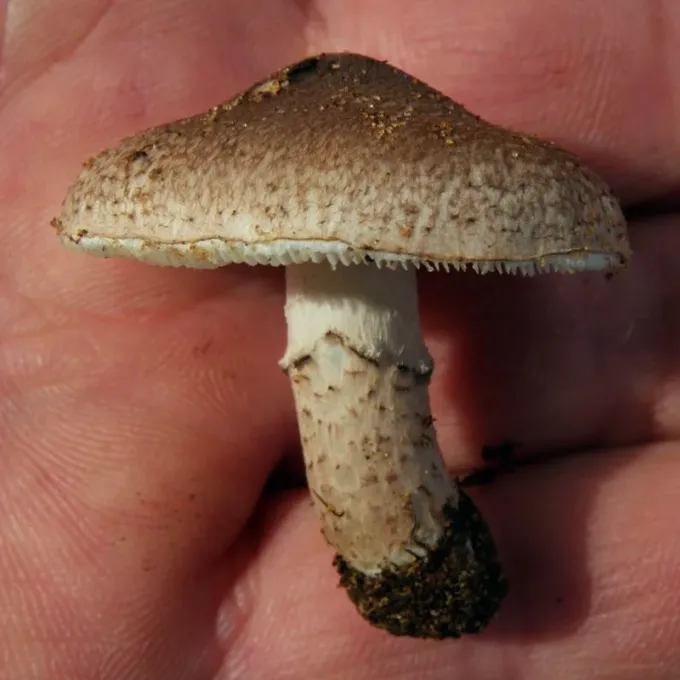
The mushroom’s fruiting body features a cap ranging from 2 to 5 centimeters in diameter, which starts hemispherical and eventually flattens out. The cap surface is covered with fine brownish-pink or purplish-brown scales, giving it a distinct mottled appearance.
The gills are crowded, free from the stem, and white in color, sometimes displaying a creamy tint; they do not show significant color changes when bruised. The stem is cylindrical, up to 4 centimeters tall, featuring a ring in its upper part that often fades as the mushroom matures.
The flesh is firm and white, showing no discoloration when cut, which is a key diagnostic feature to distinguish it from similar-looking edible species. It emits a faint but specific fruity or musty odor, which becomes more intense as the mushroom dries.
It is critical to note the lack of obvious external differences from various edible species of Lepiota or Agaricus. The specific color of the scales is a distinguishing mark, but precise identification usually requires microscopic analysis of the spores.
Unlike plant pathogens that cause agricultural diseases, this organism is a saprotroph and does not infect plants directly, but it frequently colonizes soil in areas with high levels of organic matter.
Pathogen
The causative agent is Lepiota brunneoincarnata, a fungus belonging to the Agaricaceae family. This organism acts as a saprotroph, decomposing organic waste in the soil rather than attacking living plant tissues.
Biologically, the species produces tiny, ellipsoid spores spread by wind and water. The mycelium thrives in humus-rich soils, preferring areas with high nitrogen content and consistent moisture levels.
Conditions for development
Fruiting bodies develop primarily during summer and autumn. The fungus prefers well-warmed areas with moist, loose soil and is commonly found in gardens, parks, lawns, and pastures rich in organic debris.
Optimal conditions for fruiting involve periods following moderate rainfall, accompanied by air temperatures between 18 and 25 degrees Celsius. The fungus can appear as solitary specimens or in small clusters.
Why it matters
The primary danger of this fungus is its high toxicity to humans and pets. It contains amatoxins, which are heat-stable poisons that damage the liver and kidneys and cannot be neutralized by cooking.
Consumption of even a small amount of this mushroom can be fatal. Symptoms of poisoning often appear with a significant delay, complicating timely diagnosis and the administration of medical treatment.
Protection
The main preventive measure is a strict policy against foraging for any gilled mushrooms in gardens or orchards unless their species identity is absolutely certain. Regular mowing is recommended to reduce humidity in the ground cover.
If the mushroom is found on a site, complete removal of the fruiting bodies along with the surrounding soil is recommended to prevent the spread of spores. Dispose of these by deep burial or burning.
Discussion
No discussions yet — be the first.