
Leotia
Leotia
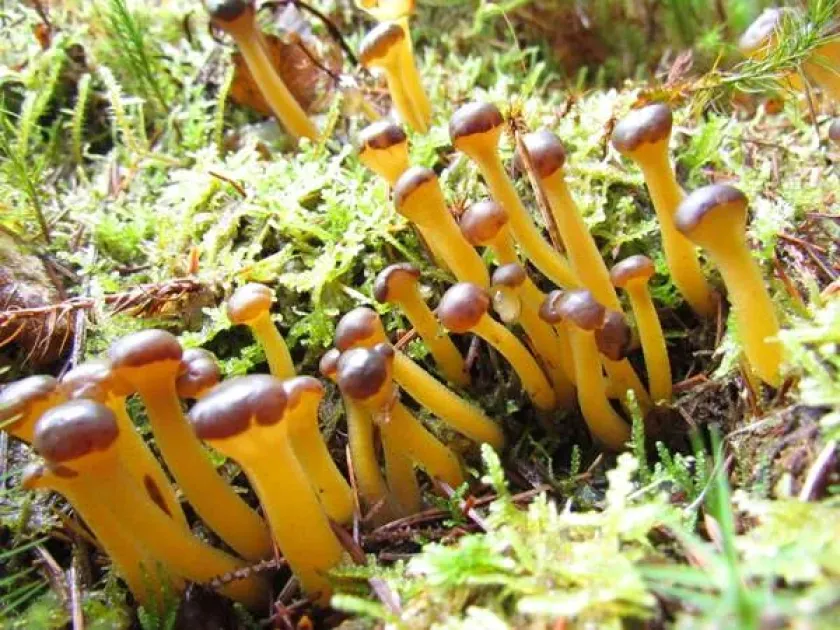
Description
Symptoms
The fruit bodies of Leotia exhibit a distinct appearance, resembling jelly-like cap fungi. They possess a characteristic gelatinous texture that remains consistent even under significant fluctuations in humidity.
The cap of the fungus is usually convex, often featuring an irregular or slightly wavy shape with curled-down edges. The surface is smooth and frequently covered with a sticky or slimy layer, which serves as a key identifying trait.
The color spectrum of the fruit bodies ranges from olive-green to yellowish-brown hues. The stem is often lighter than the cap, cylindrical, and occasionally hollow or filled with loose fungal tissue.
The height of these fungi rarely exceeds 2-5 centimeters. They often grow in dense groups or small clusters, making them highly visible against the forest leaf litter.
It is important to note that this genus belongs to saprotrophs and is not a pathogen of agricultural crops. Visual signs of fungal growth may be observed on decomposing wood or humus.
Pathogen
Leotia belongs to the phylum Ascomycota (sac fungi) and the family Leotiaceae. This object is not a plant disease pathogen, as it does not infect living plant tissues.
The life cycle of the fungus involves mycelial development within forest litter or on a substrate consisting of dead organic matter. Reproduction occurs via spores that mature within asci.
Biologically, this fungus acts as a decomposer in forest ecosystems, participating in the breakdown of organic matter. It lacks the parasitic mechanisms required to be classified as a phytopathogen.
The fruit body structure is formed through a complex sporulation process typical of sac fungi. The fungal cells contain specific pigments responsible for their characteristic coloration.
Studies indicate that Leotia metabolites do not exert phytotoxic effects on surrounding vascular plants. Therefore, the fungus is a benign component of forest flora.
Conditions for development
The development of Leotia is closely linked to high air and substrate humidity. These fungi are most commonly found in moderately moist deciduous or mixed forests.
Optimal conditions for the appearance of fruit bodies include prolonged rainfall and an absence of sharp temperature fluctuations during the summer-autumn period. The fungus prefers shaded environments.
The substrate for mycelial growth consists of well-decomposed wood, humus-rich soil, or leaf litter. Moisture concentration is a critical growth factor.
The fungus is sensitive to the chemical composition of the soil, preferring habitats with a moderately acidic reaction. Soil contamination may negatively impact the fruiting process.
Spore dispersal is facilitated by air currents after they are released from the asci due to internal osmotic pressure.
Why it matters
In an agronomic context, Leotia poses no threat to agricultural crops. It is not a causative agent of diseases affecting vegetables, fruit trees, or cereal grains.
Any reference to Leotia as a plant disease is erroneous, stemming from a misinterpretation of mycological data. This organism is strictly saprotrophic.
The absence of enzymes capable of degrading living plant cell walls makes it impossible for this fungus to act as a pathogen. It does not reduce yield or product quality.
The presence of this fungus in gardens or fields may merely indicate high organic matter content in the soil, which is typically beneficial for the growth of cultivated plants.
Any harm caused would be strictly indirect, such as rare cases where excessive soil moisture, where the fungus grows, hinders root aeration for crops.
Protection
No special control measures, fungicide treatments, or quarantine actions are required for Leotia. The fungus does not need to be eradicated within forest or park ecosystems.
If the presence of these fungi is undesirable in an ornamental garden, it is sufficient to normalize the moisture regime. Improving soil drainage and ensuring proper aeration is recommended.
Preventing the appearance of saprotrophs involves the timely removal of plant debris, which can serve as a nutritional base for the mycelium.
The use of chemical protective agents (fungicides) against Leotia is impractical, economically inefficient, and potentially harmful to soil microflora.
- Optimizing irrigation
- Improving site drainage
- Removing excess organic matter
- Maintaining soil aeration
Discussion
No discussions yet — be the first.