
Lecideaceae lichens
Lecideaceae
Description
Symptoms
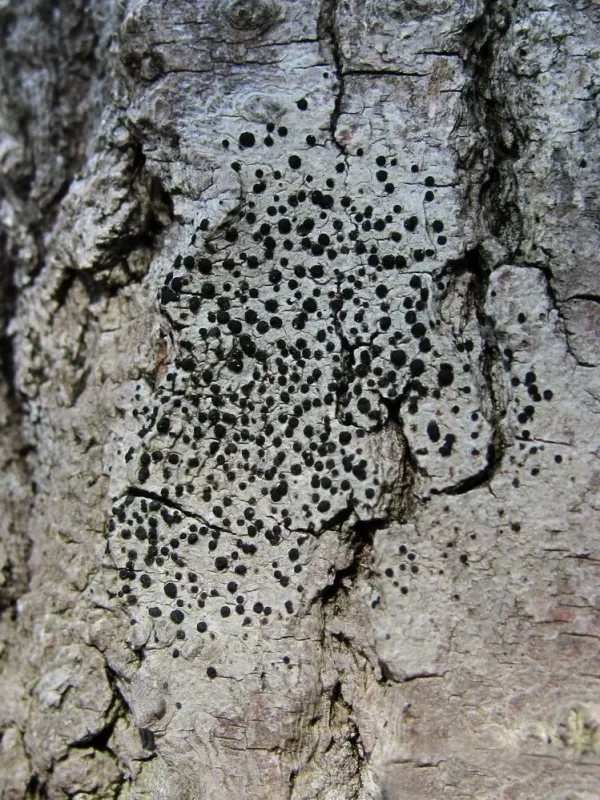
The main sign of Lecideaceae is the appearance of flat, crust-like patches on the trunks and branches of trees. These patches often differ in color from the natural bark, appearing grey, yellow, or brown.
Close inspection reveals small, disk-shaped structures known as apothecia, which are the reproductive organs where spores are produced. These give the lichen a rough, textured appearance.
Lichens are most visible on the shaded or north-facing sides of the tree where moisture persists for longer periods. They are rarely seen on young, rapidly growing branches due to the constant shedding and expansion of the bark.
Colonies can cover large sections of the trunk over time, creating a uniform layer that makes the bark look aged and weathered. The texture can vary from smooth to quite granulated.
Distinguishing lichens from fungal infections is essential: lichens are superficial and do not damage the integrity of the bark, whereas diseases usually cause cracks, oozing, or tissue decay.
Pathogen
Lecideaceae is a large family of crustose lichens that grow on various substrates, including the bark of trees. They are symbiotic organisms composed of fungal hyphae and photosynthetic algae or cyanobacteria, acting as epiphytes rather than true plant parasites.
These lichens do not penetrate deep into the live tissue of the tree. Instead, they attach themselves to the surface of the bark, using it as a stable base for growth and accessing moisture from the atmosphere.
While they are not considered infectious plant diseases that kill the host directly, their presence is often an indicator of poor tree vitality, slow bark growth, or neglected orchard conditions.
Lecideaceae lichens have a slow growth rate and reproduce via spores spread by wind or by vegetative fragments. They prefer stable, undisturbed surfaces, which is why they are commonly found on older trees.
The biology of these organisms is highly adapted to atmospheric conditions, allowing them to remain dormant during periods of drought and thrive when humidity levels increase.
Conditions for development
High humidity and poor air circulation are the primary drivers for the development of Lecideaceae. Orchards that lack regular pruning are highly susceptible to the colonization of these epiphytes.
Low light levels, especially in the interior of dense tree canopies, create favorable conditions for their growth. Sunlight exposure effectively inhibits the establishment of new colonies.
The age and health of the tree are also significant factors. Older trees with slow-growing, stable bark surfaces are ideal hosts, as the lichen is not frequently disturbed by bark shedding.
Environmental factors, such as clean air and stable moisture patterns, encourage their growth. In areas with high atmospheric pollution, certain lichen species may be absent, but they still thrive in rural garden settings.
Spring and autumn seasons, characterized by frequent rainfall and mild temperatures, provide the best conditions for the active expansion of lichen colonies on branches.
Why it matters
Lecideaceae lichens do not directly extract sap, but their presence can interfere with the tree's gas exchange by covering the lenticels on the bark surface. This can potentially hamper the respiratory processes of the trunk.
They act as a reservoir for various pests, including scale insects, mites, and aphids. The dense structure of the lichen provides a perfect hideout, protecting these pests from predators and insecticide treatments.
Their mass presence significantly degrades the aesthetic appeal of fruit trees, signaling a lack of proper orchard management. This visual cue often indicates that the tree is in a weakened state.
In cases where the bark is already compromised, the persistent moisture held by lichen colonies can promote the development of secondary rotting fungi and bacterial infections.
While not lethal, the cumulative effect of having a tree covered in lichen is a decrease in overall vigor, which may lead to reduced yields and shorter productive lifespan of the tree.
Protection
Mechanical removal is the most direct way to control Lecideaceae. Using a stiff brush or a scraping tool during the dormant season allows for the removal of the colonies without causing damage to the live wood.
Whitewashing trunks with lime-based solutions is a highly effective preventive measure. It creates a hostile environment for lichen spores and provides added protection against sunscald.
Regular sanitary pruning is essential to improve airflow and increase light penetration throughout the canopy. This prevents the humid microclimate that lichens require to thrive.
Applying copper-based fungicides in the early spring can help sanitize the bark and inhibit the germination of lichen spores. These treatments are standard practice in orchard maintenance.
- Mechanical cleaning of bark
- Whitewashing with lime
- Sanitary pruning of the canopy
- Balanced fertilization
- Copper-based spray treatments
Discussion
No discussions yet — be the first.