
Verticillium dry bubble
Lecanicillium fungicola
Description
Symptoms
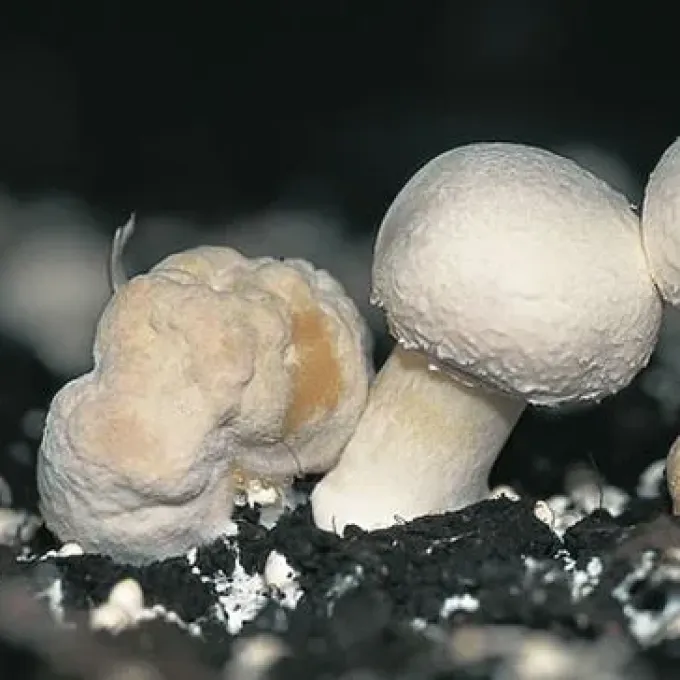
Symptoms vary depending on the stage of infection. If infection occurs during the early primordia formation phase, it leads to the condition known as "bubble disease".
A characteristic sign is severe deformation of the stem and cap, with the development of dense, shapeless pathological growths often referred to as "bubbles".
In later stages of infection, irregular brown spots appear on the cap surface, which rapidly dry out, turning a grayish-brown color.
The affected tissue gradually loses turgor and hardens, turning into a dry, brittle mass, which gives the disease its common name, "dry bubble".
- Deformed mushroom fruiting bodies (bubbles).
- Dark, irregular spots on the caps.
- Browning and decay of the mushroom stem.
- Distinctive off-odor in cases of severe infestation.
Pathogen
The causative agent of the disease is the microscopic imperfect fungus Lecanicillium fungicola (formerly known as Verticillium fungicola). It is a specialized parasite that targets exclusively the fruiting bodies of cultivated mushrooms, primarily the button mushroom Agaricus bisporus.
The fungus belongs to the hyphomycetes class and reproduces actively through spores that spread throughout the mushroom growing facility. These spores have high viability and can persist in substrate and greenhouse structures for extended periods.
The pathogen's life cycle is closely linked to the humidity and temperature conditions of mushroom growing chambers. Upon landing on a fruiting body, the fungal mycelium penetrates the tissues, gradually degrading their internal structure.
The disease spreads via water droplets carrying conidia, through tools, staff clothing, or insect vectors such as mushroom flies and phorid flies.
A key biological feature of the pathogen is its ability to form chlamydospores, making control extremely challenging if production sanitary standards are compromised.
Conditions for development
The primary factor promoting Lecanicillium fungicola development is high relative humidity and surface moisture on fruiting bodies. Water droplets are the main agent for spore dissemination.
The optimal temperature for rapid pathogen growth ranges from 18°C to 24°C, which coincides perfectly with the environmental conditions required for button mushroom cultivation.
Poor ventilation within the growing chamber leads to stagnant, humid air, which accelerates the germination of pathogen spores on healthy mushrooms.
Contamination of the casing soil used to cover the compost is the most frequent source of primary infestation across the growing beds.
Neglecting hygiene protocols during harvesting or failing to properly sanitize equipment creates an ideal environment for massive disease outbreaks within the facility.
Why it matters
Verticillium dry bubble is considered one of the most destructive diseases in industrial mushroom farming, capable of destroying up to 80–90% of marketable yield if not controlled.
The disease not only reduces total production volume but also severely ruins the appearance of mushrooms, rendering them completely unsuitable for the fresh market.
Infected mushrooms lose weight rapidly, leading to significant financial losses for commercial growers due to the mandatory disposal of entire batches.
The pathogen spreads extremely quickly within a single chamber, turning healthy mushroom blocks into infection epicenters within just a few days.
The presence of the disease requires thorough disinfection of all equipment and often results in prolonged production shutdowns for intensive sanitation measures.
Protection
The primary strategy remains prevention: strict adherence to sanitary and hygienic standards, and rigorous disinfection of facilities, tools, clothing, and footwear.
It is essential to regularly monitor and manage mushroom fly populations, as they are primary vectors for Lecanicillium fungicola spores within the growing rooms.
Ensuring the quality of casing soil is crucial; it must be properly sterilized (pasteurized) before application to the mushroom compost to prevent the introduction of the pathogen.
Upon detecting the first symptoms, affected mushrooms must be removed immediately along with the surrounding casing soil to prevent contact with healthy neighboring mushrooms.
The use of approved fungicides as a preventative measure for substrate and bed surface treatment significantly lowers the risk of disease onset and subsequent spread.
Discussion
No discussions yet — be the first.