
Laboulbenia vulgaris
Laboulbenia vulgaris
Description
Symptoms
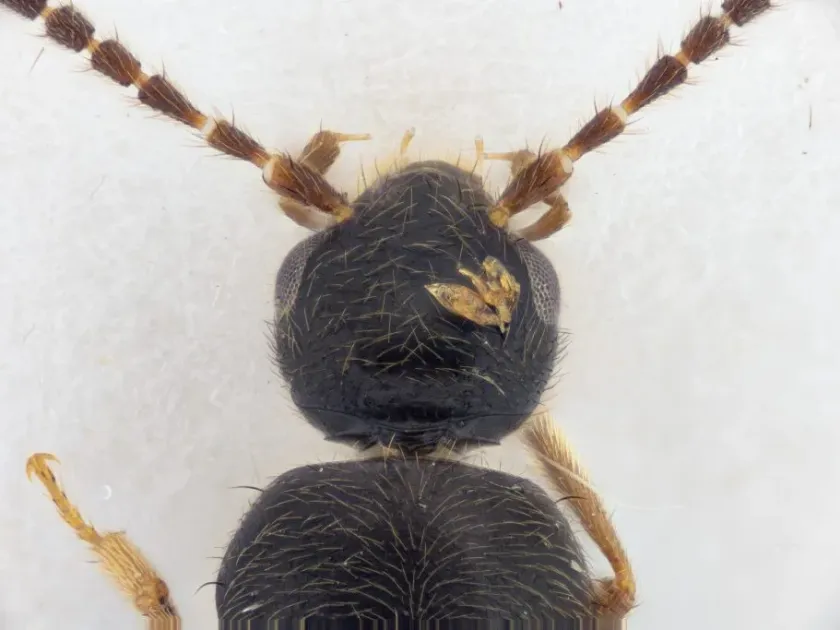
The presence of the fungus is visible as small, rigid, hair-like or club-shaped growths, typically brown or yellowish in color, on the beetle's surface.
These growths are usually concentrated on the underside of the abdomen, the legs, or the elytra (wing covers) where the fungus finds stable attachment points.
In cases of heavy infestation, the beetle may appear to be covered in a sparse, bristly layer consisting of numerous individual fungal thalli.
These signs are only observed on living or freshly deceased insects, as the fungus requires a living host to sustain its nutrient intake.
Microscopic examination reveals the perithecia, the reproductive structures of the fungus that hold spores, which are essential for spreading the infection to new hosts.
Pathogen
Laboulbenia vulgaris is not a plant pathogen. It is a specialized ectoparasitic fungus belonging to the order Laboulbeniales.
This fungus grows exclusively on the exoskeleton of insects, most commonly on members of the ground beetle family (Carabidae).
The fungus attaches itself to the host using a specialized structure called a haustorium, which penetrates the cuticle to obtain nutrients from the insect's hemolymph.
Unlike true plant pathogens, Laboulbenia vulgaris does not colonize plant tissues, roots, or leaves, making it completely harmless to agricultural crops.
The life cycle of the fungus is strictly adapted to the behavior of its host, relying on the physical contact between insects for the transmission of fungal spores.
Conditions for development
The development of Laboulbenia vulgaris is highly dependent on a high population density of its host insects, which ensures frequent contact for spore transmission.
Humid environmental conditions are vital for the germination of spores on the insect's cuticle, explaining why the fungus thrives in moist soil litter.
Peak transmission rates often occur during periods when beetles aggregate, such as during mating seasons or hibernation in protected shelters.
While environmental temperatures influence the rate of spore development, the fungus is generally resilient and adapted to the microclimates inhabited by ground beetles.
Agricultural practices and plant growth stages do not directly affect the fungus, as its survival is independent of the plant host's physiological state.
Why it matters
Laboulbenia vulgaris poses no threat to agricultural productivity, as it lacks any capability to infect or damage plant structures.
Potential harm is limited to the impact on the health of beneficial insects like ground beetles, which are natural predators of many agricultural pests.
High levels of infestation might theoretically affect the motility or lifespan of individual beetles, potentially reducing their effectiveness as biocontrol agents.
In practice, these infestations rarely reach levels that would significantly impact the overall population density or functional role of ground beetles in the field.
Because the fungus does not cause economic damage, it is classified as a neutral component of the ecosystem rather than a pest or disease of concern.
Protection
No specific control measures are required or recommended for Laboulbenia vulgaris, as it does not interfere with crop production.
The use of fungicides or insecticides to combat this fungus is strongly discouraged, as it would cause unintended harm to beneficial insects and disrupt ecological balance.
The best approach to managing beetle health is to maintain a healthy ecosystem through sustainable farming practices that preserve natural habitats.
Reducing the reliance on broad-spectrum pesticides helps preserve the population of entomophagous insects, which is more important than controlling incidental parasites.
No prophylactic methods exist or are needed against this fungus, as its presence is a natural occurrence in healthy, undisturbed agricultural landscapes.
Discussion
No discussions yet — be the first.