
Ash dieback
Hymenoscyphus fraxineus
Description
Symptoms
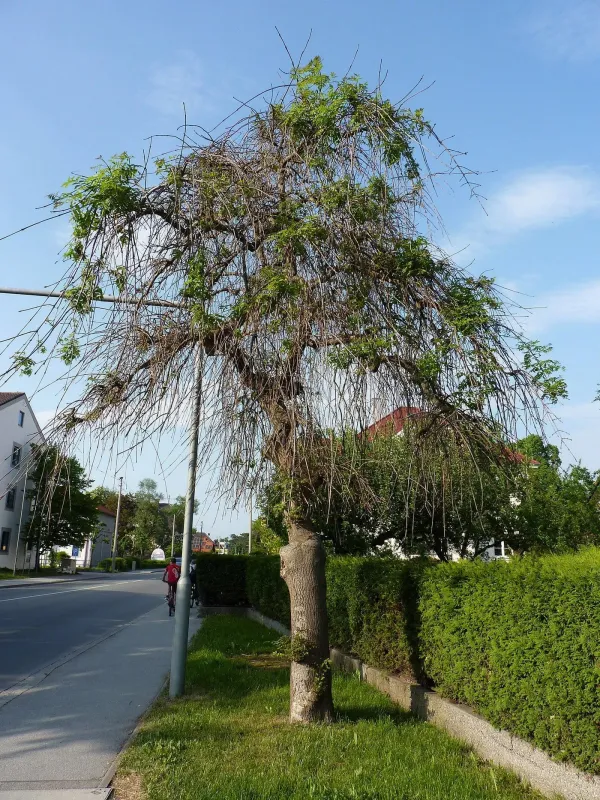
Initial symptoms include the wilting and discoloration of leaves, followed by the premature shedding of foliage, which creates a sparse appearance in the tree crown.
Dark, diamond-shaped lesions often appear on the bark of shoots and branches, usually centered around a leaf node, which effectively girdles and kills the affected branch.
As the disease progresses, the tree exhibits significant dieback of twigs and branches, leading to the characteristic "dieback" appearance that gives the disease its common name.
Affected trees may produce epicormic growth, where numerous small shoots sprout directly from the trunk or main branches in an attempt by the tree to survive.
Internal wood staining, ranging from light brown to black, is a consistent sign of the fungal colonization that blocks the tree's vascular system.
Pathogen
Ash dieback is caused by the fungus Hymenoscyphus fraxineus, a pathogen that has caused widespread mortality among ash tree species across Europe and parts of Asia.
The fungus is an ascomycete that spreads through wind-dispersed spores released from small fruiting bodies found on fallen ash leaf stalks during the summer months.
Once the spores land on leaves or shoots, the fungus grows into the twigs and branches, eventually reaching the main stem where it causes severe tissue necrosis.
The pathogen is highly aggressive, with the ability to kill young saplings within a single growing season and older, more established trees over several years.
Scientific research indicates that the fungus persists in the leaf litter, making the forest floor a significant reservoir for reinfection every year.
Conditions for development
The disease thrives in environments with high humidity and moderate temperatures, which are optimal for the growth and dispersal of fungal spores.
Densely planted areas with limited airflow facilitate the movement of spores between trees, accelerating the overall decline of the forest stand.
Environmental stress factors, such as drought, frost damage, or nutrient deficiencies, make trees significantly more susceptible to infection and secondary attacks.
Spore production peaks during the summer, coinciding with periods of rainfall, which provides the necessary moisture for the fungus to fruit on the forest floor.
Microclimates within the forest understory play a crucial role, as decaying leaves remain damp, providing a continuous supply of inoculum for the next infection cycle.
Why it matters
Ash dieback represents a severe threat to biodiversity, as ash trees provide unique habitats for numerous species of insects, birds, and other wildlife.
Economically, the disease results in massive losses for the forestry sector due to reduced timber quality and the high costs associated with clearing dead trees.
Public safety is a major concern, as dead and dying ash trees are structurally weak and pose a significant risk of branch failure in public spaces and along roadsides.
The disease causes profound landscape changes, often leading to the complete loss of ash as a dominant species in certain forest compositions within just a decade.
Ecological disruption occurs as invasive species often colonize the gaps created by dead ash trees, further altering the natural forest succession.
Protection
Management focuses on removing heavily infected trees to reduce the local spore load, although this is often insufficient once the disease becomes widespread.
Strict biosecurity measures, such as prohibiting the transport of ash wood or plants from infected areas, are essential to prevent the spread to disease-free zones.
Long-term efforts are centered on identifying and breeding ash trees that show natural resistance to the pathogen, offering hope for the future of the species.
Silvicultural practices that promote tree health, such as thinning stands to increase air circulation, can help reduce the impact of the disease in some instances.
- Monitor forest stands for early signs of infection.
- Prioritize the retention of asymptomatic trees for potential breeding.
- Dispose of infected plant material via burning or deep burial.
Discussion
No discussions yet — be the first.