
Hymenochaete rubiginosa
Hymenochaete rubiginosa
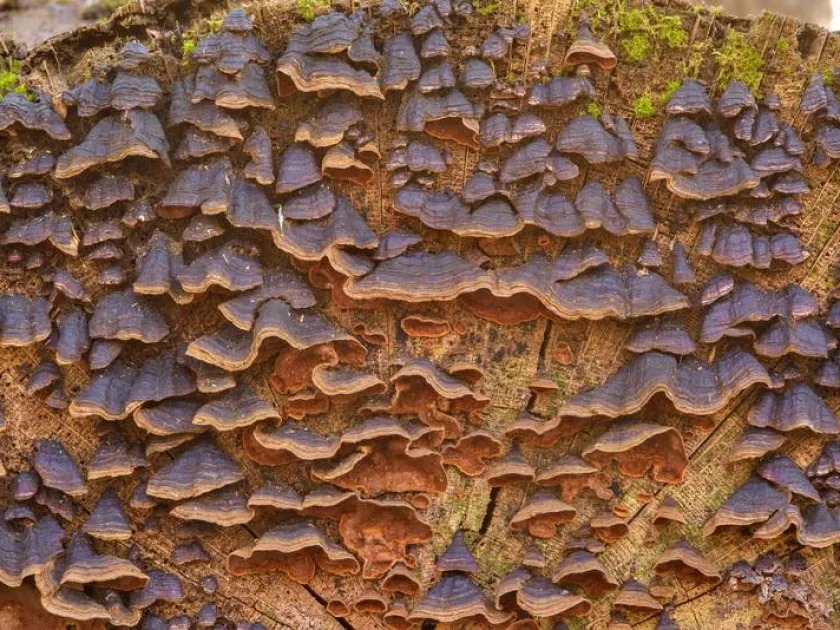
Description
Symptoms
The primary symptom of infection is the presence of hard, leathery, perennial fruiting bodies on the bark of trees. These structures are often crust-like or form small, bent shelves firmly attached to the substrate.
The surface of these fruiting bodies is typically rusty-brown to dark brown in color. It features a velvety or suede-like texture, with margins often turning a lighter, yellowish or golden hue during active growth.
A cross-section of an infected tree reveals severe heartwood decay. The wood develops a distinct reddish-brown color, which is a hallmark of this specific fungal pathogen.
As the decay progresses, the wood becomes brittle and splits both longitudinally and transversally. Within these cracks, thick sheets of mycelium, often ochre or yellowish-brown, are frequently observed.
Over time, the core of the trunk becomes almost entirely destroyed. This leads to a massive loss of structural integrity, often resulting in the tree becoming hollow and susceptible to falling during high winds.
Pathogen
The disease is caused by the wood-decay fungus Hymenochaete rubiginosa, a member of the Basidiomycota division. It functions primarily as a pathogen that often colonizes stressed or aging trees.
It predominantly infects hardwood species, particularly oak, beech, and hornbeam. The fungus typically enters the host through deep wounds, frost cracks, broken branches, or other physical damage to the bark.
The biological cycle of the fungus includes the production of basidiospores that are spread by wind. Once these spores land on an exposed injury of a suitable host, they germinate and form a mycelium.
This mycelium invades the inner wood layers, where it secretes powerful enzymes. These enzymes break down lignin and cellulose, allowing the fungus to extract nutrients and continue its growth within the host.
The perennial nature of the fruiting bodies allows them to release spores across multiple seasons. This persistent spore production ensures that the fungus can maintain a presence in the ecosystem for many years.
Conditions for development
High humidity and moderate temperatures are the most critical factors for the development of Hymenochaete rubiginosa. It thrives in shaded areas where airflow is restricted, keeping the surface damp.
Stressed trees, particularly those suffering from drought, previous pest infestations, or mechanical injury, are significantly more vulnerable to colonization by the fungus.
For spores to successfully germinate, they require the presence of moisture on the exposed wood or bark. Optimal development of the mycelium occurs within a temperature range of 18°C to 25°C.
Forest stands containing significant amounts of coarse woody debris serve as major reservoirs for the fungus. This high inoculum load increases the likelihood of spread to neighboring trees.
While the fungus may slow its activity during extreme weather, the mycelium deep within the trunk remains alive. It can resume rapid decay as soon as favorable conditions return to the forest environment.
Why it matters
The most severe impact is the rapid development of heartwood rot. This destroys the most valuable part of the trunk, leading to premature tree mortality and economic losses.
Infected trees lose their resistance to wind. Windthrow is a common consequence of this fungal infection, which can devastate large areas of forested land and disrupt timber production.
In urban environments, parks, and along roadsides, infected trees pose a severe safety hazard. The risk of sudden failure is high, posing a threat to public safety and infrastructure.
The decay caused by this fungus makes the wood unfit for high-quality industrial use. Consequently, the commercial value of the timber is almost completely eliminated once infection is established.
- Loss of high-quality timber resources.
- Increased safety risks in public and managed areas.
- Decreased stability of forest ecosystems against weather events.
Protection
Effective management relies heavily on sanitary logging. Removing diseased, dead, or decaying trees reduces the overall spore load and prevents the spread of the fungus to healthy trees.
Minimizing mechanical damage during forestry operations is essential. Protecting the bark prevents the initial entry points that the fungus requires to colonize the tree.
For high-value ornamental trees, surgical removal of the infected area, followed by the application of antifungal sealants, can sometimes slow the progression of the decay.
Regular monitoring of forest stands helps to identify early signs of infection. Early detection allows for targeted removals, which is much more cost-effective than managing large-scale outbreaks.
Maintaining a healthy stand density ensures better airflow and light penetration. This helps keep the forest environment less humid, thereby creating less favorable conditions for fungal growth.
Discussion
No discussions yet — be the first.