
Hymenochaete corrugata
Hymenochaete corrugata
Description
Symptoms
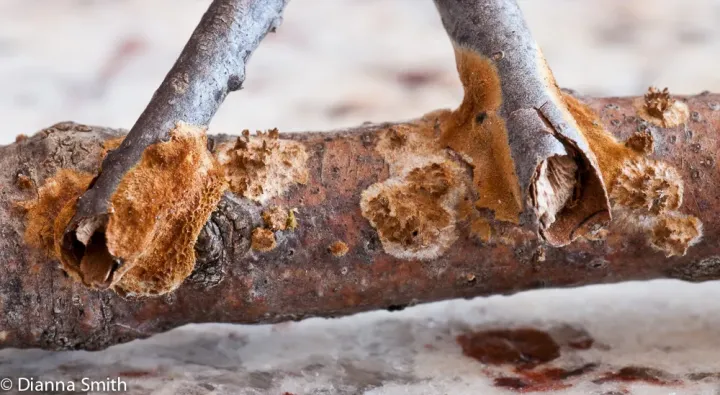
The primary symptom is the emergence of thin, crust-like fruiting bodies on the bark of branches and trunks. These bodies often appear as tightly appressed, leathery patches that may merge into extensive colonies.
The fertile surface is distinctly wrinkled, which gives the fungus its characteristic appearance. The color typically ranges from ochre to reddish-brown, often featuring a paler margin during active growth.
The fungus causes the bark to dry out, crack, and eventually slough off. Underneath these infected areas, the wood tissue shows signs of decay, as the mycelium penetrates into the sapwood.
Chronic infections lead to the dieback of individual branches or the entire tree crown. The fruiting bodies become more pliable and vibrant in color during periods of high humidity, making them easier to spot.
Damage is often internal, with necrotic processes progressing through the phloem and cambium before widespread visible signs become obvious on the surface.
Pathogen
The causative agent is Hymenochaete corrugata, a basidiomycete fungus that acts as both a saprotroph and a weak parasite. It is capable of inhabiting dead wood and encroaching onto stressed live tissues.
The mycelium colonizes the bark and outer sapwood, actively degrading cellulose and lignin. This process results in a specific type of wood rot that weakens the structural integrity of the plant.
Reproduction occurs via basidiospores that are dispersed by wind, rain splashes, or insects. These spores are highly resilient and can travel significant distances to infect new hosts.
The fungus is biologically adapted to survive fluctuations in temperature and moisture. Its mycelium can remain dormant in woody tissue for extended periods, waiting for favorable conditions.
Infection cycles are sustained by deadfall, pruning debris, and untreated stumps within the vicinity of healthy trees, acting as a constant reservoir of inoculum.
Conditions for development
High humidity and consistent rainfall are the primary drivers for fungal development. Moist environments facilitate the expansion of mycelial mats and the production of fruiting bodies.
Trees that are weakened by environmental stress—such as drought, frost damage, or physical wounds—are significantly more susceptible to successful fungal colonization.
Overcrowded plantings that limit airflow create localized microclimates with prolonged moisture on the bark surface, which is ideal for spore germination.
Mechanical damage to the bark provides direct entry points for the pathogen. Therefore, trees with pruning cuts or storm damage are at a higher risk of initial infection.
The fungus thrives within moderate temperature ranges, allowing it to maintain metabolic activity across most of the growing season provided that moisture levels are sufficient.
Why it matters
The main danger is the disruption of vascular tissues, which impairs the tree's ability to transport water and nutrients, ultimately leading to systemic decline.
Progressive decay of the bark and sapwood causes branch dieback, reducing the tree's vigor and its overall productivity, which is particularly detrimental in fruit orchards.
Infected wood loses its mechanical strength, increasing the risk of branch failure or snapping, which poses safety hazards and potential property damage.
Severe, long-term infections can result in the death of the entire tree. Once a tree is extensively colonized, it often becomes a source of infection for neighboring healthy trees.
The economic impact involves the costs of monitoring, removal of diseased trees, and potential loss of yield or ornamental value of the landscaping.
Protection
Sanitation is the most effective management tool. Regularly prune and remove all infected branches, and ensure that all dead wood is cleared from the orchard or landscape.
Protect trees from physical damage and treat any open wounds with antifungal solutions or wound sealants to prevent the entry of fungal spores.
Implement proper pruning techniques to increase canopy airflow, which helps the bark dry out quickly after rainfall and discourages fungal growth.
Applying copper-based fungicides early in the season can help suppress spore germination on the bark and protect sensitive tissues from initial colonization.
- Disinfect pruning tools between trees to prevent cross-contamination.
- Burn or dispose of infected woody debris properly; do not use it for mulch.
- Ensure adequate tree health through proper fertilization and irrigation.
- Monitor trees regularly for the presence of new crust-like fungal growths.
Discussion
No discussions yet — be the first.