
Pear rust
Gymnosporangium tremelloides
Description
Symptoms
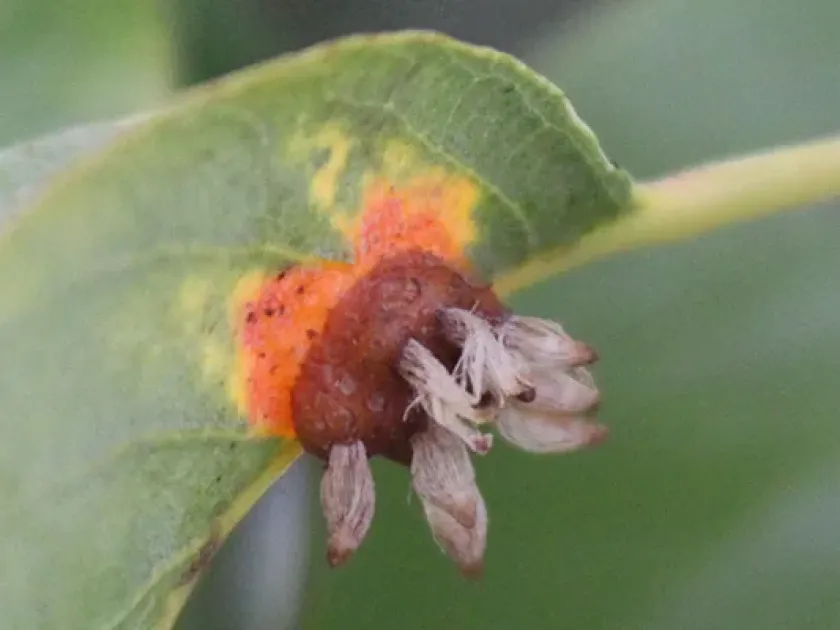
The first symptoms on pear trees appear in late spring or early summer as bright orange or reddish spots on the upper side of the leaves. Gradually, these spots increase in size and become covered with black dots called spermogonia.
By mid-summer, convex, cone-shaped outgrowths called aecia form on the underside of the affected leaves. These structures store a huge quantity of aeciospores that are easily released when the wind blows.
When the disease is severe, the affected leaves begin to yellow, curl up, and fall off prematurely, which significantly weakens the tree.
In some cases, the pathogen affects young shoots and fruit. The shoots become twisted, slow their growth, and may die, while the fruit develops characteristic spots, rendering the harvest unsuitable for consumption.
On juniper, the disease manifests as branch thickening accompanied by bark cracking and resin secretion, followed by the appearance of orange, jelly-like growths in the spring.
Pathogen
The causative agent of the disease is the basidiomycete fungus Gymnosporangium tremelloides. This is a highly specialized parasite with a complex life cycle that involves two completely different host plants: juniper and pear.
The fungus overwinters as mycelium in the tissues of juniper branches and stems, causing deformation and the formation of specific swellings. In spring, teliospores develop from these centers, forming orange, jelly-like outgrowths during wet weather.
Once mature, the spores are carried by the wind over long distances, eventually reaching pear orchards. Upon germination, they infect the leaves and young shoots of the fruit tree, forming aecia — the reproductive organs of the summer stage of the fungus.
The fungus's life cycle requires the presence of both plant species within the range of spore dispersal. The absence of one of the "links" in the chain interrupts the pathogen's infection cycle.
The fungal mycelium can overwinter in the tissues of perennial juniper, making this plant the primary reservoir of infection in agroecosystems.
Conditions for development
The development of the disease is directly dependent on meteorological conditions, especially air humidity. Heavy spring rainfall promotes the rapid swelling of spore-bearing structures on juniper.
Strong winds during the spore-production period on juniper facilitate the transport of spores over large distances. A distance of several hundred meters between pear and juniper plantings does not guarantee the orchard's safety.
The optimal temperature for spore germination and infection of pear tissues ranges from +15 to +20 degrees Celsius, provided high humidity is maintained.
Dense, poorly ventilated tree plantings create a favorable microclimate for spore accumulation and accelerated infection penetration into leaf tissues.
Long periods of persistent rain in May and June significantly increase the likelihood of a large-scale epiphytotic outbreak in the orchard.
Why it matters
Pear rust causes serious damage to yields, reducing the overall productivity of fruit plantings. Massive leaf drop disrupts the photosynthesis process.
As a result of premature leaf fall, the tree enters winter in a weakened state, which sharply reduces its cold hardiness and increases the risk of mortality during severe winters.
Fruit affected by the disease loses its marketability, becomes deformed, and fails to develop proper taste qualities, making it unsuitable for storage or processing.
With chronic infection, there is a noticeable lag in shoot growth and development, which is critical for young saplings in nurseries.
Without protective measures, an orchard can lose up to 50–70% of its potential yield in years favorable for the spread of the fungus.
Protection
The primary agronomic method is spatial isolation. Pear trees should not be planted in immediate proximity to ornamental plantings of Savin juniper (Juniperus sabina).
Regular sanitary pruning is necessary: remove and destroy infected juniper branches, and prune and burn dead pear branches.
An important step is the application of fungicides during critical phases of disease development. Treatments should begin before flowering and be repeated immediately after, using copper-based or systemic preparations.
- Spraying with Bordeaux mixture (1%).
- Using systemic fungicides (triazoles, strobilurins).
- Timely removal of fallen leaves in autumn.
Preventive treatments should cover not only the pear canopy but also potentially infected juniper bushes, if they cannot be removed from the site.
Discussion
No discussions yet — be the first.