
Powdery mildew of ragweed
Golovinomyces ambrosiae
Description
Symptoms
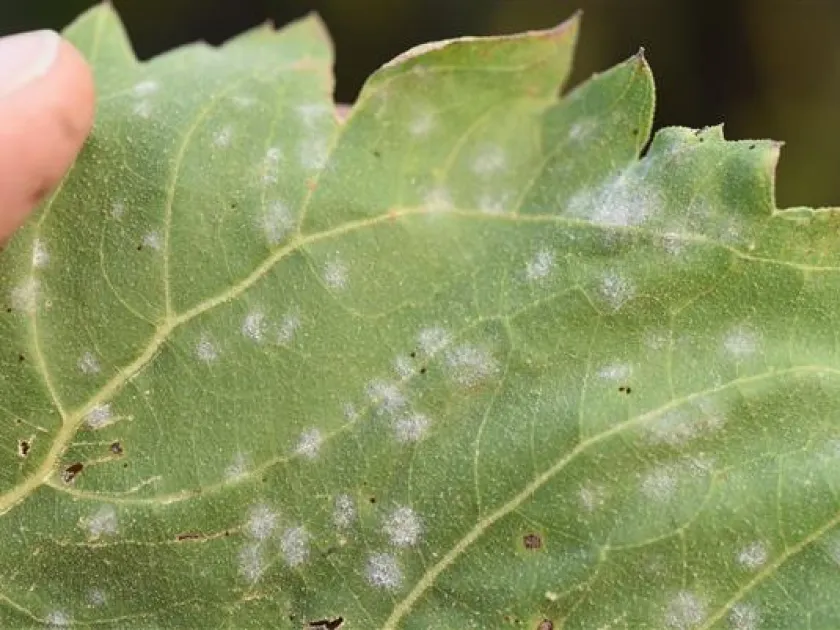
The primary symptom of the infection is the development of white, flour-like fungal mycelium on the upper and lower surfaces of ragweed leaves.
As the infection progresses, the spots of mycelium expand and merge, eventually covering large portions of the leaf blade, resulting in a yellowing and necrotic appearance.
Severely infected leaves become brittle, curl, and eventually drop off prematurely, significantly reducing the photosynthetic area of the weed.
Stems may also show signs of infection, appearing stunted or deformed as the fungus colonizes the epidermal tissues of the growing plant.
The presence of small, dark brown to black spherical structures (cleistothecia) within the white mycelial mat is a diagnostic indicator of the pathogen's late developmental stage.
Pathogen
The causative agent of this disease is the fungus Golovinomyces ambrosiae (formerly Erysiphe ambrosiae), an obligate biotroph specialized in parasitizing species of the Ambrosia genus.
As an obligate parasite, this fungus requires living plant tissue to complete its life cycle, deriving all necessary nutrients from the cells of the ragweed plant.
The pathogen reproduces by forming conidia on the surface of the infected host, which creates the characteristic white powdery appearance on leaves and stems.
The life cycle typically includes both asexual reproduction during the growing season and sexual reproduction, which leads to the formation of cleistothecia for overwintering.
This species is highly host-specific, meaning it does not pose a risk to common agricultural crops, making it a subject of interest for biological weed management.
Conditions for development
The development of Golovinomyces ambrosiae is favored by mild to warm temperatures and moderate to high relative humidity, common in late summer environments.
Temperatures ranging from 18°C to 25°C are ideal for the rapid production and dispersal of conidia across ragweed populations.
Dense infestations of ragweed provide a microclimate with reduced airflow and trapped humidity, which facilitates the rapid spread of the fungus between individual plants.
Lack of direct sunlight in dense thickets further creates stable conditions for the mycelium to persist and colonize new leaves efficiently.
The pathogen spreads primarily via windborne conidia, which can move across fields during periods of steady, light wind movement.
Why it matters
The disease significantly stresses the ragweed plant by depleting its nutrient reserves and obstructing essential physiological processes like photosynthesis.
Reduced biomass production in infected ragweed means the plant is less capable of competing with nearby crops for light, water, and essential soil nutrients.
Infection can cause a decrease in seed production, which helps limit the spread of the weed's seed bank in the soil for subsequent seasons.
By weakening the host, the powdery mildew makes the ragweed plant more susceptible to other environmental stressors and secondary infections.
In ecological terms, the presence of the pathogen serves as a natural check on the proliferation of invasive Ambrosia species.
Protection
Golovinomyces ambrosiae is recognized as a potential biological control agent for Ambrosia artemisiifolia, aimed at reducing its population density.
Management strategies in some regions involve monitoring the spread of the fungus to evaluate its effectiveness in naturally suppressing weed outbreaks.
Integrated weed management approaches suggest encouraging conditions that might favor natural pathogen development to help suppress the weed without heavy chemical use.
Research into this pathogen focuses on its host range safety and the potential for mass production as a bio-herbicide in specific non-crop habitats.
Practical management relies on recognizing the natural decline of ragweed patches caused by the fungus and integrating this factor into broader vegetation management plans.
Discussion
No discussions yet — be the first.