
Gibbsiella quercinecans
Gibbsiella quercinecans
Description
Symptoms
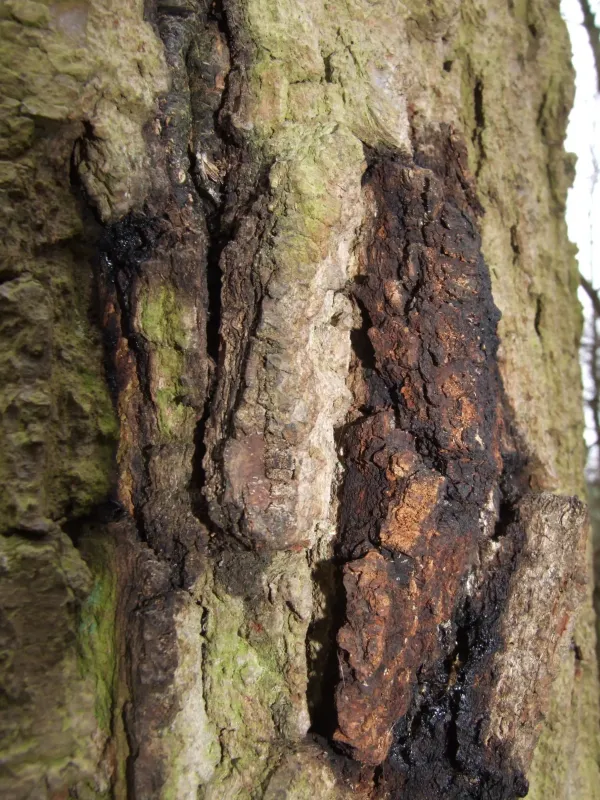
The primary symptom of Gibbsiella quercinecans infection is the appearance of dark, weeping patches on the bark of the trunk. These patches often exude a sticky liquid, a condition commonly referred to as bacterial flux or bleeding.
Upon removing the bark at the site of infection, one can observe necrotic lesions. The inner bark and cambium typically show a reddish-brown or black discoloration, often accompanied by a distinct, unpleasant putrefactive smell emanating from the affected tissues.
Crown thinning is a common secondary symptom. As the pathogen blocks the water-conducting tissues of the trunk, the tree experiences a lack of water, leading to premature leaf wilting, canopy dieback, and eventually the death of the entire tree.
In the early stages, trees might appear healthy, but internal tissue death is already underway. When the necrosis girdles the circumference of the trunk, the tree dies rapidly as the circulation of water and minerals is completely severed.
Field diagnosis requires checking the trunk for recent exudation and identifying the characteristic discoloration of the tissues underneath the bark. Laboratory PCR testing is necessary for a definitive diagnosis of this bacterial agent.
Pathogen
The causative agent of this disease is the Gram-negative bacterium Gibbsiella quercinecans. It belongs to the Enterobacteriaceae family and is widely recognized as a significant pathogen involved in the complex of diseases causing acute bark necrosis and oak decline across Europe.
The bacterium colonizes the vascular tissues and cambium of the tree, gradually disrupting nutrient transport. It often acts in synergy with other pathogenic bacteria and fungi, which complicates the clinical picture and makes the infection more aggressive.
Gibbsiella quercinecans exhibits high survival rates within the tree host. It can persist in the wood tissues for extended periods, silently expanding the area of necrosis before outward symptoms become visible to the naked eye.
Transmission occurs through physical damage to the bark, insect vectors, or via rainwater runoff carrying bacterial cells. Even minor wounds on the trunk can serve as entry points for the pathogen, particularly in weakened trees.
Research into the biological traits of this bacterium is ongoing. Scientists emphasize its role in the "acute oak decline" syndrome, noting that the combination of this bacterium with other stressors significantly accelerates the death of infected trees.
Conditions for development
The development of Gibbsiella quercinecans is highly dependent on environmental factors, particularly humidity and temperature. Periods of high rainfall provide the necessary moisture for the bacteria to multiply and move across the surface of the bark.
Tree stress is a crucial predisposing factor. Drought, sudden temperature fluctuations, and soil compaction weaken the host's natural defenses, making the tree significantly more susceptible to bacterial colonization through bark fissures.
Stands characterized by high density and poor air circulation often experience higher rates of infection. Such environments create a microclimate that promotes bacterial activity and increases the speed at which the disease spreads from tree to tree.
Anthropogenic impacts, such as logging damage or improper pruning, play a major role in disease dispersal. Each mechanical injury creates an infection court, allowing the bacterium to bypass the protective layer of the bark.
Climate change trends, including milder winters and increased frequency of extreme weather, likely facilitate the spread of the pathogen. These conditions increase the survival rate of the bacteria and expand their geographical range.
Why it matters
Gibbsiella quercinecans poses a severe threat to forestry and urban landscaping by causing the widespread decline and death of valuable oak species. The commercial value of timber from infected trees is heavily degraded.
The ecological impact is significant, as the loss of mature oaks leads to the degradation of essential forest habitats. This disrupts food chains and reduces biodiversity, as oaks provide critical support for numerous insects, birds, and mammals.
The disease can cause the rapid collapse of healthy oak stands within a few seasons. Once established, the pathogen is difficult to contain, leading to large-scale forest fragmentation and loss of mature canopy cover.
Regeneration failure is another long-term consequence. Because infected trees cease to produce healthy acorns, the natural recruitment of young oaks is severely limited, endangering the long-term survival of the species in affected regions.
Management costs for forest services are substantial. These include regular monitoring, sanitary felling of infected trees, and the safe disposal of infected wood to prevent the spread of the bacterium to neighboring stands.
Protection
Sanitary management is the primary approach for controlling the disease. Early detection followed by the prompt removal and destruction of infected trees is essential to minimize the inoculum pressure within a forest stand.
Strict hygiene protocols must be followed during silvicultural operations. Sterilizing tools used for pruning or felling is a critical measure to prevent the mechanical transmission of Gibbsiella quercinecans between healthy and infected trees.
Enhancing tree vitality through sustainable silviculture is a key preventive measure. Ensuring optimal growing conditions, such as proper spacing and water management, helps trees maintain the defenses required to resist potential infections.
Minimizing mechanical injury to the bark and root systems during forest activities is paramount. Maintaining the integrity of the tree's exterior is the best defense against bacterial entry.
- Regular forest health surveillance programs.
- Mandatory tool disinfection before moving between trees.
- Prevention of stand density issues through thinning.
- Quarantine restrictions on moving wood from infected areas.
Discussion
No discussions yet — be the first.