
Fusarium rot
Fusarium haematococcum
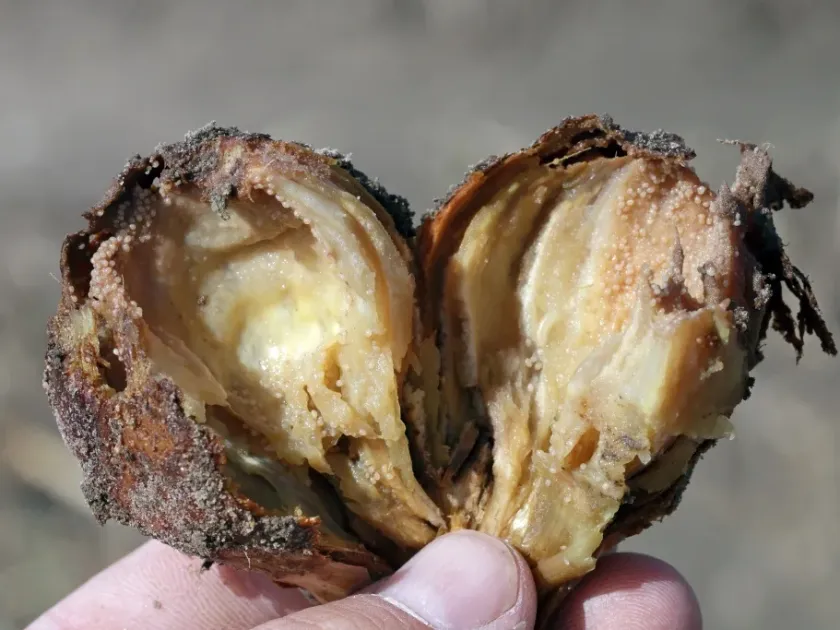
Description
Symptoms
The initial signs of the disease include the darkening and rotting of the roots and the crown. The affected tissues become soft, watery, and discolored, often turning dark brown or black.
Under humid conditions, a characteristic fungal growth, or mycelium, appears on the surface of the lesions. This growth is typically white to pinkish in appearance.
Plants display symptoms of wilting during the hottest part of the day, even when soil moisture is adequate. This is due to the obstruction of the xylem, which prevents efficient water transport.
Lower leaves exhibit chlorosis, which eventually turns into necrosis. The plant stops growing, and in severe cases, the entire plant collapses or dies prematurely.
- Darkening of the root system.
- Pinkish or white fungal growth.
- Wilting during midday.
- Yellowing and necrosis of foliage.
- Stunted plant development.
Pathogen
The causative agent of this disease is the fungus Fusarium haematococcum (teleomorph stage Nectria haematococca), a common soil-borne pathogen. It is highly resilient, surviving in the soil as chlamydospores for many years.
The pathogen utilizes infected crop debris as a substrate for saprophytic survival and reproduction. It secretes various mycotoxins that interfere with the host plant's enzymatic activities and cellular integrity.
Infection spreads via contaminated seeds, movement of soil by farm equipment, and irrigation water. The fungus is capable of attacking a wide range of host plants, including field crops and vegetables.
Genetic plasticity allows the fungus to overcome various environmental stressors and develop resistance to certain agricultural conditions, making it a persistent threat to global agriculture.
The pathogen usually attacks the root system first, but under high humidity, it can spread to the stem, leaves, and fruits, causing widespread tissue necrosis.
Conditions for development
High soil moisture and waterlogged conditions are the primary drivers for the rapid development of Fusarium rot. Poor soil drainage significantly increases the risk of infection.
Optimal temperature for the fungus ranges between 20°C and 28°C. Warmer conditions, combined with high relative humidity, facilitate rapid spore germination and colonization.
Excessive use of nitrogen fertilizers can promote lush but weak growth, making plants more susceptible to fungal entry. Balanced nutrition is crucial for maintaining natural plant resistance.
Acidic soil environments tend to favor the growth and pathogenicity of Fusarium haematococcum. Monitoring and adjusting pH levels is an essential part of disease management.
Mechanical damage to the roots, often caused by soil pests like nematodes, provides an entry point for the fungus to establish itself within the plant tissues.
Why it matters
The disease causes significant economic loss by reducing crop density through seedling damping-off. Large areas of the crop can be lost in the early stages of the growing season.
Fruits and tubers that are harvested from infected plants often rot in storage. This dramatically reduces the shelf life and overall quality of the agricultural products.
Mycotoxin accumulation in the plant tissues poses a serious risk to food safety. Contaminated produce may be toxic to livestock and humans, leading to market rejection.
Long-term soil contamination makes it extremely difficult to rotate crops effectively, forcing farmers to avoid sensitive species on infested fields for extended periods.
The destruction of the root system limits the plant's ability to uptake water and nutrients, leading to reduced yields even if the plant survives until harvest time.
Protection
Implementing a robust crop rotation plan is essential. Avoiding the cultivation of host crops for at least three to four years helps to reduce the inoculum level in the soil.
Seed treatment with professional fungicides is the most effective way to protect seeds and seedlings from early-season soil-borne infections.
Soil management, including liming to correct acidity and improving drainage, creates an environment less conducive to fungal growth and more suitable for plant health.
Post-harvest sanitation is critical. Removing and destroying all crop debris prevents the accumulation of inoculum in the field for the subsequent growing season.
Utilizing biological control agents, such as Trichoderma species, can help outcompete the pathogen in the root zone and enhance the overall health and vigor of the crop.
Discussion
No discussions yet — be the first.