
Fusarium rot
Fusarium breviconum
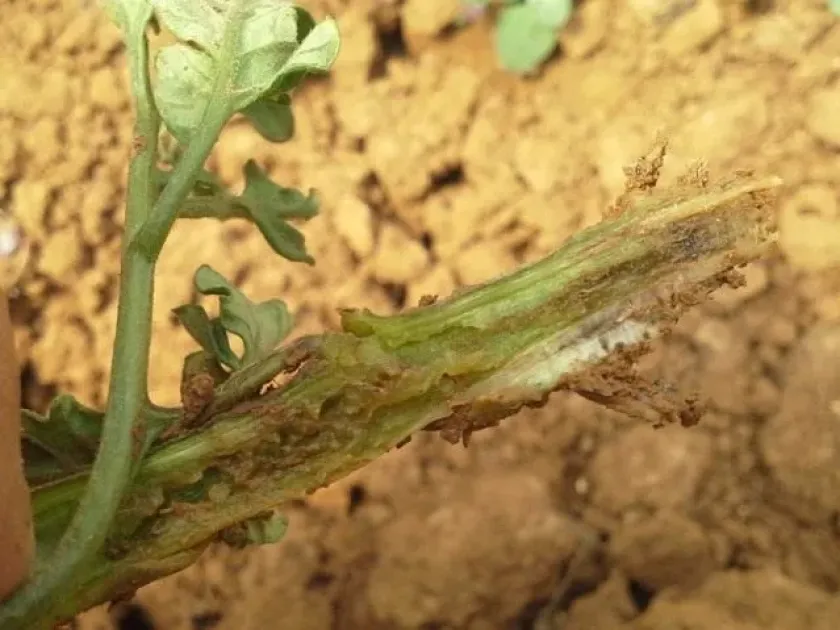
Description
Symptoms
The initial signs of infection often involve the yellowing and wilting of the lower foliage, which progresses upward as the disease advances. The root system undergoes discoloration, turning dark brown or black.
In humid conditions, a visible fungal growth or mycelial mat can be observed near the crown of the plant. This growth may appear white, grey, or slightly pinkish, indicating active sporulation.
A cross-section of the stem often reveals browning of the vascular tissues, which restricts the movement of nutrients and water. This obstruction manifests as stunted growth and a general decline in plant vigor.
In advanced stages, the root system loses its structural integrity and becomes soft or rotted. The plant may eventually collapse completely due to the inability to maintain sufficient water uptake.
- Yellowing and wilting of leaves.
- Browning and decay of the root system.
- Fungal mycelium on the crown.
- Vascular tissue discolouration.
- Stunted growth and premature death.
Pathogen
The causative agent of this disease is the fungus Fusarium breviconum, which belongs to the genus Fusarium. It is a soil-borne pathogen capable of persisting in the soil environment for extended periods as mycelium or resistant chlamydospores.
The pathogen utilizes infected plant debris as a nutritional reservoir, allowing it to survive in the absence of a host crop. Its life cycle involves active mycelial growth that penetrates the root tissues of susceptible plants.
F. breviconum produces various mycotoxins that interfere with the host's metabolic processes and degrade cellular structure. These toxins facilitate the colonization of the vascular system, leading to systemic infection.
Microscopic investigation reveals characteristic conidia that serve as secondary inoculum during the growing season. The fungus is well-adapted to surviving under diverse soil conditions.
Environmental dispersal is primarily facilitated by water splashing, wind, and the movement of soil during routine agricultural practices such as plowing or cultivation.
Conditions for development
Fusarium breviconum development is favored by warm and moist soil conditions. Optimal temperatures for active mycelial growth range between 20°C and 25°C.
Poorly drained, compacted soils that lack proper aeration are particularly conducive to the establishment and spread of this disease. Soil acidity also plays a critical role in promoting fungal proliferation.
Plants under physiological stress, such as drought, nutrient deficiency, or temperature fluctuations, exhibit reduced resistance to infection. Monoculture systems facilitate the rapid accumulation of inoculum in the soil.
Mechanical damage to roots caused by soil insects or agricultural machinery creates entry points for the pathogen. Once infected, the plant's defense system is often compromised by the presence of toxins.
High moisture levels at the time of seedling emergence are especially dangerous, as young plants are highly susceptible to pre-emergence and post-emergence damping-off caused by Fusarium species.
Why it matters
The economic impact of Fusarium rot is significant, often resulting in severe yield losses due to reduced plant stands. The disease can cause complete crop failure in highly infested fields.
In addition to yield reduction, the quality of the harvested produce is severely degraded. Infected plants typically produce smaller, lighter, and lower-quality seeds or fruits.
The accumulation of mycotoxins in the harvested product poses a safety concern for both human and animal consumption. This limits marketability and often results in the total loss of the crop value.
Fusarium rot can weaken the overall health of the agricultural ecosystem, making crops more prone to attack by secondary pathogens. Managing this disease is essential for sustainable farm operations.
Large-scale outbreaks necessitate drastic intervention measures, which increase production costs and complicate farm management strategies in subsequent growing seasons.
Protection
Effective management begins with the use of high-quality, certified seeds treated with systemic fungicides. Seed treatment is crucial for protecting the root zone during the early stages of development.
Implementing a balanced crop rotation that excludes susceptible host plants for several years helps deplete the population of the pathogen in the soil. Resistant cultivars should be prioritized whenever available.
Agronomic practices, including proper soil drainage and adequate mineral nutrition, strengthen the plants' natural defense mechanisms. Potassium-based fertilizers can enhance cellular resistance to infection.
Biological control agents, such as Trichoderma species, have shown promise in suppressing the growth of F. breviconum within the rhizosphere. These are often used as part of an integrated pest management program.
Regular monitoring of field conditions, timely removal of infected crop residues, and controlling soil-dwelling pests are essential components for preventing the spread and impact of this fungal rot.
Discussion
No discussions yet — be the first.