
Description
Symptoms
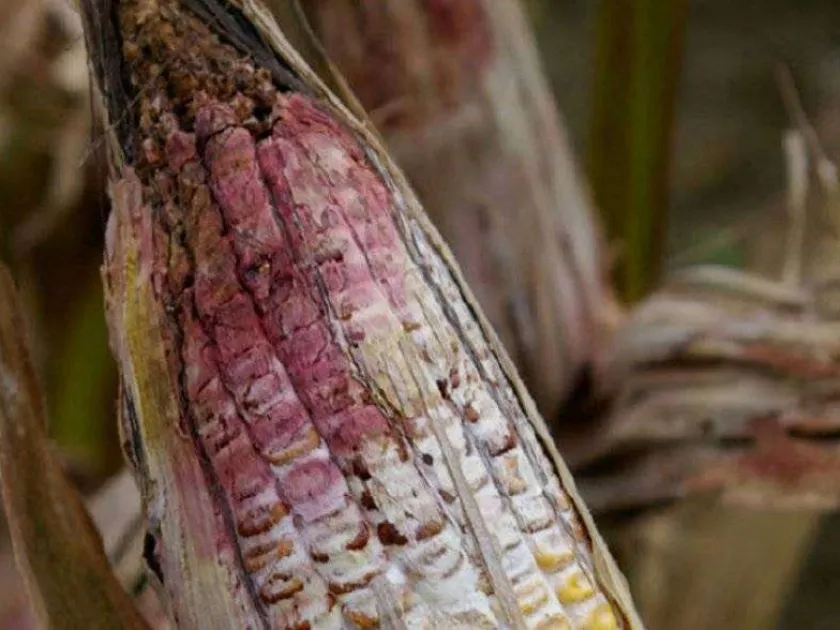
The primary symptom is the appearance of a white to pinkish or light-gray fungal mold on the tips or scattered patches of the ear.
Infected kernels lose their luster, appear dull, and are often covered with tiny black dots known as perithecia. The interior of the kernel may become hollowed out.
In severe infections, the kernels become brittle, crumble easily, and develop a distinct, musty, or moldy odor.
The ear is often distorted, and the husks may remain tightly adhered to the kernels due to mycelial growth, which hinders the natural maturation of the crop.
In field conditions, signs of the disease often become visible during the milk-to-dough stage, especially in high-humidity environments.
Pathogen
The causative agents of the disease are fungi of the Fusarium genus, specifically Gibberella intermedia (the teleomorph stage of Fusarium moniliforme). This pathogen is capable of surviving for long periods in soil and on crop residues.
The fungus belongs to the Ascomycota division and actively attacks the generative organs of plants. It penetrates the kernels through the silk or via mechanical wounds caused by pests.
The life cycle of the pathogen is closely tied to environmental humidity and temperature. During its growth, the fungus produces mycotoxins that render the agricultural produce unsafe for consumption.
The pathogen can be disseminated by wind, rain splashes, and insects, making total control in the field extremely challenging.
The inoculum builds up in seeds and debris, making proper crop rotation a critical component of disease management.
Conditions for development
Disease development is promoted by prolonged rainy weather during flowering and grain fill, which prevents ears from drying out quickly.
The optimal temperature for mycelial growth is between 22–27 degrees Celsius, though the fungus can thrive across a wider thermal range.
Damage by pests such as the European corn borer or corn earworm provides entry points for the infection, significantly increasing the rate of infestation.
High planting density, which restricts airflow around the ears, also facilitates the rapid spread of the disease within the stand.
Delayed harvest during a wet autumn triggers mass development of Fusarium ear rot, as water-soaked ears become an ideal medium for fungal proliferation.
Why it matters
The main danger is the accumulation of hazardous mycotoxins, such as fumonisins, which are toxic to both humans and livestock.
Poor grain quality makes the harvest unsuitable for the food and feed industries, leading to severe economic losses for farmers.
The disease causes a sharp decline in yields, as infected grains have lower weight, poor viability, and reduced seedling vigor.
Contaminated seeds used for planting serve as a primary source of infection, causing seedling blight and poor stand establishment.
Infected crops have poor storage stability, as the fungus continues to grow in grain bins if moisture and temperature levels are not strictly managed.
Protection
The cornerstone of protection is the use of maize hybrids with documented resistance to Fusarium ear rot.
Implementing a balanced crop rotation system, avoiding continuous corn cultivation, helps lower the infectious potential of the soil.
Proper tillage and the incorporation of crop residues into the soil promote faster decomposition and reduce pathogen survival.
The application of insecticides to manage ear-feeding insects significantly reduces the risk of secondary fungal colonization.
Treating seed material with high-quality fungicides before planting is a mandatory step to protect developing seedlings from soil-borne pathogens.
Pathogens and affected parts
Affects crops · 1
Discussion
No discussions yet — be the first.