
Powdery mildew of teak
Erysiphe tectonae
Description
Symptoms
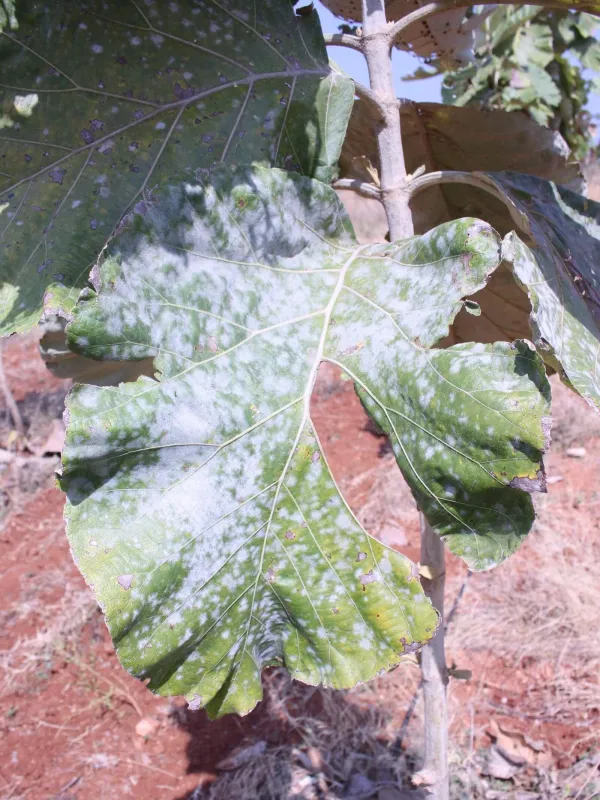
The hallmark symptom is the presence of white to grayish-white, floury patches on the foliage. These patches can appear on both the upper and lower leaf surfaces.
As the infection progresses, the powdery spots coalesce, eventually covering entire leaves. This reduces the aesthetic and biological value of the teak foliage.
Infected leaves often show signs of curling, crinkling, and distortion. Stunted growth of young, succulent shoots is a common observation in heavily infested nurseries.
Chlorosis and premature defoliation occur in severe cases. This leaf drop significantly reduces the photosynthetic area of the tree, hindering its overall physiological functions.
Under magnification, the mycelial mat shows small, dark, globe-shaped structures known as chasmothecia, which are part of the sexual reproductive phase of the fungus.
Pathogen
The causal agent of this disease is the fungus Erysiphe tectonae. It is a specialized biotrophic pathogen that specifically targets the teak tree (Tectona grandis) and belongs to the Erysiphaceae family.
The fungus develops primarily as a white, cottony mycelium on the surface of leaves and young stems. It obtains nutrition through specialized structures called haustoria, which penetrate the plant's epidermal cells.
Reproduction occurs via the production of conidia, which are asexual spores distributed by wind currents. This allows the disease to spread rapidly through nursery settings and established plantations.
The life cycle is closely synchronized with the growth of the host plant. The pathogen survives between growing seasons in the form of dormant mycelium or specialized overwintering structures depending on the regional climate.
Being an obligate parasite, the pathogen cannot survive long without living host tissue, making its ecology entirely dependent on the presence and distribution of teak trees.
Conditions for development
High relative humidity and moderate temperatures provide the most favorable environment for the germination and colonization of Erysiphe tectonae.
Dense planting configurations limit air circulation, leading to a microclimate with stagnant, humid air that promotes rapid fungal growth and spore dispersal.
The disease is most prevalent during the rainy season or periods with high dew point. Reduced sunlight penetration into the lower canopy also facilitates the persistence of the pathogen.
Young teak seedlings are particularly susceptible due to their rapid development of soft, succulent tissue which is easily penetrated by the fungal hyphae.
Excessive use of nitrogen fertilizers can exacerbate the situation, as it promotes lush, tender growth that the pathogen easily exploits.
Why it matters
Powdery mildew causes significant damage in teak nurseries, leading to reduced growth rates and poor quality of saplings, which can impact the success of reforestation projects.
In mature plantations, the disease causes premature leaf senescence. This results in reduced carbon sequestration and lower annual biomass increment, directly affecting timber production.
Trees weakened by consistent fungal attacks become more vulnerable to environmental stresses and secondary pest infestations, such as leaf defoliators.
The economic impact involves not only the loss of potential wood volume but also the increased operational costs associated with disease management and fungicide application.
In regions where teak is a primary economic timber source, the cumulative effect of annual powdery mildew outbreaks can substantially reduce the profitability of forest management operations.
Protection
Integrated disease management is essential. This includes thinning of stands to improve ventilation and reduce the humidity levels that the pathogen requires for its development.
In nurseries, maintaining adequate spacing and ensuring optimal air movement are critical preventative steps. Proper sanitation practices, such as removing and destroying infected debris, help reduce the inoculum load.
Chemical control involving sulfur-based fungicides is highly effective. These products inhibit spore germination and mycelial expansion when applied correctly during the early stages of an outbreak.
Developing and deploying resistant teak clones through breeding programs offers the best long-term solution for managing this pathogen in commercial forestry.
- Application of sulfur-based fungicides;
- Thinning of dense canopy structures;
- Promotion of balanced nutrient management;
- Selection of resistant genetic stock;
- Sanitary removal of infected plant debris.
Discussion
No discussions yet — be the first.