
Powdery mildew of pistachio
Erysiphe pistaciae
Description
Symptoms
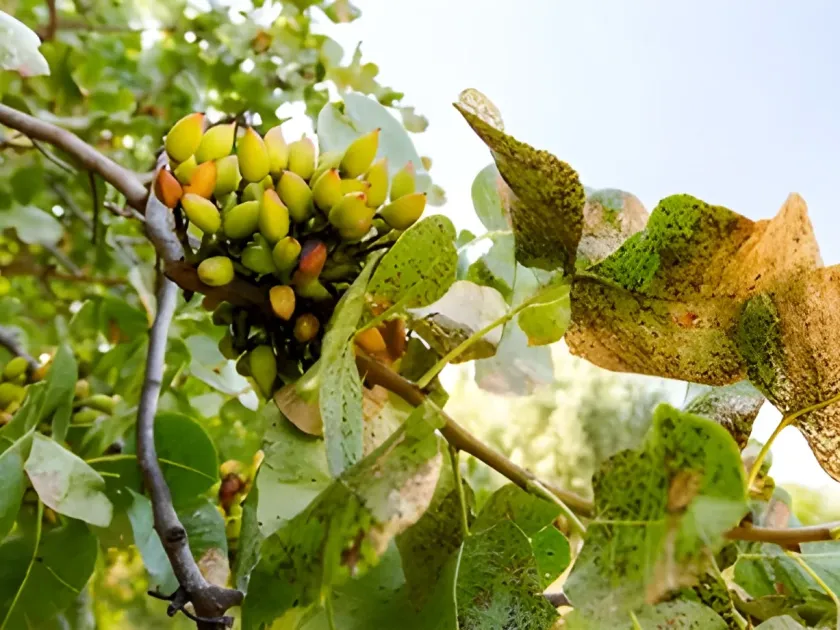
The main symptom of the disease is the appearance of a characteristic white powdery coating on young leaves, shoots, and pistachio nuts. At the onset of infection, the coating appears as separate spots that gradually merge to cover the entire leaf surface.
Over time, the white coating becomes denser and turns gray or yellowish, indicating the formation of the fungus's fruiting bodies (cleistothecia). Affected tissues often become deformed, curled, and drop prematurely.
In severe cases, the infected nuts stop growing, their hulls become coarse, leading to a significant loss in market quality. On shoots, the infection manifests as local necroses that can lead to dieback.
The disease affects the plant gradually, starting from the lower parts of the canopy where humidity is typically higher. In cases of severe infection, the entire tree may look as if it has been dusted with flour or lime.
It is important to distinguish the early stages of infection from pollen or other deposits. Powdery mildew attaches firmly to the plant epidermis and leaves characteristic damp traces on the affected area when rubbed with a finger.
Pathogen
The causative agent of the disease is the specialized ascomycete fungus Erysiphe pistaciae. This is a highly specialized parasite that develops exclusively on representatives of the genus Pistacia.
The fungus leads an ectoparasitic lifestyle, growing mycelium on the surface of plant organs. It feeds through specialized protrusions called haustoria, which penetrate the epidermal cells.
The pathogen reproduces via conidia (asexual spores), which are easily carried by the wind over long distances. This ensures rapid spread of the infection within orchards during the growing season.
The fungus overwinters as mycelium in buds or as cleistothecia on fallen leaves and plant debris under the tree. As temperatures rise, the release of spores initiates primary infection.
The fungus's life cycle includes several generations of conidia during a single season, making the disease highly aggressive under favorable conditions and requiring systematic monitoring of orchards.
Conditions for development
Moderate temperatures ranging from +20°C to +26°C favor the development of pistachio powdery mildew. While the fungus is less active in hot and dry weather, high nighttime humidity supports its growth.
High planting density and lack of proper pruning play a significant role. Poor canopy ventilation creates a microclimate with high humidity, which is ideal for spore germination.
Frequent fog, heavy dew, or the presence of liquid moisture on leaves after rain accelerates the infection process. Under these conditions, the mycelium spreads much faster across the plant.
Excessive application of nitrogen fertilizers also provokes the disease. Excess nitrogen leads to the formation of tender, rapidly growing tissues that are more susceptible to fungal mycelium penetration.
Old, weakened trees or orchards with poor water management are more prone to infection than healthy, well-maintained stands.
Why it matters
The primary damage lies in the disruption of photosynthesis due to the dense layer of mycelium covering the leaf surface. This weakens the tree, reducing its overall immunity and winter hardiness.
Infection of reproductive organs leads to direct yield loss. Pistachio nuts become smaller, lose nutritional value, and the shell does not form properly.
With systematic infection over several seasons, the tree becomes exhausted, leading to reduced flower bud formation for the following year. Consequently, yields drop by 30–50% or more.
Harmfulness is increased by secondary infections that penetrate through damaged tissues. Shoot necroses become entry points for pathogenic bacteria and other fungi.
For nurseries, powdery mildew is a fatal threat, as infected seedlings may die or become unsaleable due to shoot deformation.
Protection
Integrated pest management begins with cultural practices. Regular sanitary pruning and the removal of fallen leaves significantly reduce the primary infectious background in the orchard.
It is important to maintain an optimal planting scheme that ensures good air circulation. Canopy thinning is a mandatory step in pistachio orchard maintenance.
- Application of sulfur-based fungicides at the beginning of the growing season.
- Use of systemic triazole-based fungicides upon detection of initial symptoms.
- Adherence to chemical application protocols to prevent the development of resistance.
Chemical protection must be preventive. Initial treatments are performed before flowering when conditions become favorable for fungal growth. If necessary, treatments are repeated at 10–14 day intervals.
Using resistant varieties (if available) is the most environmentally friendly method. It is recommended to select adapted cultivars that possess genetic tolerance to local strains of the pathogen.
Discussion
No discussions yet — be the first.