
Euonymus powdery mildew
Erysiphe euonymi-japonici
Description
Symptoms
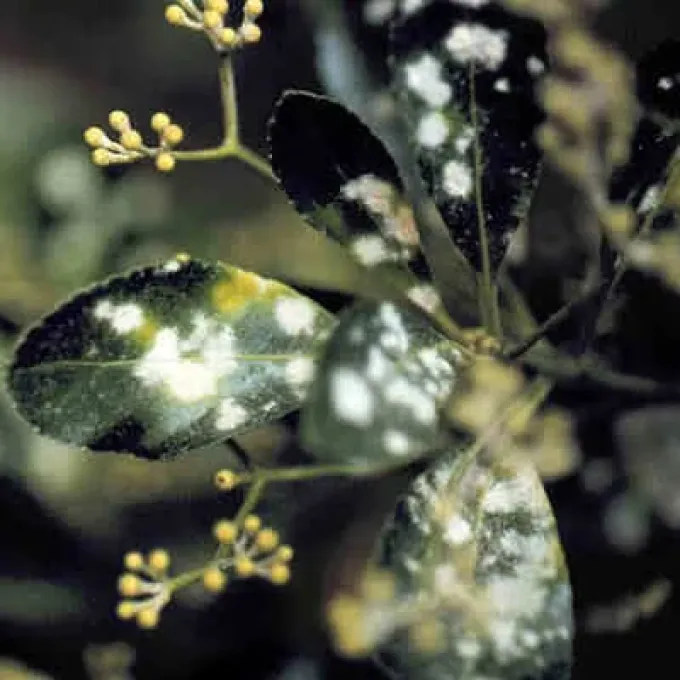
The primary symptom of this disease is the appearance of a white, powdery coating on the upper and sometimes lower leaf surfaces. This fungal mycelium can eventually cover stems and young buds, giving the plant a dusty appearance.
As the infection progresses, the foliage may begin to curl, turn yellow, and drop prematurely. Young shoots often show signs of stunted growth, twisting, and distortion, which significantly ruins the ornamental quality of the shrub.
On more mature lesions, small black or brown dots known as cleistothecia may appear within the white felt. These are the overwintering structures of the fungus, allowing it to survive until the next growing season.
The disease usually starts on lower, more sheltered leaves where air circulation is restricted. If left untreated, the white patches expand and coalesce, eventually covering the entire plant and creating a heavy fungal mat.
Distinguishing this from other spots is relatively easy, as the white spores can be rubbed off with a finger, though the underlying tissue often displays chlorosis or necrosis where the fungus has extracted nutrients.
Pathogen
The causal agent is the obligate parasite Erysiphe euonymi-japonici. This fungus strictly requires living plant tissue to thrive, as it obtains nutrients through specialized structures called haustoria.
The fungus is a member of the Erysiphaceae family. It is highly host-specific, primarily targeting species within the Euonymus genus, most notably the Japanese spindle tree. The fungus spreads via wind-borne conidia.
The life cycle involves an asexual stage, responsible for rapid seasonal spread, and a sexual stage, which produces fruiting bodies that remain in fallen debris through the winter months.
Conidia are highly efficient at dispersal; they can travel long distances via air currents. Upon landing on a suitable Euonymus leaf, they germinate quickly if environmental humidity levels are sufficient.
The pathogen's biology allows it to stay hidden in plant crevices or soil surface debris, ensuring that once it is established in a garden, it can recur annually if conditions allow for its development.
Conditions for development
Powdery mildew thrives in conditions characterized by warm temperatures and fluctuating humidity. It is most prevalent when daytime temperatures range between 18 to 25 degrees Celsius and nights remain cool and moist.
High humidity and poor air circulation are critical drivers of the infection. Densely planted shrubs that do not allow for cross-ventilation are significantly more susceptible than those planted with adequate spacing.
Excessive nitrogen fertilization encourages rapid, succulent growth that is physically easier for the fungus to penetrate. This soft tissue lacks the robust cuticle needed to naturally repel the fungal germ tubes.
Shaded locations or gardens with heavy dew contribute to longer leaf wetness durations, which significantly aids the germination of conidia and the subsequent spread of the mycelium.
Fluctuating moisture levels, especially when combined with crowded conditions, create a perfect microclimate where the fungus can reproduce exponentially during the active growing season.
Why it matters
The primary harm caused by this disease is the degradation of the plant's aesthetic value. Since Euonymus is largely grown for its foliage, a white-coated, stunted, and dropping plant is essentially useless in landscaping.
The infection severely limits the photosynthetic capacity of the leaves, weakening the plant. This loss of vigor can make the shrub susceptible to winter damage or opportunistic secondary infections.
In nursery environments, this disease causes significant economic loss due to crop rejection. Infected plants may fail to meet quality standards and often require costly chemical interventions to be saved.
Chronic infections lead to weakened root systems and reduced overall growth rates. Over several seasons, a plant that suffers from annual mildew attacks may become sparse, unattractive, and prone to dying back.
Distortion of flower buds and new growth impacts the plant's architecture, preventing it from forming the dense, healthy canopy that Euonymus is known for.
Protection
The first line of defense is proper cultural management, including regular pruning to improve airflow. Removing and disposing of infected clippings and fallen leaves is essential to reduce the primary inoculum load.
Chemical control involving systemic fungicides, such as those in the triazole or strobilurin classes, is effective at stopping active infections. These should be applied at the first signs of white spots.
Adjusting fertilization regimes is vital; avoid high-nitrogen fertilizers that push soft, vulnerable growth. Instead, focus on balanced or potassium-rich fertilizers to help toughen the plant’s tissues.
Avoid overhead irrigation, as water on the leaves can facilitate fungal growth. Use drip irrigation or water the base of the plant to keep the foliage as dry as possible during the day.
Biological controls, such as spraying with Bacillus subtilis formulations or diluted horticultural oils, can be used as a preventative or early-intervention measure to inhibit the spread of the mycelium.
Discussion
No discussions yet — be the first.