
Epipyxis utriculus
Epipyxis utriculus
Description
Symptoms
Epipyxis utriculus manifests as a distinct brown or golden-colored coating on the submerged parts of aquatic plants.
In cases of heavy infestation, this organism forms slimy aggregates that coat stems and leaves, making the surfaces feel slippery.
The visual appearance of the affected plant is often described as a rusty film, which can be easily brushed off mechanically.
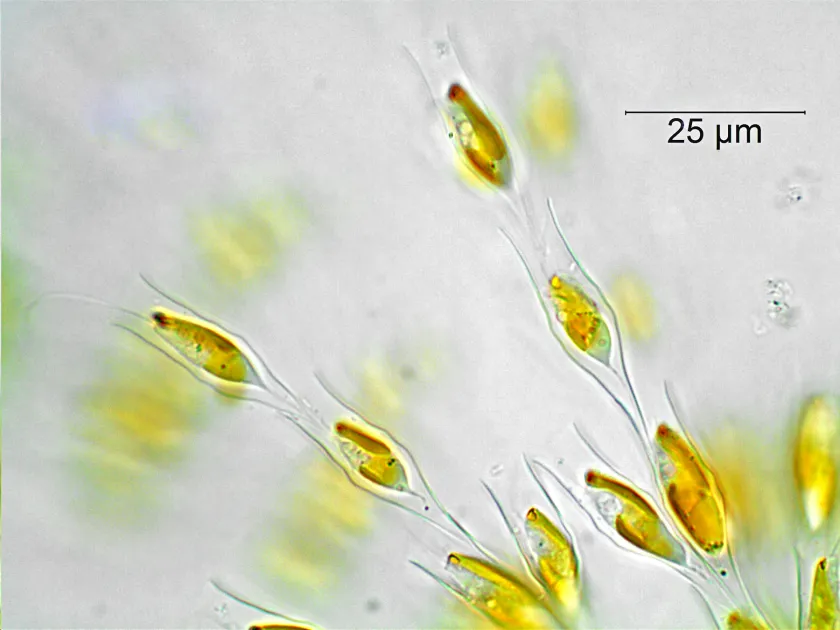
Under microscopic observation, one can see bottle-shaped houses (loricae) containing the cells, which give the colony its unique bubbly texture.
Affected plants often appear stunted or suffer from reduced vitality due to the layer of organisms blocking their physiological processes.
Pathogen
The causative agent is the golden alga Epipyxis utriculus, which belongs to the class Chrysophyceae.
This organism typically lives as an epiphyte, attaching itself to other algae, mosses, or higher aquatic plants.
Each cell is protected by a cellulose-based structure known as a lorica, which serves as a protective housing for the living cell.
Reproduction occurs mainly through cell division, where new individuals detach and seek new surfaces for attachment.
While not a parasite in the strict sense, its dense colonization significantly alters the immediate environment of the host plant.
Conditions for development
Active growth occurs primarily in still or slow-moving water bodies, where temperatures remain moderate during spring and early summer.
High levels of nutrients, particularly nitrogen and phosphorus runoff, are major drivers of rapid colony development.
Epipyxis prefers water temperatures ranging between 12 and 20 degrees Celsius, typical of early seasonal warming phases.
Low water turnover and lack of efficient aeration contribute to the stability of the aquatic environment required by this alga.
The presence of suitable submerged substrates, such as fine-leaved aquatic plants, is essential for the initial establishment of colonies.
Why it matters
The primary damage is caused by shading, which prevents sunlight from reaching the leaves, thereby inhibiting photosynthesis.
The dense slime layer obstructs gas exchange, leading to leaf chlorosis and premature tissue senescence in the host plants.
Epipyxis can degrade water quality in ponds by shifting the nutrient balance and affecting dissolved oxygen levels.
Accumulation of decayed colonies contributes to the build-up of organic detritus on the pond floor, encouraging further decomposition.
In ornamental settings, the rusty appearance of plants significantly reduces their visual value and requires immediate maintenance.
Protection
Preventive measures include managing fertilizer runoff into ponds to minimize the risk of nutrient-rich water conditions.
Manual removal of the alga from plant surfaces is the most effective and safest method for small-scale pond maintenance.
Improving pond aeration helps disrupt the calm water conditions that these golden algae rely on for proliferation.
Biological control, such as introducing zooplankton filter-feeders, can help manage the population density naturally.
The use of chemical algaecides should be avoided if possible and used only as a last resort to protect the pond's ecosystem balance.
Discussion
No discussions yet — be the first.