
Poinsettia scab
Elsinoë poinsettiae
Description
Symptoms
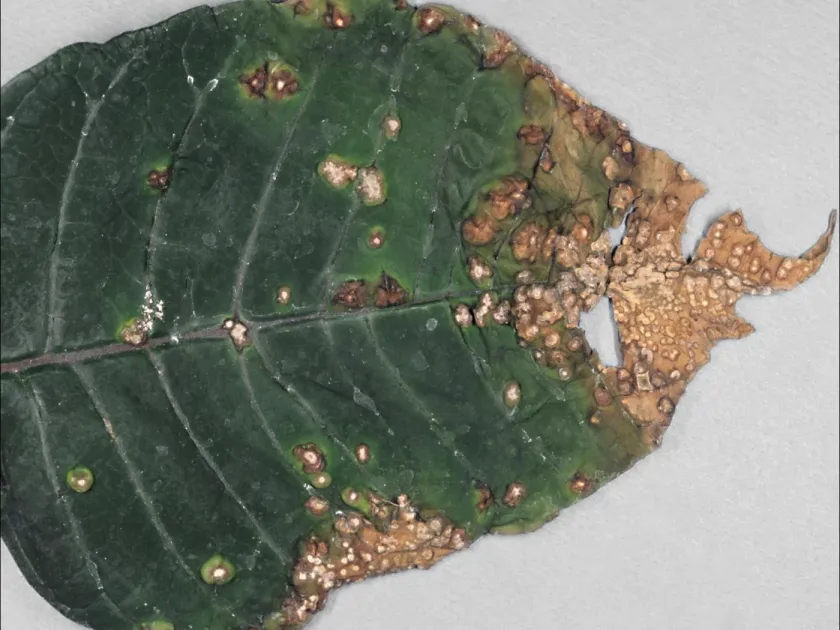
Symptoms typically start as small, water-soaked, greenish spots on leaves, stems, and bracts. As the lesion matures, these spots turn greyish or brown and may develop a raised, scab-like appearance.
As the infection progresses, individual lesions may coalesce, leading to necrotic areas. Tissue in these regions becomes brittle and frequently ruptures, causing the characteristic "scab" damage.
Stem infections are particularly severe, often manifesting as raised, irregular-shaped pustules or cankers. These lesions impede vascular transport, often causing the plant parts above the infection site to wilt.
The bracts, which are the primary ornamental feature of the poinsettia, become severely deformed and discolored when attacked, rendering the plant unsuitable for the commercial market.
- Small green to brown spots on foliage and bracts.
- Raised, corky scabs or pustules on stems.
- Distorted and stunted plant growth.
- Wilt symptoms resulting from vascular damage.
- Premature leaf drop in severe cases.
Pathogen
The causative agent of Poinsettia scab is the fungus Elsinoë poinsettiae, an ascomycete specifically adapted to infect plants of the Euphorbia genus. This pathogen is a significant challenge for commercial greenhouse production.
The fungus produces conidia, which are the primary inoculum for spreading the disease. These spores are easily disseminated within the greenhouse through water splashes from irrigation, air currents, or handling.
Elsinoë poinsettiae is highly persistent. It can survive for extended periods in infected plant debris, soil, or even on greenhouse equipment, making it a recurring threat in monocultural environments.
Infection occurs when spores land on susceptible plant tissues, particularly young, developing growth. The fungus penetrates the epidermis, establishes a mycelial network, and begins disrupting cellular integrity.
Understanding the biology of this pathogen is crucial for greenhouse managers, as its ability to survive in a latent state allows it to re-emerge rapidly whenever favorable environmental conditions arise.
Conditions for development
High relative humidity, consistently above 80%, is the primary environmental factor that promotes the infection and rapid spread of Elsinoë poinsettiae.
The fungus thrives in warm temperatures, with the optimal range for mycelial growth and spore production between 20°C and 28°C (68°F to 82°F).
Crowded greenhouse benches reduce airflow between plants, trapping moisture on the leaf surfaces for prolonged periods. This creates the perfect microclimate for fungal colonization.
Irrigation methods play a critical role; overhead watering or misting systems facilitate the splash dispersal of conidia from diseased plants to healthy ones.
Insufficient sanitation, specifically the failure to remove infected plant parts or debris, ensures a continuous supply of inoculum that sustains the disease cycle throughout the season.
Why it matters
Poinsettia scab is highly damaging to commercial operations because it targets the aesthetic quality of the crop, making plants unmarketable and leading to direct financial losses.
The disease interferes with the plant's metabolic functions. Severe stem cankers restrict the movement of water and essential nutrients, leading to stunted development and eventual wilting.
Because the disease spreads rapidly under greenhouse conditions, a minor initial infection can escalate into a widespread epidemic, resulting in the loss of entire crop batches.
Damaged tissues are susceptible to secondary infections, including soft rot bacteria, which further deteriorate the plant health and complicate the disease management process.
Even if the plant survives the infection, the cosmetic damage caused by the scabs and deformities permanently lowers its value, making it impossible to satisfy quality standards.
Protection
Rigorous greenhouse sanitation is the first line of defense. All infected plant material must be removed and destroyed immediately, and benches or tools should be disinfected regularly.
Improving the greenhouse environment is essential. Reducing humidity levels through better ventilation and airflow helps to dry plant surfaces and inhibit spore germination.
Switching from overhead irrigation to drip irrigation is a highly effective cultural practice to minimize the water splashes that facilitate the spread of Elsinoë poinsettiae.
If an outbreak occurs, fungicide applications are necessary. Products containing copper compounds, mancozeb, or systemic fungicides approved for ornamental use can be effective when applied as a preventative or curative measure.
Effective management requires a strict spray rotation program to avoid the development of fungicide resistance in the pathogen population, ensuring long-term control of the disease.
Discussion
No discussions yet — be the first.