
Hevea scab
Elsinoë heveae
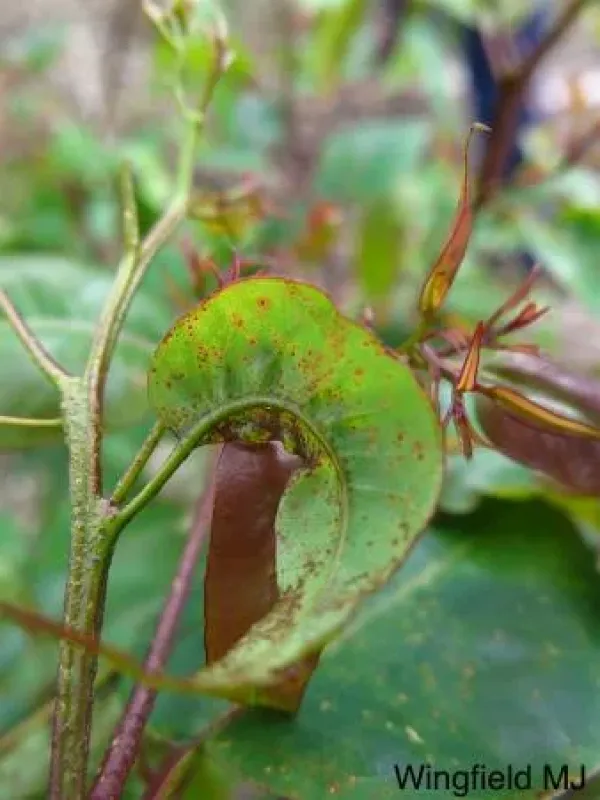
Description
Symptoms
The disease first manifests on young, expanding leaves as minute spots. As the infection progresses, these spots expand, turn brown, and eventually become necrotic, often falling out to create a shot-hole appearance.
Leaf distortion is a common symptom, with infected leaves becoming crinkled and stunted. Severe infections can lead to premature leaf abscission, leaving branches bare and stressed.
On green stems and young shoots, the infection causes small, depressed, corky lesions that give the surface a scab-like appearance. In severe cases, these lesions can coalesce, causing stem deformation or tip dieback.
Petiole infection is also common, leading to weakening and breakage of leaves. The overall canopy appears sparse and unhealthy compared to non-infected trees.
Microscopic examination of the spots, especially under humid conditions, may reveal the presence of conidial masses, although the scabbed tissue itself is the most prominent visual sign.
Pathogen
The causal agent of Hevea scab is the ascomycete fungus Elsinoë heveae, which has an anamorph stage known as Sphaceloma heveae. This pathogen is highly host-specific to rubber trees (Hevea spp.).
The fungus survives on infected plant tissues, primarily on fallen leaves and necrotic stem lesions, waiting for favorable moisture conditions to initiate new infection cycles.
Reproduction occurs through the production of conidia within acervuli. These spores are dispersed by splashing water during rain events, which is why the disease spread is closely linked to precipitation.
The pathogen thrives by colonizing the succulent, rapidly growing tissues of young rubber trees, utilizing the high nutrient availability found in unhardened leaves and stems.
Research indicates that the fungal mycelium penetrates the epidermal layers of the host, leading to the characteristic localized lesions that define the disease progression.
Conditions for development
High humidity and rainfall are the primary drivers of Hevea scab development. Raindrops act as the main vehicle for spore transmission within the canopy of the tree.
The disease is most prevalent during the growth flushes of the rubber tree, as the young, immature tissues are highly susceptible to penetration by the fungus.
Temperature plays a crucial role, with optimal growth of Elsinoë heveae typically occurring in warm, tropical climates between 20°C and 28°C.
Plantations with dense planting patterns often suffer more severely because poor air circulation maintains a humid microclimate that favors fungal sporulation and infection.
In nurseries, overcrowded conditions create an environment where the disease can spread rapidly from one plant to another, leading to significant nursery stock losses.
Why it matters
The primary impact of Hevea scab is the reduction of the photosynthetic leaf area. This limits the tree's ability to produce energy, thus slowing down overall growth rates.
Young trees in nurseries or newly established plantations may be stunted to the point where they take significantly longer to reach the maturity required for rubber tapping.
Chronic infection weakens the tree, making it more susceptible to other secondary pathogens and environmental stressors, potentially decreasing the lifespan of the plantation.
Economic losses include not only the cost of management and fungicide applications but also the long-term impact on potential latex yields from compromised trees.
In severe cases, massive defoliation can lead to temporary or permanent impairment of the tree's development, necessitating expensive replanting in the worst-affected areas.
Protection
The most effective long-term strategy is the deployment of rubber tree clones that are genetically resistant to Elsinoë heveae.
Fungicide applications, particularly copper-based or systemic treatments, are recommended in nurseries or young plantations during the critical periods of new leaf development.
Cultural practices, such as ensuring proper spacing between trees to improve ventilation and reduce humidity, can significantly decrease the risk of severe outbreaks.
Sanitation measures, including the removal of heavily infected shoots or fallen debris in young stands, help in reducing the primary inoculum levels.
- Regular monitoring of canopy health during active growth flushes.
- Use of disease-free planting material to prevent initial introduction to new areas.
- Balanced nutrition to ensure rapid hardening of tissues, reducing the susceptibility window.
Discussion
No discussions yet — be the first.