
Diploschistes scruposus
Diploschistes scruposus
Description
Symptoms
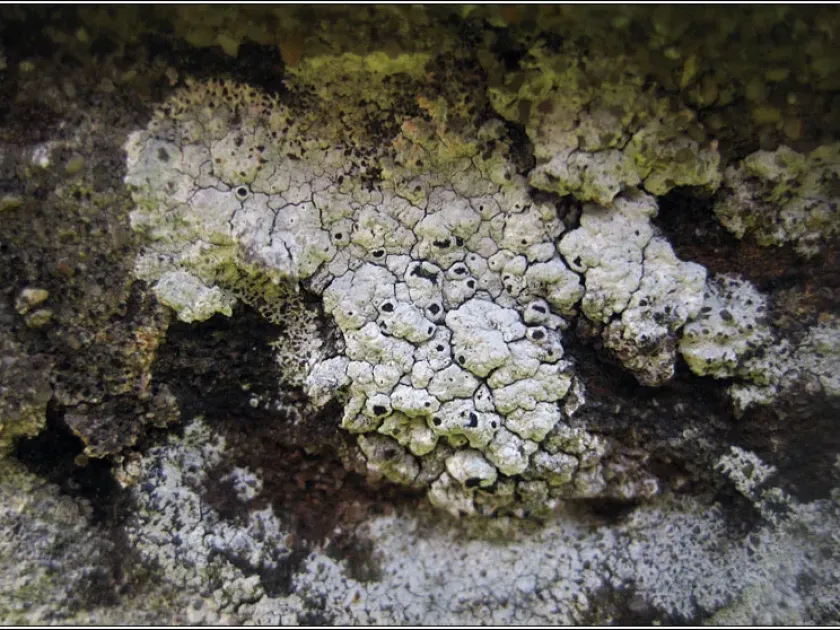
Diploschistes scruposus is a crustose lichen characterized by a thin, tightly attached, and often cracked greyish or off-white thallus that looks like a crust.
The surface is covered with numerous apothecia, which appear as small, dark, sunken dots that look like pinpricks on the lichen's surface.
It typically forms irregular patches on substrates such as rocks or the bark of mature trees, blending in with the underlying texture of the surface.
The lichen is extremely slow-growing and tends to expand over time, potentially covering large areas of bark without damaging the tree tissue itself.
Its overall appearance is that of a rough, matte-finish layer that is impossible to scrape off without causing significant physical damage to the bark underneath.
Pathogen
It is crucial to note that Diploschistes scruposus is not a plant pathogen and does not cause infectious diseases in agricultural crops or forest trees.
It is a symbiotic organism comprised of fungi and algae, which relies on the surface solely for physical support, not for nutrient extraction.
The lichen does not have root-like structures to penetrate the tree's vascular system, meaning it cannot interfere with the sap flow or nutrient transport.
Its biological cycle is entirely independent of the tree's physiological processes, as it obtains all necessary nutrients from the atmosphere and rainwater.
Labelling it as a disease is a common misconception, as it simply utilizes the bark as a substrate in the same way it would use a rock or a wall.
Conditions for development
This species thrives in areas with clean air, as it is highly sensitive to pollutants like sulfur dioxide, making it a bioindicator of environmental health.
It prefers well-lit environments and can often be found on sunny, exposed surfaces where it can photosynthesize efficiently during moist periods.
High relative humidity and consistent exposure to rainfall are essential for its growth, explaining its frequent presence in areas with mist or high atmospheric moisture.
The chemical composition of the substrate is important, with this particular lichen showing a preference for limestone, calcareous rocks, or bark with a neutral pH.
While it is drought-tolerant, it requires periodic hydration to maintain metabolic activity, remaining dormant during prolonged dry spells.
Why it matters
There is no direct harm caused by Diploschistes scruposus to the health of trees, as it does not parasitize the plant or consume its stored reserves.
Some concerns exist regarding its density, which could theoretically restrict minor gas exchange on the bark, although this impact is negligible in reality.
The main issue is that a heavy cover of lichens can provide a hiding place for overwintering pests, potentially shielding them from contact insecticides.
Its presence often indicates an older, slower-growing tree, as lichens struggle to establish themselves on the rapidly expanding bark of young, vigorous trees.
Visually, it may suggest poor maintenance, but the lichen itself is an innocent bystander in the garden, representing natural ecosystem succession.
Protection
Since the organism is not a disease, chemical control or the use of fungicides is unnecessary and serves no benefit to the tree's health.
If removal is desired for aesthetic reasons, physical cleaning with a stiff brush during the dormant season is the safest and most effective method.
Good orchard management, including proper pruning and tree maintenance, helps prevent the conditions that favor excessive lichen growth.
Applying a lime wash to the trunks is a traditional preventative measure that alters the surface chemistry of the bark, discouraging lichen colonization.
Encouraging tree vigor through balanced fertilization and irrigation will help the tree bark stay healthier and more resistant to epiphytic colonization.
Discussion
No discussions yet — be the first.