
Diploschistes diacapsis
Diploschistes diacapsis
Description
Symptoms
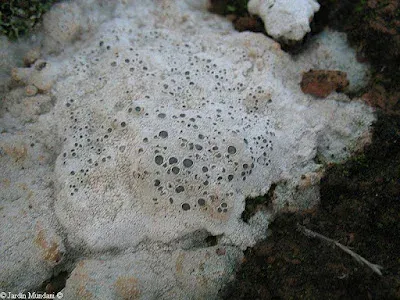
The primary sign of its presence is the formation of grayish-white or ash-colored crusts on the surface of the soil.
The thallus (the vegetative body) has a cracked appearance and adheres tightly to soil particles.
Mature colonies display apothecia, which are small black discs or dots that function as the fungal reproductive organs.
Unlike pathogenic fungi, it does not form mycelium within the roots or stems of crops; its growth is strictly limited to the soil surface.
- Presence of pale gray crusts on open or bare soil.
- Tough, brittle texture that resists mechanical pressure.
- Clear absence of necrotic spots or decay on surrounding vegetation.
Pathogen
It is crucial to clarify that Diploschistes diacapsis is not a plant pathogen or a cause of crop disease. It is a crustose lichen belonging to the Thelotremataceae family.
This organism is a symbiotic association between a fungus and an alga, living on the surface of substrates such as soil or rocks.
In an agricultural context, it is often misidentified as a fungal disease due to its ability to form dense crusts on the soil surface.
It does not parasitize plant tissues, nor does it produce toxins that could harm vascular plants or negatively affect crop yields.
Biologically, it is an epigeic lichen typical of arid or semi-arid environments where it occupies niches with minimal vegetation.
Conditions for development
The development of Diploschistes diacapsis occurs under high light intensity and prolonged drought conditions.
It favors open areas with sparse vegetation, where it does not face competition from higher plants for nutrients or light.
Soils that are saline, loamy, or sandy with a neutral to slightly alkaline pH provide an ideal habitat for this lichen.
The organism grows very slowly and is highly sensitive to intense human activities such as tillage, fertilization, or irrigation.
In agricultural fields, the presence of such lichen crusts often serves as a bioindicator for degraded, poorly managed, or long-fallow land.
Why it matters
The organism poses no direct threat to agricultural crops as it lacks parasitic activity and metabolic pathways that harm plants.
Its presence is not a symptom of disease but rather a sign that the soil surface has been undisturbed for a long period.
While the crust might slightly alter soil micro-porosity, it does not hinder crop growth once the land is properly prepared for sowing.
The lichen is naturally outcompeted by dense canopy crops and is typically eradicated through standard agricultural practices.
There is no economic damage associated with this organism in professional farming, making it irrelevant to plant protection programs.
Protection
No chemical pesticides or fungicides are required, as Diploschistes diacapsis is not a pathogen and does not cause plant damage.
Mechanical tillage, such as plowing or disc harrowing, effectively destroys the lichen crust and incorporates it into the soil.
Increasing soil fertility through fertilization and consistent crop rotation makes the environment unsuitable for the lichen to thrive.
Maintaining a dense crop cover prevents the lichen from establishing itself on the soil surface by blocking necessary sunlight.
Good agricultural practice remains the most effective management strategy for maintaining clean and productive fields.
Discussion
No discussions yet — be the first.