
Diploschistes
Diploschistes
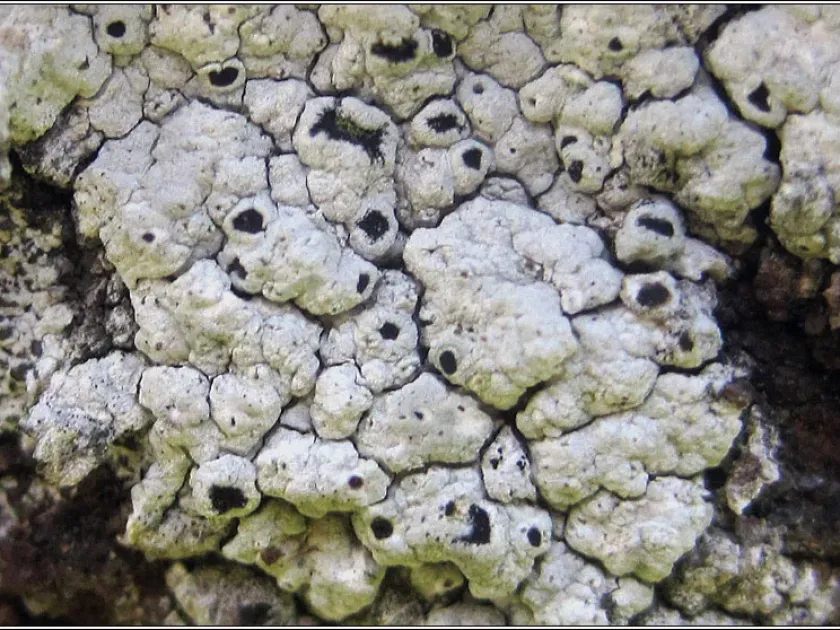
Description
Symptoms
Diploschistes is a genus of crustose lichens that form thin, hard, and crust-like patches on the bark of trees and stones.
They typically appear as grayish or brownish rough surfaces that are tightly fused to the underlying substrate.
You may observe tiny black circular pits or dots on the surface, which are the apothecia, or the fungal fruiting bodies of the lichen.
The organism does not cause any lesions, rot, or discoloration of the actual plant tissues beneath it.
Unlike parasitic fungi, the lichen remains strictly on the surface and does not penetrate into the cambium or wood of the tree.
Pathogen
It is critical to clarify that Diploschistes is not a plant pathogen; it is a symbiotic organism comprised of fungi and algae.
These organisms are classified as epiphytes, meaning they use the tree only as a surface for anchorage.
The lichen does not extract water, minerals, or nutrients from the host plant, and therefore does not interfere with its physiological processes.
The relationship between the lichen and the plant is commensal, where the lichen benefits from the surface while the tree is unaffected.
Identifying this as a disease is a common misconception among amateur gardeners who confuse lichen growth with fungal infections.
Conditions for development
The development of Diploschistes is favored by high relative humidity and stable atmospheric conditions over long periods.
These organisms thrive in clean, non-polluted environments, which is why they are often used as biological indicators of air quality.
They colonize trees with mature or aging bark, as the stable, dry surface provides an ideal anchoring point for their growth.
Poorly ventilated areas within a garden or orchard provide a microclimate that supports the expansion of lichen colonies.
Growth is extremely slow, meaning it takes years for a colony to cover a significant portion of a tree limb.
Why it matters
Diploschistes poses no direct harm to the vitality or productivity of trees, shrubs, or other woody plants.
The only potential risk is that thick lichen crusts may provide a shelter for other insects or fungal spores that might actually be harmful.
However, this is a secondary issue related to habitat rather than a disease process caused by the lichen itself.
The plant does not suffer from stunted growth or loss of vigor due to the presence of these epiphytes.
Gardeners should view their presence as a sign of environmental health rather than a target for chemical control.
Protection
There is no chemical control necessary for Diploschistes as it is not a parasite and does not cause economic damage.
If you prefer to remove it for aesthetic reasons, gentle manual brushing with a stiff nylon or brass brush is sufficient.
The most effective preventative measure is regular pruning, which ensures adequate light penetration and airflow through the tree crown.
Maintaining strong tree growth through proper fertilization and watering helps the tree shed old bark, naturally limiting lichen colonization.
- Manual removal with brushes
- Proper canopy thinning
- Whitewashing trunks
Discussion
No discussions yet — be the first.