
Diploicia canescens
Diploicia canescens
Description
Symptoms
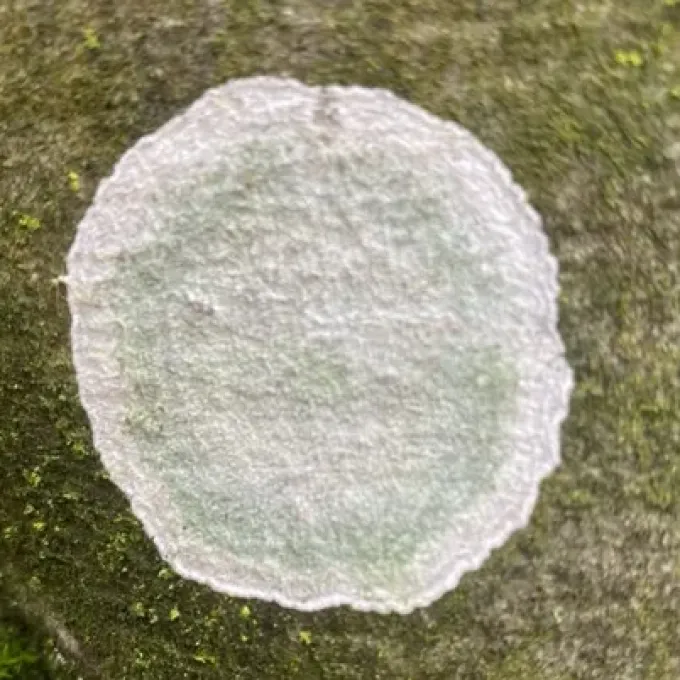
Diploicia canescens manifests as crustose thalli firmly attached to the bark surface. It typically presents as a grey or ashy-white patch, often with a fine, powdery or granulated appearance that distinguishes it from other species.
A distinctive diagnostic feature is the presence of apothecia, which are small, dark, or black fungal reproductive structures. These are often scattered or grouped towards the center of the lichen colony, creating a notable visual contrast.
The colonies grow in a rosette pattern, frequently displaying lobed, white-edged margins. Over time, these patches can expand and coalesce, covering significant areas of the trunk or larger branches in mature trees.
The texture of the lichen is relatively thin and brittle when dry. Unlike parasitic fungi that cause visible decay or lesions, this lichen sits on the surface without penetrating the inner wood or causing obvious tissue necrosis.
Color variations occur based on environmental moisture levels. During wet conditions, the lichen may appear darker or more vibrant, while in dry periods, it can become pale, almost chalky, reflecting its adaptive nature to atmospheric water sources.
Pathogen
Diploicia canescens is a symbiotic lichen consisting of a fungal mycobiont and a green algal photobiont. It is not an infectious pathogen and does not derive nutrients from the tree's internal circulation system.
As an epiphyte, its relationship with the tree is primarily physical, using the bark as a substrate for growth. It benefits from the host's stability and access to atmospheric moisture and nutrients found in dust and organic debris on the bark.
Reproduction is both sexual, via spores released from the apothecia, and asexual, through the fragmentation of the thallus. These propagules are easily dispersed by wind or rain, facilitating colonization of new surfaces.
The organism is highly resilient, capable of enduring periods of drought by entering a dormant state. Its biological success is attributed to its efficiency in atmospheric nutrient absorption and its tolerance to varying levels of air quality.
The presence of this lichen is a natural ecological occurrence. It is commonly found in a wide variety of habitats, including gardens and orchards, where it utilizes the bark surface as an available niche.
Conditions for development
High relative humidity and moderate levels of diffused light are critical factors for the development of Diploicia canescens. It frequently colonizes trees in shaded environments or those near water sources where air moisture remains elevated.
Mature trees with rough, fissured bark provide the most suitable substrate. These crevices accumulate the dust, pollen, and organic particles necessary for initial spore germination and long-term establishment of the lichen thallus.
Poor orchard management, such as lack of pruning, encourages dense canopy growth, which creates the humid microclimate favored by this species. Air circulation is often stagnant in these conditions, promoting rapid spread.
Temperature patterns across the growing season influence metabolic rates, though the species is notably frost-tolerant. It thrives in temperate regions where seasonal rains contribute to consistent bark hydration.
Environmental factors like atmospheric cleanliness also play a part, though Diploicia canescens is known to be relatively tolerant of urban pollution compared to many other lichen species, allowing it to persist even in suburban areas.
Why it matters
The primary concern regarding this lichen is its role as a harbor for pests. The dense thallus and the space beneath it provide an ideal refuge for scale insects, mites, and various other garden pests, protecting them from predators.
While it does not feed on the tree, heavy encrustation may interfere with bark gas exchange. While trees are usually resilient to this, excessive coverage on young or struggling trees can be suboptimal for physiological health.
The presence of abundant lichen growth is often interpreted as a symptom of tree neglect or decline. It acts as an indicator that the tree may be growing too slowly or lacks the vigor to shed its outer bark layers naturally.
In cases of extremely dense coverage, the aesthetic value of ornamental trees can be compromised. For fruit trees, although the fruit itself is rarely affected, the overall vigor of the plant may be reflected in lower productivity.
Direct damage to the living wood is non-existent, but the presence of the lichen suggests that the tree is an inactive participant in the local ecosystem, needing better cultural care to maintain optimal health.
Protection
The most effective management strategy is regular manual removal of dead, loose bark using a soft wire brush or wooden scraper during the dormant season when the bark is damp and easier to clean.
Painting the trunks and the base of major branches with a lime wash is a traditional and effective preventive measure. The alkaline environment created by the lime inhibits the development of spores and young lichen colonies.
Periodic dormant sprays, such as a 3-5% iron sulfate solution, can be used to manage lichen populations. This is best applied early in the spring or late in the autumn to ensure maximal efficacy without disturbing active tree growth.
Cultural practices should focus on improving airflow within the canopy. Pruning to open the center of the tree reduces humidity levels, making the environment less favorable for lichen establishment.
- Maintain tree vigor through proper fertilization and watering.
- Avoid overcrowding of plantings to increase light and air penetration.
- Sanitize tools after working on heavily infested trees.
- Monitor trees for secondary pest issues under the lichen patches.
Discussion
No discussions yet — be the first.