
Phomopsis stem canker
Diaporthe kochmanii
Description
Symptoms
Symptoms typically begin as brown or greyish necrotic lesions on the leaf blades, spreading along the veins toward the petiole.
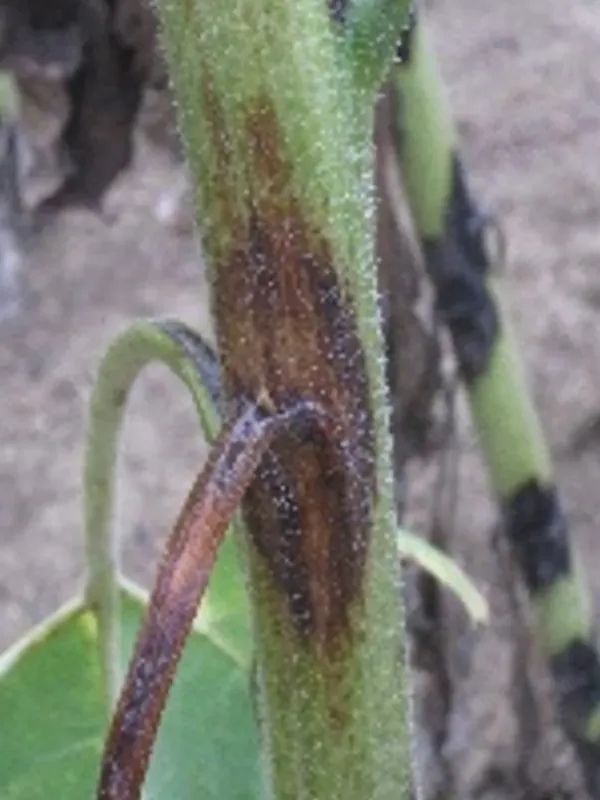
The infection reaches the stem base, forming large, elongated brown lesions that encircle the plant, causing it to weaken and wither.
Internal tissue degradation occurs as the fungus destroys the stem pith, leading to stem breakage and lodging of the mature sunflowers.
Heads become poorly filled, and seeds often remain shriveled or fail to develop due to the disruption of water and nutrient transport.
Black, speck-like pycnidia appear on the surface of dead stems, serving as the primary diagnostic feature for identifying the disease in the field.
Pathogen
The disease is caused by the ascomycete fungus Diaporthe kochmanii, which manifests its asexual stage as Phomopsis helianthi. It is a highly destructive pathogen globally.
The fungus infects sunflower plants through leaf stomata and migrates into the stem, colonizing the pith and cortical tissues systematically.
Its survival strategy relies on producing specialized fruiting bodies known as pycnidia and perithecia, which persist on dead plant material for several seasons.
The pathogen is highly aggressive and possesses a wide range of adaptations, allowing it to colonize various tissues of the sunflower plant effectively.
Spore dispersal occurs via wind and rain splashes, making the pathogen extremely difficult to contain once it is established in a field environment.
Conditions for development
Phomopsis development is strongly influenced by prolonged periods of high humidity, frequent rainfall, and moderate temperatures.
The fungus thrives during warm summer days, typically between 20°C and 25°C, when the sunflower plant is in its rapid growth phase.
Poor field management, including high plant density and inadequate aeration, significantly increases the risk of successful infection.
Fields with crop residue from previous seasons are at a higher risk, as the fungus survives in old debris and releases spores into the air.
Wet weather during the flowering period is particularly dangerous, as it facilitates the spread of spores and their colonization of healthy leaves.
Why it matters
Phomopsis stem canker causes significant yield losses, often resulting in 30% to 60% reductions in oil content and total seed weight.
Stalk breakage complicates harvest operations, leading to major machinery losses and increased costs for producers during the autumn season.
The quality of harvested seed is severely compromised, making it unsuitable for both crushing for oil and use in future sowing.
Widespread outbreaks can devastate entire sunflower industries in specific regions, threatening the economic stability of farming operations.
The disease's ability to persist in the soil for years forces farmers to adjust crop rotation plans, often abandoning sunflower production for extended periods.
Protection
Implementing genetic resistance through the use of resistant sunflower hybrids is the primary and most effective control measure.
Long-term crop rotation schemes, with a break of at least 6 to 8 years between sunflower plantings, are essential to break the pathogen's life cycle.
Deep plowing of crop residues is recommended to accelerate decomposition and reduce the amount of inoculum available for the next season.
Proactive application of broad-spectrum fungicides during the critical growth stages (V6 to R1) can suppress the spread of the pathogen.
- Use of disease-resistant hybrids.
- Adoption of extensive crop rotations.
- Timely and targeted fungicide applications.
- Effective management of crop residue.
Discussion
No discussions yet — be the first.