
Davidsoniella virescens
Davidsoniella virescens
Description
Symptoms
Early symptoms of infection often include a noticeable loss of leaf turgor and a characteristic change in leaf color. Affected leaves may turn a dull greenish-brown before wilting entirely.
Dieback typically progresses from the top of the crown downwards. As the disease advances, entire branches begin to wither, leading to a thin and sparse canopy appearance.
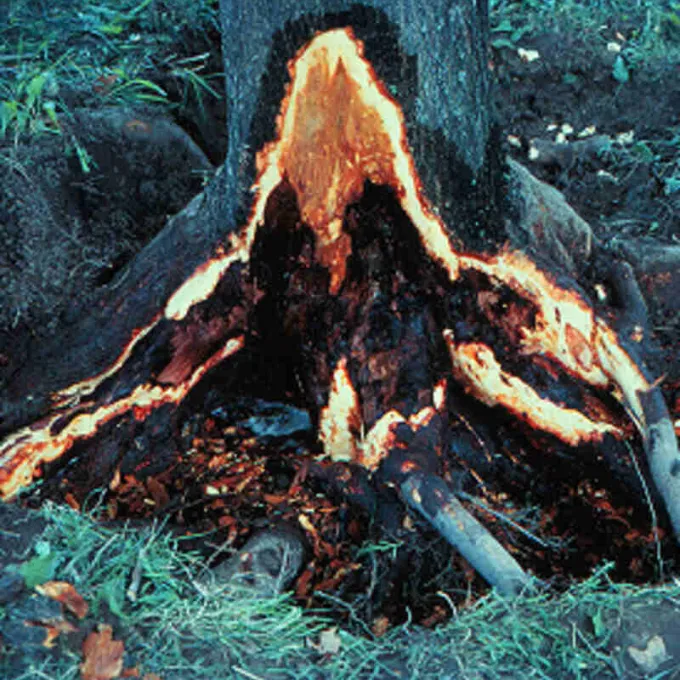
Internal diagnostics reveal significant discoloration in the sapwood. When wood is exposed, dark streaks or localized lesions are frequently visible, indicating the presence of fungal mycelium.
At advanced stages, necrosis may become visible on the trunk surface, often where the fungus has emerged to release its spores into the surrounding air.
- Premature wilting and drooping of foliage.
- Top-down dieback of the tree crown.
- Darkened vascular streaks visible in the wood.
- Sparse canopy and early leaf drop.
- Development of localized bark necrosis.
Pathogen
The fungus Davidsoniella virescens (formerly known as Ceratocystis virescens) is an ascomycete pathogen responsible for significant vascular wilt diseases in various deciduous tree species.
This fungus operates as an endophyte, colonizing the host's xylem and disrupting its normal physiological functions. It is characterized by its ability to spread rapidly through moisture and insect vectors.
The life cycle of the pathogen involves both sexual and asexual stages, allowing it to produce various types of spores that remain viable in the environment for extended periods.
Biologically, the fungus produces secondary metabolites that contribute to vessel occlusion. By clogging the conductive tissues, the pathogen essentially starves the tree of nutrients and water.
The resilient nature of Davidsoniella virescens makes it a significant subject of study in phytopathology, especially concerning its role in the decline of temperate forest ecosystems.
Conditions for development
High humidity and mild temperatures create the most favorable environment for the germination of Davidsoniella virescens spores, particularly during the spring and early summer seasons.
Trees under stress, such as those suffering from prolonged drought, nutrient deficiencies, or mechanical wounds, are significantly more susceptible to successful colonization by the pathogen.
Stand density plays a critical role in the dissemination of the fungus. In crowded forests, the proximity of host trees allows for the rapid spread of spores via natural air currents.
Optimal growth for the fungal mycelium occurs between 20°C and 25°C. In these conditions, the incubation period is significantly shortened, leading to more aggressive symptom development.
Anthropogenic factors, such as improper logging practices and leaving infested debris in the forest, contribute to an increase in the local spore load and disease prevalence.
Why it matters
The primary harm caused by Davidsoniella virescens is the obstruction of the water-conducting system. This leads to a systemic wilting process that can eventually cause total tree mortality.
From an economic perspective, the wood quality is severely compromised. Discoloration and the degradation of structural integrity render the timber unsuitable for commercial applications.
Ecologically, the loss of mature trees disrupts forest biodiversity and canopy cover, which affects the habitat of local wildlife and the microclimate of the forest floor.
Infected trees become highly attractive to secondary pests, such as wood-boring beetles. This secondary infestation often accelerates the death of the tree, creating further forest management challenges.
The potential for rapid spread in susceptible species poses a long-term threat to regional forest health and the sustainability of timber production in affected areas.
Protection
Effective control strategies focus on sanitation. The prompt removal and destruction of infected trees are essential to minimize the source of inoculum within the forest stand.
Strict hygiene protocols must be implemented for equipment used in forest maintenance. Sanitizing saws and pruning tools between trees is a crucial step in preventing human-aided disease spread.
Silvicultural practices that maintain forest health are vital. By ensuring proper spacing and providing appropriate care to young trees, foresters can increase the stand's natural resistance.
In high-value areas, such as urban parks, the targeted application of systemic fungicides may be considered under professional supervision to protect high-risk specimens.
Continuous monitoring and early detection programs are the most effective way to manage the disease. Identifying and isolating small infection sites prevents the need for drastic control measures later on.
Discussion
No discussions yet — be the first.