
Daldinia vernicosa
Daldinia vernicosa
Description
Symptoms
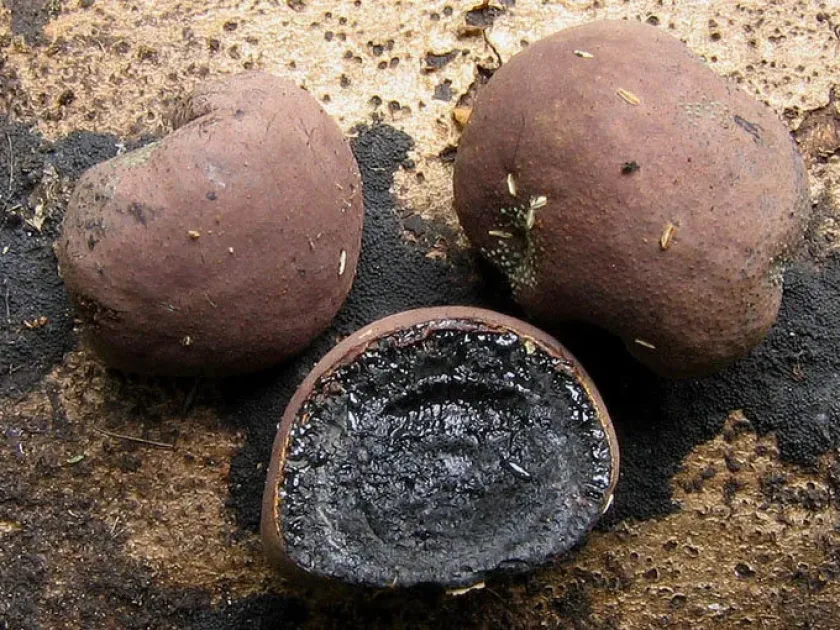
The most distinctive signs are the hemispherical, cushion-like fruiting bodies. They are typically carbon-black, very hard, and possess a distinct lacquered, shiny surface.
When sectioned, the fruiting bodies reveal concentric layers, which are often compared to growth rings. These layers represent different stages of sporulation and growth.
Wood decay is evident through the softening and discoloration of the internal tissues. The bark may crack and peel off as the underlying wood loses its structural integrity.
These fungi are usually found on decaying branches, old stumps, or severely weakened deciduous trees. The shiny surface helps distinguish them from other similar fungal species.
Early identification is often difficult as the fungus develops primarily inside the wood. Visible fruiting bodies typically appear only when the infection is well-established.
Pathogen
The causative agent is Daldinia vernicosa, a fungus belonging to the Ascomycota division. It acts as a wood-decay fungus, primarily colonizing dead or dying wood tissues.
It is classified as a white-rot pathogen that degrades lignin and cellulose components of the woody tissue. This process slowly weakens the internal structure of the tree.
Biologically, the fungus functions as a saprotroph, though it can transition to an opportunistic pathogen on weakened hosts. It plays a critical role in nutrient cycling in natural ecosystems.
The life cycle involves the release of spores that travel via wind currents. Once a spore settles on an exposed wound or crack, it germinates and begins forming a mycelial network.
The mycelium grows through the woody substrate, extracting energy and providing the necessary mass to produce characteristic fruiting bodies later in its development.
Conditions for development
Daldinia vernicosa thrives in high-humidity environments, which are essential for spore germination and active growth. Shaded, damp areas are highly susceptible to infestation.
The fungus prefers moderate temperatures, allowing for continuous growth throughout the warmer months. Stagnant air and poor ventilation can facilitate the accumulation of spores.
The presence of physical injuries such as pruning wounds, cracks, or sunscald creates ideal entry points for the fungus. These wounds allow the mycelium to penetrate deeper tissues.
Host susceptibility is a key factor; trees already stressed by drought, poor nutrition, or secondary diseases are much more likely to be colonized by this fungus.
Lack of orchard sanitation allows the fungus to remain in the area. Decaying wood left on the ground serves as a permanent reservoir for new spores.
Why it matters
The primary risk is the loss of structural strength in the tree's trunk or branches, leading to a high risk of breakage. This poses safety hazards in gardens and parks.
The fungus disrupts the tree's ability to transport nutrients and water. This results in dieback, foliage loss, and, eventually, the death of the infected host.
As a source of spores, an infected tree can threaten the health of neighboring specimens. This often leads to localized outbreaks within a garden or orchard.
Economically, the presence of the fungus necessitates costly maintenance, such as surgical cleaning or complete tree removal to prevent the spread of the pathogen.
The progression of decay is permanent. Once the fungus has deeply colonized the woody core, the tree's vitality is significantly compromised beyond recovery.
Protection
Effective control relies on rigorous sanitation, including the prompt removal of deadwood. All pruning cuts should be sealed with specialized wound dressings.
Strengthening tree health through proper fertilization and watering is the best proactive measure. A vigorous tree can better defend itself against fungal pathogens.
Regular monitoring for fruiting bodies is essential. Any discovered fungus should be physically removed and destroyed by burning to prevent further spore release.
If an infection is localized on a branch, deep excision to reach healthy tissue followed by antiseptic treatment is necessary to halt further spread into the trunk.
- Remove all dead or decaying plant material.
- Treat pruning wounds with protective antiseptics.
- Burn harvested fruiting bodies immediately.
- Protect bark from mechanical impact.
- Monitor trees for early decay symptoms.
Discussion
No discussions yet — be the first.