
Daldinia
Daldinia
Description
Symptoms
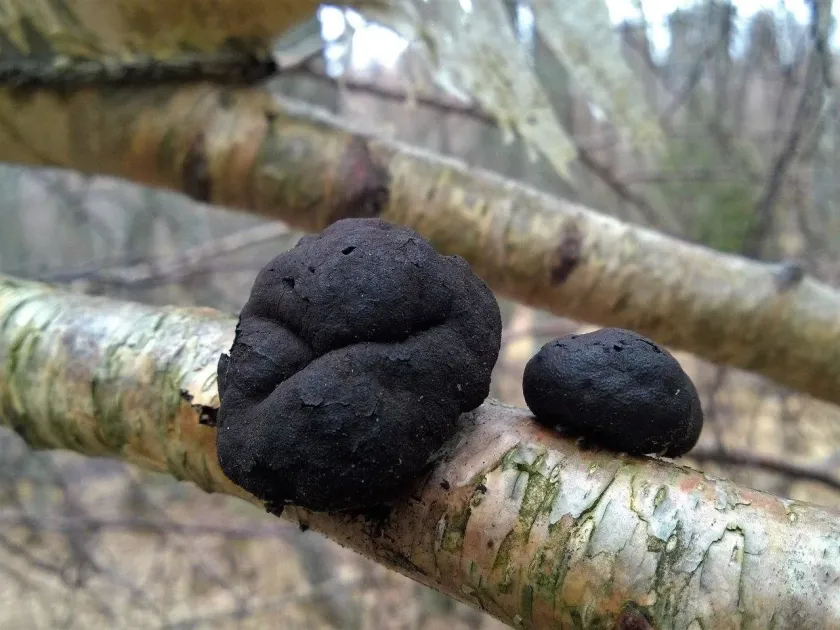
The most distinctive visual indicator is the presence of hemispherical to globular fruiting bodies (stromata) on the bark of stems, branches, or stumps. These bodies measure roughly 2–8 cm in diameter.
Young fruiting bodies are reddish-brown, eventually turning coal-black with a matte or shiny texture as they age. A cross-section of the stroma reveals a unique concentric growth pattern, similar to tree rings.
Bark in infected areas often becomes brittle, cracks, or begins to slough off, exposing the underlying wood. White, mycelial threads may be visible beneath the loosened bark as a white mat of tissue.
Internal wood decay manifests as a bleached, spongy, or fibrous texture. In many cases, dark, wavy "zone lines" of fungal pigments form within the wood, delimiting the areas where the fungus is actively growing.
Canopy thinning, leaf yellowing, and branch dieback are common secondary symptoms, indicating that the tree’s water and nutrient transport systems are compromised by the internal decay.
Pathogen
The disease is caused by fungi of the genus Daldinia, with Daldinia concentrica being the most recognized species. These are saprotrophic, sometimes parasitic ascomycetes known as part of the Xylariaceae family.
The fungus acts as a white-rot agent, efficiently degrading the structural components of wood such as lignin and cellulose. By secreting powerful enzymes, it breaks down the wood’s integrity from within.
The life cycle involves the formation of distinctive stromata, which are the visible part of the fungus. These structures are hard, carbonaceous, and typically spherical, often resembling burnt charcoal.
Spores are produced in microscopic chambers called perithecia embedded within the stroma. When mature, these spores are released in high concentrations and disseminated by wind currents to new hosts.
This fungus is highly resilient, capable of persisting in dead wood for long periods and waiting for the right environmental conditions to sporulate and infect nearby susceptible trees.
Conditions for development
Infection primarily occurs through wounds caused by mechanical damage, pruning errors, frost cracks, or insect activity. These entry points provide the fungus with immediate access to inner tissues.
High humidity and moisture are the main environmental drivers for the development of Daldinia. The fungus flourishes in environments with poor air circulation, such as dense or unpruned plantations.
Weakened or stressed trees are much more susceptible to colonization. Factors such as drought, nutrient deficiency, or prior damage make a tree a prime target for the fungus.
The presence of decomposing organic matter, including old stumps and fallen branches in the immediate vicinity, serves as a permanent reservoir of spores.
Although the fungus is adaptable, it thrives during the growing season when temperatures are warm (approx. 15–25°C) and moisture levels are sufficiently high to support mycelial expansion.
Why it matters
The primary concern is the significant structural weakening of the tree trunk and branches. This increases the risk of tree failure, making the affected trees hazardous to property and public safety.
The fungus kills the living cambium layer, which disrupts the flow of water and nutrients. This inevitably leads to the decline and eventual death of the affected tree.
For fruit orchards, the infection translates into reduced fruit production, decreased tree vigor, and significant economic losses due to the need for tree removal.
The infection is often difficult to detect in early stages, meaning that by the time the fruiting bodies appear, the structural integrity of the wood may already be critically compromised.
If left unmanaged, the fungus can spread rapidly throughout a landscape, moving from dead wood to healthy trees, creating a long-term management challenge for land owners.
Protection
- Prompt removal of infected branches and destruction of fruiting bodies to reduce the local spore load.
- Applying protective wound sealants or antiseptic pastes to fresh pruning cuts to prevent colonization.
- Stump removal and disposal of all woody debris to eliminate the primary sources of infection in the area.
- Regular garden sanitation, including the removal of deadwood and maintenance of healthy tree vigor through proper fertilization.
- Ensuring adequate tree spacing and pruning to promote good air circulation, which helps keep the bark dry and less hospitable to fungi.
Discussion
No discussions yet — be the first.