
Cystodinium cornifax
Cystodinium cornifax
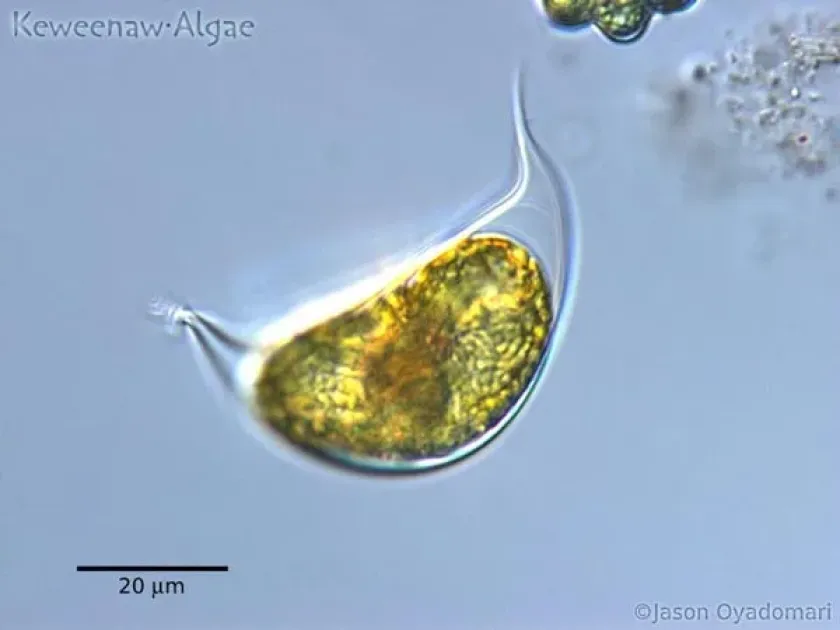
Description
Pathogen
Cystodinium cornifax is a unicellular organism belonging to the Dinophyta division. It is characterized by a distinct morphology with horn-like appendages, which allow it to anchor onto various surfaces within an aquatic environment.
Unlike free-swimming plankton, this species often exhibits a sessile (attached) lifestyle. It possesses a complex life cycle that includes a vegetative phase and a resting cyst stage, which ensures its survival during harsh environmental shifts.
In agronomy, this organism is primarily studied in the context of controlled aquatic environments, such as hydroponic systems or aquaculture ponds. It acts as a bio-indicator of nutrient imbalances or poor circulation in the water supply.
The organism is photosynthetic, relying on light energy to synthesize organic matter. Its cellular structure is adapted for efficient light absorption, enabling it to thrive in various aquatic strata where light is sufficient.
As a biological entity, its presence can significantly alter the local microflora composition. Understanding its reproductive biology is crucial for maintaining a healthy and stable aquatic environment for crop production.
Conditions for development
High nutrient concentrations, specifically nitrogen and phosphorus, are the primary drivers for the rapid proliferation of Cystodinium cornifax. Excess fertilizers in hydroponic systems often trigger blooms.
The organism favors stagnant or slow-moving water, where light penetration is high. Temperature plays a critical role, with moderate to warm conditions promoting optimal metabolic rates and cell division.
pH stability is essential for the growth of this species. While it can adapt to various conditions, a stable neutral or slightly alkaline pH environment is preferred for colonizing surfaces efficiently.
Substrate availability is another important factor. The organism's ability to anchor itself makes it prone to forming biofilms on plastic tubing, filtration membranes, and the roots of cultivated plants.
Lack of biodiversity in a closed aquatic system often leads to a monoculture dominated by this species, as it effectively outcompetes other microorganisms for resources.
Why it matters
The primary concern regarding this organism is the formation of dense biofilms, which can obstruct irrigation pipes and filtration systems. This leads to increased maintenance costs and potential crop stress.
Algal blooms caused by Cystodinium cornifax lead to significant fluctuations in dissolved oxygen levels. Nighttime respiration can cause acute hypoxia, endangering fish populations or plant root systems.
As a nutrient consumer, the algae compete with cultivated crops for essential minerals. This competition can result in reduced growth rates and lower quality yields in aquaponic or hydroponic setups.
Dead cells and decomposition products from large colonies can release organic matter into the water, potentially favoring the growth of pathogenic bacteria that may harm primary crops.
Reduced water clarity and light penetration, caused by high densities of this organism, can suppress the photosynthetic activity of submerged aquatic plants, leading to overall ecosystem instability.
Protection
Maintaining a balanced nutrient profile is the most effective preventive measure. Avoiding over-fertilization limits the available resources for algal growth and helps maintain system stability.
Installation of UV-C sterilization systems is a highly recommended technological solution. Ultraviolet radiation effectively disrupts the cellular mechanisms of Cystodinium cornifax, preventing its spread.
Regular mechanical cleaning of all water reservoirs, pipes, and surfaces is vital. Removing established biofilms prevents the maturation of cysts and disrupts the life cycle of the organism.
Implementing effective aeration and water circulation systems prevents stagnation, making it harder for the organism to anchor and establish large-scale colonies in the system.
Biological control, such as introducing herbivorous zooplankton, can manage the population density naturally, providing a sustainable and eco-friendly approach to water management.
Discussion
No discussions yet — be the first.