
Cystoderma jasonis
Cystoderma jasonis
Description
Symptoms
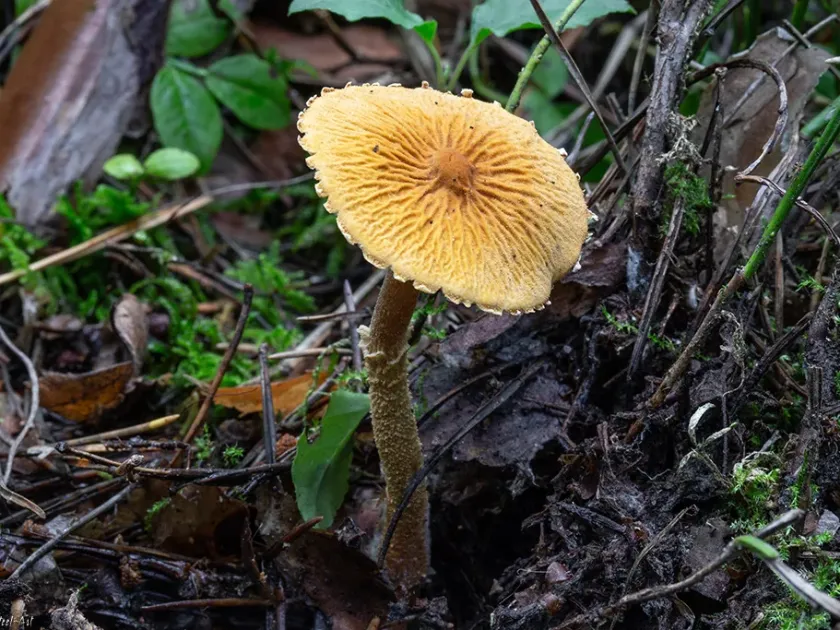
The fruiting body of Cystoderma jasonis is characterized by a granular or scaly appearance on both the cap and the stem, which is typical for the genus.
The cap is convex when young, becoming flatter with age, and often features a distinct central umbo. It is usually shades of ochre or yellowish-brown.
The gills are crowded and can be attached to the stem. In immature specimens, the gills are protected by a partial veil, which later forms a ring on the stem.
The stem is cylindrical and covered in a fine, granular coating. This texture is one of the primary visual keys used to identify this specific species in the wild.
The spore print is white. Microscopic examination of the spores reveals an ellipsoid shape with a smooth surface, providing a reliable diagnostic feature.
Pathogen
Cystoderma jasonis is a species of gilled mushroom in the Agaricaceae family. It is important to note that this organism is not a plant pathogen and does not cause diseases in agricultural crops.
As a saprotrophic fungus, it derives its nutrients from decaying organic matter such as leaf litter and woody debris. It does not parasitize living plant tissues.
The fungus is classified as a decomposer, playing a vital role in forest ecosystems by breaking down complex organic materials and recycling nutrients back into the soil.
It is not related to any agricultural blight, rust, or wilt, and therefore has no negative impact on the yield of field crops or garden plants.
Mycologically, it is a significant member of woodland ecosystems, contributing to the humification process of the forest floor.
Conditions for development
This fungus thrives in moist woodland environments. It requires a substrate rich in decaying organic matter, typically found in coniferous or mixed forests.
Fruiting occurs primarily during the autumn months when temperatures are cooler and soil moisture levels are consistently high, providing ideal conditions for development.
Optimal temperatures for the appearance of fruiting bodies generally range from 8 to 15 degrees Celsius. Extreme cold or drought inhibits the development of the mycelium.
The presence of a stable layer of moss, pine needles, or leaf litter is essential, as it protects the delicate mycelial network from desiccation and temperature fluctuations.
The fungus is often found in sheltered areas where the microclimate remains stable, allowing for the slow and continuous breakdown of forest litter.
Why it matters
Cystoderma jasonis is harmless to cultivated plants. It does not cause root rots, leaf spots, or any other physiological damage to crops or ornamental plants.
Since it is a saprotroph, it poses no threat to the vitality of living plants. Its presence in a field or garden indicates a healthy decomposition cycle in the soil.
The fungus does not produce toxins that would inhibit the growth of surrounding vegetation or compete with plants for mineral resources.
There are no economic losses associated with this species in agriculture. It is an ecologically neutral organism that serves a functional purpose in its natural habitat.
It is not considered a pest and does not require monitoring by agricultural professionals or plant health authorities.
Protection
Since this fungus is not a pathogen, there are no prescribed control methods or chemical treatments necessary for its management in agricultural settings.
To discourage fungal growth in areas where it is not desired, standard cultural practices such as removing excess organic debris and improving soil drainage are sufficient.
Maintaining proper aeration in the soil and preventing waterlogging can naturally limit the proliferation of many saprotrophic mushroom species.
No fungicidal applications are needed or recommended, as they would be environmentally wasteful and ineffective against a beneficial decomposer.
We encourage the preservation of biodiversity in woodland areas, where Cystoderma jasonis plays a natural and helpful role in the ecosystem.
Discussion
No discussions yet — be the first.