
Cystoderma carcharias
Cystoderma carcharias
Description
Symptoms
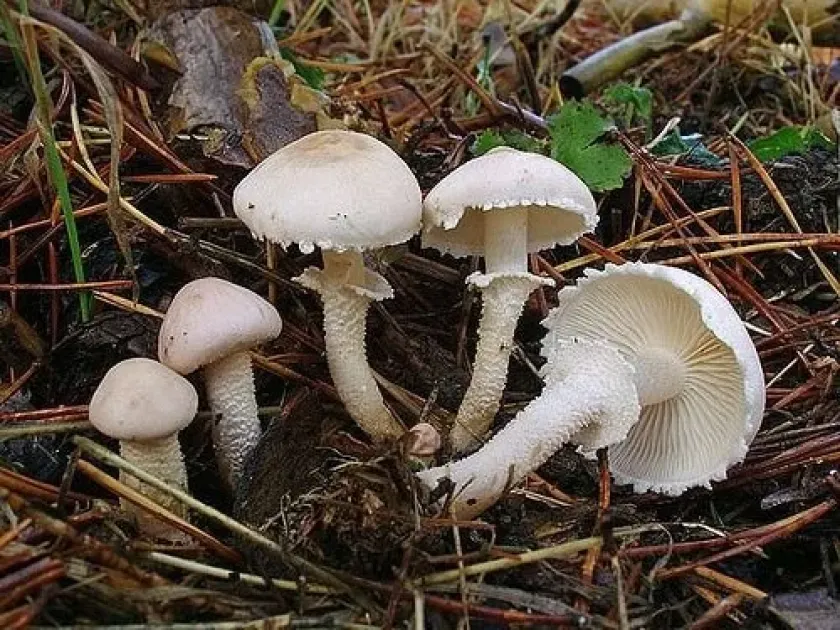
The fruiting bodies of Cystoderma carcharias typically range in color from whitish-grey to pale pink or ochre-brown. The cap, which reaches 2–6 cm in diameter, is covered with small, delicate scales that give the surface a granular texture.
The gills are white to cream-colored and are attached to the stem. As the mushroom matures, they may slightly darken or change color, reflecting the transition of the fruiting body's development cycle.
The stem is cylindrical and features a prominent, often cottony ring located near the upper section. The area of the stem below the ring is also covered in small scales, mirroring the texture of the cap.
A notable diagnostic feature is the scent of the mushroom, which is often described as earthy, floury, or slightly unpleasant. This scent helps distinguish it from other species within the same genus.
- Cap diameter: 20–60 mm
- Gill attachment: Adnate or slightly decurrent
- Spore print color: White to cream
- Surface texture: Granular-scaly
Pathogen
Cystoderma carcharias is a basidiomycete fungus belonging to the Agaricaceae family. It is important to emphasize that this organism is not a plant pathogen; it is a saprotrophic fungus that feeds on decaying organic matter rather than living plant tissues.
As a saprotroph, it plays a vital ecological role by breaking down complex organic materials, such as pine needles, leaf litter, and wood debris, in forest ecosystems. This process helps recycle nutrients back into the soil, making them available for forest vegetation.
Unlike parasitic fungi that cause plant diseases, Cystoderma carcharias does not invade living plant structures. It lacks the biological mechanisms required to penetrate healthy plant cells, meaning it does not cause wilt, necrosis, or root decay.
The life cycle of this fungus relies on the presence of organic debris and high environmental humidity. Its mycelium grows throughout the substrate, efficiently decomposing organic matter and contributing to the formation of soil humus.
From a mycological perspective, the species is identified by its distinct physical characteristics, including its granular or scaly appearance. It is a common inhabitant of coniferous and mixed forests worldwide.
Conditions for development
This fungus thrives in moist, shaded environments, particularly in coniferous forests where a thick layer of needle litter provides a constant moisture source. It is most active during periods of high humidity.
Fruiting typically occurs from late summer through late autumn. The species prefers cooler temperatures, which trigger the development of the reproductive structures (the mushrooms) from the underlying fungal network.
Soil acidity plays a significant role in the habitat preference of Cystoderma carcharias. It flourishes in the acidic, organic-rich soils typical of pine and spruce forests, where it faces little competition from other organisms.
The survival of the mycelium is dependent on the moisture content of the substrate. During dry seasons, the mycelium remains dormant in the soil, protected by the organic layer, until optimal conditions return.
Spore dispersal is facilitated by wind. Once the spores are released from the gills, they travel long distances, colonizing new patches of suitable substrate to continue the fungal life cycle.
Why it matters
Cystoderma carcharias causes no harm to agricultural crops, ornamental plants, or forest trees. It is essentially neutral in an agronomic context, as it does not pose any threat to the yield or health of economic crops.
There is no evidence to suggest that this fungus is capable of parasitizing living organisms. It occupies a niche as a recycler, which is a beneficial function in maintaining soil health and preventing the accumulation of debris.
Confusion often arises when gardeners mistake saprotrophic fungi for pathogenic ones. It is important to clarify that this species is not a disease-causing agent and does not require management in a professional or private garden.
While the edibility of this mushroom is generally regarded as poor or even questionable, this is irrelevant to plant pathology. It poses no threat to the vitality of the landscape or the productivity of the soil.
Ultimately, the presence of these fungi indicates a healthy rate of organic matter turnover in the soil, which is a positive sign for the overall biodiversity of the local ecosystem.
Protection
No control measures are necessary for Cystoderma carcharias, as it is not a pest or a disease agent. The application of fungicides or other chemical treatments would be ineffective, unnecessary, and environmentally harmful.
If the appearance of fruiting bodies is undesired for aesthetic reasons, simple cultural practices like raking away excessive litter or improving soil drainage can reduce the local humidity and substrate available for fungal growth.
Focusing on the overall health and vigor of plants is the best way to ensure immunity against actual pathogens. Resources should be allocated to preventing diseases caused by true phytopathogens like mildew, rust, or blights.
The management of garden beds should prioritize maintaining proper nutrient levels and adequate airflow to plants, which naturally keeps the fungal environment in balance.
Farmers and gardeners are advised to focus on identifying true crop stressors and to leave beneficial or harmless decomposer fungi, like Cystoderma carcharias, to perform their natural ecological work.
Discussion
No discussions yet — be the first.