
Curvularia leaf spot
Curvularia spicifera
Description
Symptoms
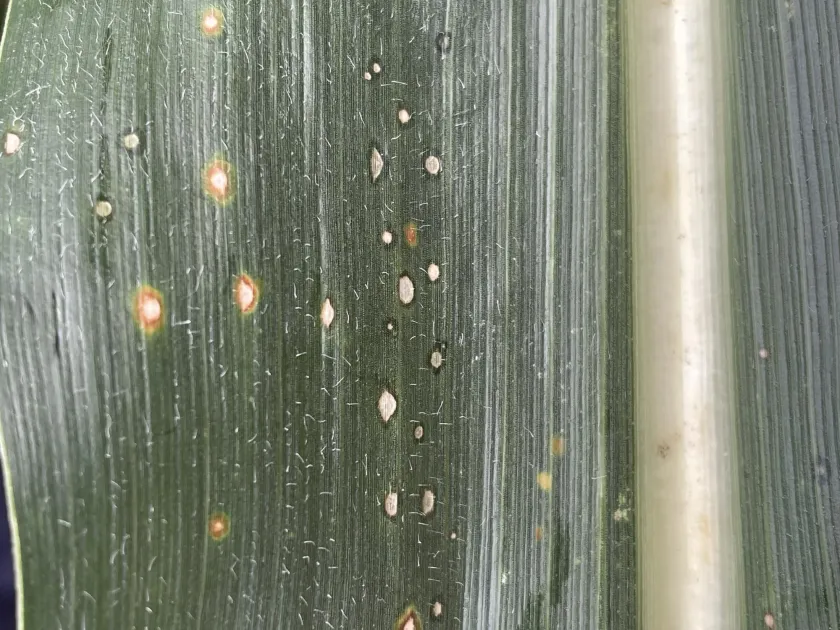
Early symptoms appear as small chlorotic spots that eventually turn dark brown or black. Necrosis can expand to cover entire leaf surfaces, leading to premature leaf drop and overall plant wilting.
When the ears or panicles are infected, the characteristic "black mold" appearance develops on the grains. The kernels become shriveled, lose their vitality, and are covered in a dark, velvety mycelial mat.
Stems and leaf sheaths often display elongated stripes with defined dark borders. Under high humidity conditions, the presence of the fungus is confirmed by the development of an olive-black or grey conidial layer.
Root systems may also suffer from decay if the pathogen colonizes the base of the stem. In seedlings, the disease frequently leads to pre-emergence or post-emergence damping-off, resulting in thin, patchy stands.
Visual diagnosis can be challenging due to the similarity of symptoms with other fungal leaf spot diseases, necessitating laboratory isolation and identification of the conidia.
Pathogen
The causative agent of the disease is the microscopic imperfect fungus Curvularia spicifera, belonging to the class of deuteromycetes. It acts primarily as a saprotroph and a facultative parasite capable of surviving for long periods in soil and on crop debris.
The fungus produces dark-pigmented conidiophores and multicellular conidia that disperse easily through wind, rain splashes, and insects. These spores exhibit significant resistance to environmental stressors.
Infection occurs when spores enter plant tissues through stomata or mechanical wounds. Once inside, the fungus secretes metabolites that cause rapid necrosis of host cells.
This pathogen is commonly associated with seed-borne fungal complexes. Unlike highly specialized pathogens, Curvularia spicifera shows remarkable biological plasticity, allowing it to adapt to diverse ecological niches.
The mycelium colonizes the intercellular spaces of the plant tissue, gradually degrading its structural integrity. Chronic infection often weakens the plant, making it prone to secondary infections by other opportunistic pathogens.
Conditions for development
The development of Curvularia leaf spot is favored by high relative humidity (above 80%) and moderate temperatures ranging from +20°C to +28°C. It is a quintessential disease of warm, humid seasons.
Frequent rainfall during the flowering and grain-filling stages facilitates mass spore dispersal and infection of reproductive organs. Prolonged moisture on foliage is a key trigger for rapid pathogen propagation.
Poor agricultural practices, such as high planting density and inadequate ventilation, create a microclimate that is optimal for the germination of fungal spores on the plant surface.
Plant stress, induced by nutrient imbalances, moisture fluctuations, or pest pressure, significantly increases host susceptibility to the fungal infection.
A high accumulation of crop residues in the topsoil layer provides a continuous reservoir for the fungus to persist throughout the off-season, ensuring early infection of subsequent crops.
Why it matters
Curvularia leaf spot causes substantial economic damage by reducing both yield quantity and quality. Infected seeds exhibit poor germination energy and reduced field emergence rates.
Infected leaves show diminished photosynthetic activity, which leads to lower biomass accumulation and stunted grain development. This results in significant losses in total harvest mass.
The accumulation of mycotoxins in affected grains renders the produce unsuitable for food or feed consumption. This imposes strict quality control measures and potential rejection of entire grain batches.
In seed production fields, the disease can compromise the genetic and health quality of the seed stock, leading to significant financial losses for agricultural enterprises.
Systemic infection often causes premature ripening of crops, which reduces the grain filling period and drastically decreases the thousand-kernel weight.
Protection
The primary control strategy involves using high-quality, fungicide-treated seeds. Systemic seed treatments (e.g., triazole-based compounds) effectively suppress the fungus during the early growth stages.
Crop rotation is essential to break the pathogen's life cycle. Deep plowing of crop residues helps accelerate the decomposition process, which effectively reduces the primary inoculum present in the field.
Optimizing mineral nutrition helps maintain the plant's natural resistance. Balanced fertilizer application is crucial to avoid conditions that promote excessive succulent growth, which is more susceptible to infection.
During the growing season, preventive fungicide applications are recommended if environmental conditions favor disease development. Adherence to label rates and timing is critical for success.
- Selection and planting of disease-resistant cultivars.
- Timely harvesting to prevent the crop from staying in the field under moist conditions.
- Proper drying and storage of grain to prevent mold development during the post-harvest period.
Discussion
No discussions yet — be the first.