
Curvularia leaf spot
Curvularia nodulosa
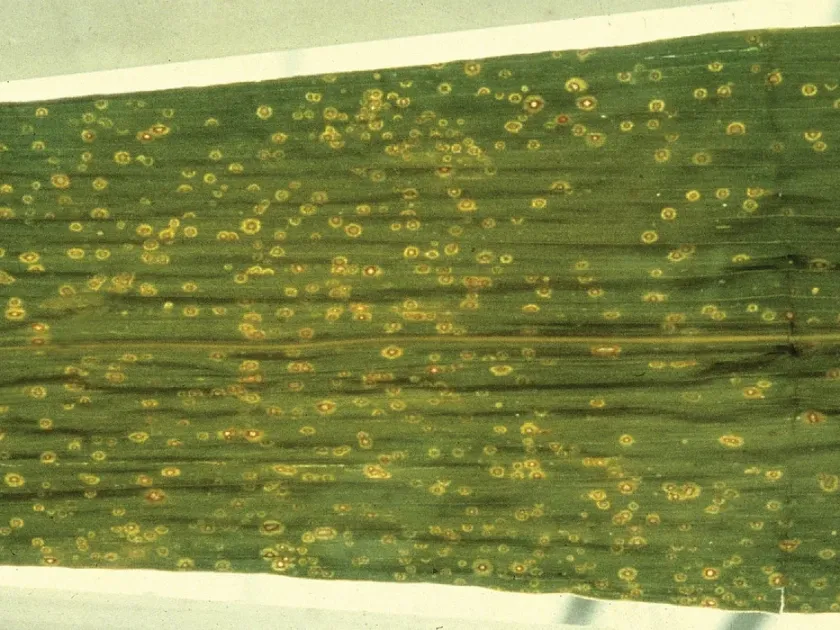
Description
Symptoms
The initial signs of Curvularia leaf spot appear as small lesions on the leaves, which expand over time. These spots are often oval-shaped and may feature a light-colored halo.
A diagnostic feature is the emergence of an olive-black mold in the center of the spots, which consists of the fungus's conidial sporulation. This mold is easily visible under mild magnification.
As the disease progresses, individual spots coalesce, covering significant portions of the leaf surface, leading to premature drying. Infection can also spread to leaf sheaths and stems.
On cereals, the fungus can infect the heads, causing darkening of glumes and kernels. Under high humidity, affected parts develop a characteristic fungal fuzz.
The spread of symptoms typically follows a bottom-up pattern, as lower leaves are the first to encounter soil-borne inoculum.
Pathogen
The disease is caused by the imperfect fungus Curvularia nodulosa, a member of the Hyphomycetes class. This pathogen is characterized by the production of dark, multicellular conidia that facilitate its transmission through wind and water splashes.
The fungus persists in soil, plant debris, and on seed surfaces as dormant mycelium or spores. It has a broad host range, affecting various grasses and agricultural crops.
Categorized as a leaf spot disease, it causes necrosis in host tissues. The fungus enters the plant through stomata or mechanical injuries, initiating tissue degradation.
The biology of this fungus is marked by high adaptability to diverse environments. Its life cycle involves both active vegetative stages and resting phases that ensure survival during unfavorable seasons.
The aggression level of the pathogen depends on the host's physiological state and its genetic resistance to fungal stressors.
Conditions for development
High relative humidity and moderate temperatures are critical for the development and spread of the pathogen. Frequent rainfall, dew, and fog create an ideal environment for spore germination.
The presence of free moisture on the leaf surface is required for successful infection. Temperatures ranging from 20°C to 28°C are most favorable for mycelial growth.
Poor agricultural practices, such as high planting density, contribute to increased humidity in the plant canopy, facilitating rapid disease progression.
Plants weakened by nutrient deficiencies or abiotic stress are significantly more susceptible to infection. Nearby weed hosts often serve as additional reservoirs for the pathogen.
Conidia are easily disseminated by wind over long distances, making the containment of the disease challenging once an outbreak begins.
Why it matters
Curvularia leaf spot causes substantial damage by reducing the photosynthetic surface of the plant, which hampers biomass accumulation and grain development.
Early infections often lead to stunted heads and shriveled grains, resulting in lower test weight. Grain quality can also be compromised by the presence of mycotoxins.
The disease weakens the overall plant immune system, making the crop more vulnerable to secondary infections and pests. In severe cases, significant yield losses occur.
Economic damage stems from both reduced yield quantity and loss of commercial quality. This necessitates investments in preventive fungicide treatments.
Infected seeds often exhibit low germination energy and reduced vigor, complicating the establishment of uniform crops.
Protection
Crop rotation is the primary preventive measure, ensuring that susceptible species are not grown in the same field for consecutive seasons. Deep plowing helps bury and decompose infected residues.
Seed treatment with broad-spectrum fungicides is essential to prevent primary infections during the seedling stage. This ensures better crop establishment.
Foliar fungicide applications are recommended when early symptoms are observed, particularly during periods of high humidity. Triazole and strobilurin-based products are highly effective.
Optimizing plant nutrition, especially potassium and phosphorus levels, strengthens the natural resistance of the crop. Excessive nitrogen should be avoided to prevent succulent growth.
- Elimination of alternative weed hosts.
- Adherence to recommended seeding rates.
- Use of resistant or tolerant crop varieties.
- Rigorous seed quality control and inspection.
Discussion
No discussions yet — be the first.