
Curvularia blight
Curvularia intermedia
Description
Symptoms
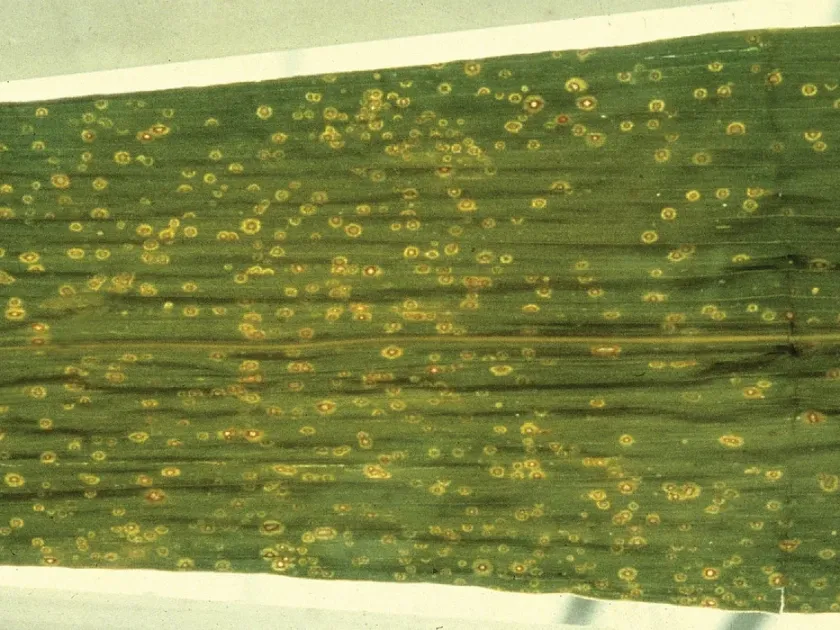
Symptoms initially appear as small, chlorotic spots that gradually develop into oval or elongated lesions with dark, necrotic centers and often a yellowish halo.
Under high humidity, the lesions show a characteristic olive-black fuzzy growth, which is the mass production of conidia, aiding in the rapid identification of the fungal infection.
In severe cases, the lesions merge, leading to extensive tissue death, premature leaf drying, and stem weakening, which may result in lodging of the crop.
Seedling infection is characterized by dark rotting of the roots and coleoptile, leading to pre-emergence or post-emergence damping-off and poor crop stand.
In mature plants, the infection can manifest as dark spots on the grain, leading to discolored kernels and potential losses in seed quality and viability.
Pathogen
The causative agent of this disease is the fungus Curvularia intermedia, a facultative parasite capable of surviving as a saprophyte on plant debris and in soil for extended periods.
The pathogen produces dark-colored conidia that are disseminated by wind, water splashes, and agricultural machinery, allowing the infection to spread rapidly across fields during the growing season.
Curvularia intermedia infects various plant parts, including leaves, stems, and seeds, by penetrating through stomata or mechanical injuries caused by insects or other environmental factors.
The biology of this fungus is marked by its ability to thrive under various environmental conditions, making it a persistent threat to cereal and turfgrass crops in different climate zones.
Its mycelium is characterized by dark pigmentation, which provides protection against ultraviolet radiation, further increasing its resilience in open field conditions.
Conditions for development
High relative humidity and frequent rainfall are the most critical environmental factors that promote the germination of spores and the development of the disease.
The optimum temperature for the growth of Curvularia intermedia typically ranges from 20 to 28 degrees Celsius, which often coincides with the active growth phases of many host plants.
Poor soil drainage and low-lying areas in fields tend to retain moisture, creating localized microclimates that are highly conducive to the spread of the pathogen.
Excessive nitrogen fertilization can lead to dense foliage, which reduces airflow and increases humidity within the plant canopy, facilitating infection progress.
Presence of plant debris from previous susceptible crops provides an inoculum source, significantly increasing the probability of early season infections if proper sanitation is not practiced.
Why it matters
Curvularia blight causes significant reduction in grain yield due to the destruction of leaf tissue, which inhibits the plant's photosynthetic capacity during the critical grain-filling period.
Infection leads to reduced seed germination rates and poor vigor of seedlings, necessitating costly reseeding and causing non-uniform crop establishment.
The disease negatively impacts the aesthetic and commercial value of crops, particularly in turfgrass and seed production, where the presence of the pathogen is strictly regulated.
Mycotoxins produced by some species of the genus Curvularia can potentially degrade the quality of harvested grain, making it unsuitable for feed or food processing.
Persistent presence of the disease in a field degrades the soil health in terms of pathogen load, making it difficult to maintain profitable production of host crops in successive seasons.
Protection
The implementation of diverse crop rotation systems is essential to break the infection cycle and reduce the population of Curvularia intermedia in the soil.
Seed treatment with systemic fungicides is a standard and highly effective practice for preventing seed-borne infections and protecting young seedlings from root rots.
Deep plowing and the thorough incorporation of crop residues into the soil promote the decomposition of plant tissues and reduce the primary inoculum reservoir.
Foliar application of fungicides, particularly those belonging to the strobilurin or triazole classes, can effectively suppress the spread of the disease when applied at the first sign of symptoms.
Effective weed management and proper irrigation practices help maintain good aeration in the canopy and prevent the formation of conditions favorable for the development of fungal spores.
Discussion
No discussions yet — be the first.