
Curvularia leaf spot
Curvularia hawaiiensis
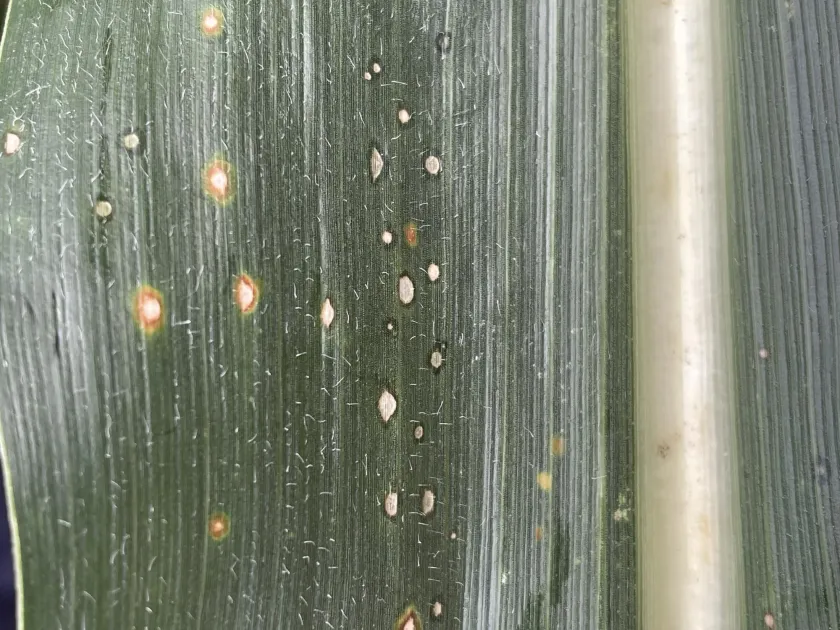
Description
Symptoms
Initial symptoms include chlorotic spots on leaf surfaces, which gradually develop into brown or dark gray lesions. As the disease progresses, these spots expand and typically assume an oval shape.
Under high humidity, an olive-black or grayish velvety coating appears on the surface of the lesions. This is the sporulation of the fungus, which concentrates in the necrotic areas of the affected leaf tissue.
When the ears or panicles of cereal crops are infected, darkening of the glumes and grains is observed. This frequently results in the «black point» symptom, which renders the seeds unsuitable for planting and reduces market quality.
Severe infection of the stems causes premature drying and brittleness. In some cases, the fungus causes lodging of the crops due to the destruction of the base of the plant, significantly complicating mechanical harvesting.
In seedlings and young plants, the infection can manifest as root rot and necrosis of the hypocotyl, often leading to damping-off and poor crop establishment in the early stages of development.
Pathogen
The disease is caused by the fungus Curvularia hawaiiensis (teleomorph: Cochliobolus hawaiiensis). It is a soil-borne pathogen classified as a dematiaceous hyphomycete capable of long-term saprophytic survival on plant debris.
The fungus produces dark, septate mycelia and characteristic multicelled, slightly curved conidia. This high enzymatic activity allows the pathogen to easily penetrate and colonize the tissues of a wide range of host species.
The pathogen is noted for its high flexibility and broad host range, affecting cereals, legumes, and various ornamental crops. Infection is primarily spread through conidia dispersed by wind, rain splashes, and infested plant material.
An essential part of the life cycle is the fungus's ability to infect seeds. Mycelium can penetrate the germ of the seed, ensuring the disease is carried over to new fields and ensuring long-distance transmission.
The fungus often acts as a secondary pathogen, attacking plants already stressed by other diseases or unfavorable environmental factors, which often makes accurate field diagnosis difficult.
Conditions for development
Optimal conditions for Curvularia hawaiiensis development are warm temperatures, ranging from +25°C to +30°C, combined with high relative humidity. These factors promote intense spore germination.
Disease outbreaks are often triggered by prolonged rains during the flowering and grain-filling stages. High plant density also contributes to the creation of a favorable microclimate within the crop canopy for pathogen proliferation.
The presence of abundant crop residues on the soil surface serves as a primary reservoir for the infection. Reduced or no-till practices often correlate with higher levels of Curvularia incidence if residues are not managed properly.
Plants suffering from nutrient deficiencies or mechanical damage are highly susceptible to colonization. A weakened immune system limits the plant's ability to resist the aggressive spread of the fungus.
Delayed sowing into cold or overly wet soil can lead to seed infection and seedling death. This creates primary foci of infection that spread throughout the field during the growing season.
Why it matters
The primary economic impact of Curvularia leaf spot is a significant reduction in crop productivity. Damage to the leaf canopy reduces photosynthetic efficiency and leads to premature leaf senescence.
Infection of reproductive organs directly affects the 1000-grain weight and overall grain filling. The resulting grain is shriveled, of low quality, and often contaminated with fungal toxins, making it unsuitable for feed or food processing.
Infected seed lots exhibit low germination energy and field emergence rates. This leads to direct financial losses for farmers, necessitating reseeding or resulting in yield losses due to reduced plant populations.
Stem infection leads to increased lodging, which reduces yield and causes substantial losses during harvesting, as combines cannot efficiently pick up the brittle, lodged crop material.
The economic impact is multifaceted, including the costs of fungicide applications, reduced market value of the harvested yield, and risks of contamination, necessitating integrated disease management.
Protection
The primary control measure is the use of high-quality, treated seed. Systemic fungicides are effective at suppressing the infection on the seed surface and within the seed tissues before planting.
Crop rotation is an essential practice to break the life cycle of the pathogen. It is recommended to avoid planting susceptible crops in the same field for at least 2-3 years to reduce the soil-borne inoculum pressure.
Agronomic measures include deep plowing of crop residues and effective weed control, as some weeds can serve as alternative hosts. Balanced fertilization enhances the natural resistance of the plants to the pathogen.
During the growing season, systemic fungicides (e.g., triazoles or strobilurins) should be applied upon the appearance of early symptoms. Proactive monitoring and timely application are critical for successful management.
- Rigorous cleaning and disinfection of grain storage facilities.
- Monitoring of grain moisture levels during storage to prevent mold development.
- Selection of resistant crop varieties and hybrids adapted to the specific growing region.
Discussion
No discussions yet — be the first.