
Crumenulopsis canker
Crumenulopsis sororia
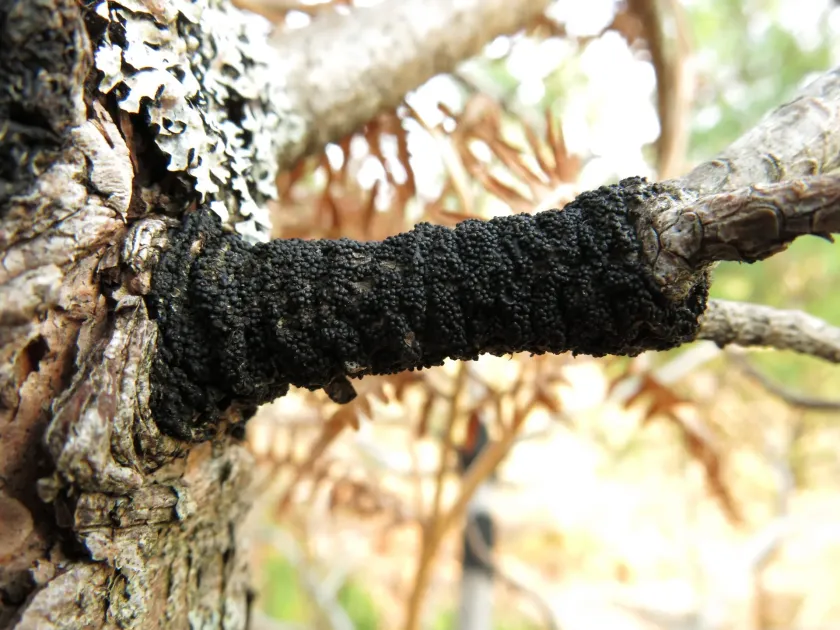
Description
Symptoms
The most distinctive sign is the formation of resinous cankers on the stems or branches, often clustered around branch whorls.
Needle discoloration is a common symptom, where the foliage turns yellow and subsequently reddish-brown as the water transport system is blocked.
During damp weather, the presence of dark, erumpent apothecia on the bark surface serves as a definitive diagnostic feature for field identification.
Severe infections frequently cause extensive resin bleeding, which can mat the bark and eventually girdle the branch or stem, leading to dieback.
Dead tops or branches in otherwise healthy-looking stands are often the first visual indicator that Crumenulopsis sororia is present in the area.
Pathogen
The disease is caused by the fungus Crumenulopsis sororia, an ascomycete pathogen that primarily targets species within the Pinus genus.
This fungus behaves as a necrotrophic parasite, invading the bark and cambium of stems and branches, leading to characteristic lesion development.
The life cycle involves the production of apothecia—tiny, cup-shaped fruiting bodies—that emerge from the bark of infected tissues during wet periods.
Spores are dispersed by water splashes and wind currents, settling on fresh wounds or natural openings in the pine bark to initiate new infections.
It is a long-standing pathogen that can persist in dead bark, ensuring its continued presence within infected forest stands for several growing seasons.
Conditions for development
High humidity and moderate temperatures are the primary environmental drivers that favor the germination and spread of fungal spores.
Dense, poorly managed stands with restricted airflow often experience higher infection rates due to the prolonged moisture on the tree surfaces.
Physical injuries caused by hail, heavy wind, or forestry equipment provide essential entry points for the pathogen into the tree's vascular system.
Stressed trees, particularly those suffering from nutrient deficiency or drought, demonstrate significantly less resistance to the colonization of this fungus.
The pathogen thrives in temperate regions where cool, rainy springs provide ideal conditions for the reproductive phase of the fungus.
Why it matters
The disease is economically damaging as it causes significant growth loss and mortality, particularly in young to middle-aged pine plantations.
Cankers cause structural degradation of the wood, rendering it unsuitable for high-quality timber products and reducing its commercial value.
Infected trees become physiological sinks, often attracting secondary pests such as wood-boring insects, which further accelerates tree decline.
Widespread outbreaks can devastate entire forest compartments, creating large gaps that require expensive reforestation efforts to restore.
The loss of canopy cover due to branch and top dieback alters the forest microclimate, potentially leading to long-term ecological consequences.
Protection
Effective management requires prompt sanitation harvesting, which involves the removal and destruction of infected stems to reduce spore inoculum.
Thinning operations should be carefully timed and managed to ensure adequate stand density, which promotes airflow and reduces surface moisture.
Preventing mechanical damage during forest operations is a crucial prophylactic measure to minimize potential infection sites on standing trees.
Regular forest pathology surveys should be conducted to detect early signs of the disease, allowing for targeted intervention before it reaches epidemic levels.
Promoting forest resilience through balanced fertilization and planting site-adapted pine varieties are key strategies for long-term disease mitigation.
Discussion
No discussions yet — be the first.