
White pine blister rust
Cronartium ribicola
Description
Symptoms
The earliest sign of white pine blister rust on pine trees is the yellowing of needles on specific branches, a symptom often referred to as "flagging." This occurs as the fungal infection restricts the flow of nutrients.
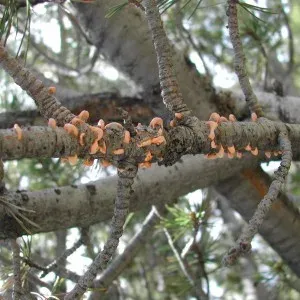
During the spring, characteristic orange-yellow blisters, known as aecia, erupt through the bark of the infected trunk or branches. These blisters release powdery, bright orange aeciospores that are easily carried by the wind.
Following the rupture of these blisters, the bark becomes sunken and eventually dies, creating open, diamond-shaped cankers. These wounds can girdle the stem, leading to the death of everything above the point of infection.
On Ribes leaves, the disease manifests in mid-summer as small, bright yellow or orange pustules on the underside of the leaves. These are the uredinia, which produce spores that can re-infect other Ribes leaves.
By late summer and early autumn, brownish, hair-like structures called telia develop on the underside of the currant leaves. These produce basidiospores, which are capable of infecting white pine needles during moist weather.
Pathogen
The disease is caused by the rust fungus Cronartium ribicola. It is a heteroecious fungus, meaning it requires two unrelated hosts to complete its complex biological life cycle.
The primary hosts are five-needle pines, such as the eastern white pine, western white pine, and sugar pine. On these trees, the fungus colonizes the inner bark, eventually producing aecia that release spores to infect the secondary host.
The alternate hosts are plants of the genus Ribes, which includes currants and gooseberries. The fungus completes its uredinial and telial stages on these shrubs, which is essential for the disease to propagate throughout the summer.
The life cycle of the fungus is intricate, involving five distinct spore stages: pycniospores, aeciospores, urediniospores, teliospores, and basidiospores. Each stage is adapted to survival and dispersal under specific environmental conditions.
The pathogen is highly evolved and persistent, allowing it to maintain an infection reservoir in environments where both pine and currant species coexist within close proximity.
Conditions for development
High humidity and cool temperatures are critical for the successful germination and infection of pine needles by basidiospores. Extended periods of fog, rain, and dew in late summer are highly favorable for disease transmission.
Wind is the primary vector for spore dispersal. Basidiospores are fragile and sensitive to drying out, so their survival depends on rapid transport during cool, damp weather conditions from Ribes plants to pines.
Dense forest stands that inhibit airflow create microclimates with increased humidity, which significantly promotes the infection process. Proper spacing and thinning are important to reduce the moisture levels in the canopy.
The prevalence of the disease varies from year to year based on climatic cycles. Dry, hot summers often result in a significant decrease in infection rates because the spores fail to survive the harsh atmospheric conditions.
Physical injuries to the bark of the pine tree can also act as entry points for the pathogen if the bark is colonized, though the fungus predominantly infects the tree through the stomata of the needles.
Why it matters
White pine blister rust is one of the most destructive diseases for five-needle pines. It causes progressive branch dieback and, if the main trunk is girdled, the entire tree will die, leading to significant timber losses.
In nurseries, this disease is particularly devastating. It can wipe out entire batches of seedlings, making the commercial production of susceptible pine species extremely risky and economically challenging.
Mature trees infected with the fungus suffer from reduced growth, lower wood quality, and a higher vulnerability to secondary attacks by wood-boring insects or other decay-causing fungi.
For Ribes crops, severe rust infection causes premature leaf drop. This reduces the vigor of the plant, decreases fruit yield, and compromises the shrub's ability to survive the subsequent winter.
Management costs for this disease are substantial, involving large-scale sanitation operations, constant monitoring of nursery stock, and the potential exclusion of certain plant species from specific geographic regions.
Protection
The primary control strategy is spatial isolation, which involves removing all Ribes plants within a 300 to 500-meter buffer zone around pine plantations or nurseries to break the infection cycle.
Systematic sanitation pruning is essential in infected areas. All branches showing signs of cankers should be removed and destroyed by burning to reduce the overall spore load in the immediate environment.
- Planting rust-resistant or tolerant cultivars of white pine.
- Pruning lower branches to reduce the likelihood of basidiospore infection.
- Applying fungicides to Ribes to suppress spore production.
- Frequent inspections of pine stands for early symptoms.
- Promoting diverse forest stands with better airflow to prevent high humidity.
Chemical control with fungicides is generally limited to nursery settings or high-value plantations, where precise timing during the spring or autumn infection windows can provide protection.
Long-term resistance breeding programs are currently the most effective method for ensuring the future viability of five-needle pine forests in areas where the fungus is endemic.
Discussion
No discussions yet — be the first.