
Cronartium
Cronartium
Description
Symptoms
The most visible symptom on conifer trunks and branches is the development of localized swellings or galls. These areas are frequently accompanied by excessive resin flow, which hardens on the bark surface.
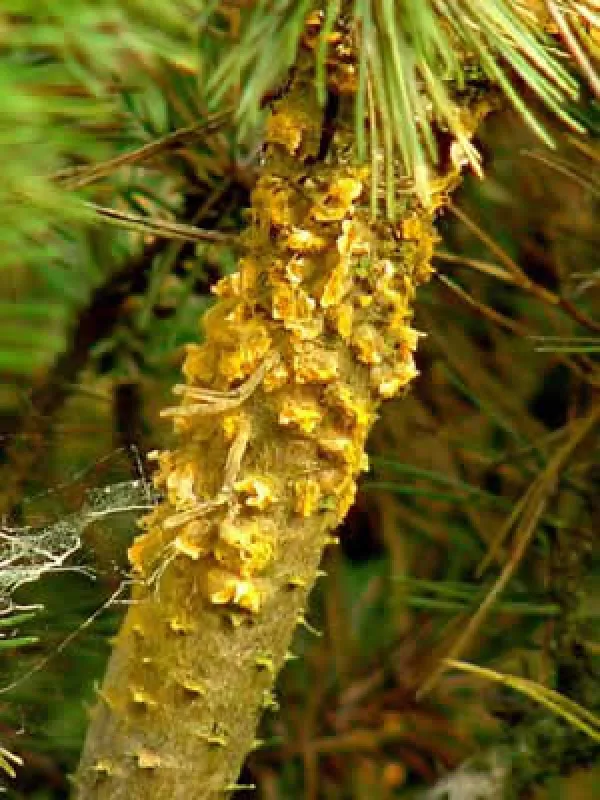
In spring, the pathogen produces characteristic aecia—blister-like structures that break through the bark. These release bright orange spores, giving the stem a distinct rusty appearance that is diagnostic of the infection.
Foliage on affected branches typically turns yellow, loses turgor, and eventually drops off. In severe cases, the canopy begins to die back from the top down as the structural integrity of the tree fails.
On alternate hosts, such as currant leaves, signs appear as small yellow or brown spots on the underside of the leaves. These spots eventually develop into pustules containing various spore stages of the fungus.
Eventually, the fungal growth forms a necrotic canker that encircles the branch or trunk. This girdling prevents the transport of nutrients and water, leading to the death of the tissues above the infection point.
Pathogen
The disease is caused by a group of heteroecious rust fungi from the genus Cronartium. These fungi require two different host plants to complete their complex life cycle, which involves several spore stages.
The pathogen utilizes airborne spores, such as aeciospores and urediniospores, to spread over vast distances. The mycelium invades the plant tissues, often colonizing the cambium and bark of woody hosts for many years.
Each species within this genus is highly specialized, targeting specific conifer hosts. The most notorious member is Cronartium ribicola, which is responsible for the devastating white pine blister rust.
Alternative hosts, which are essential for the fungus to complete its cycle, usually include shrubs or herbaceous plants, such as Ribes species (currants and gooseberries). The absence of these hosts can significantly reduce disease pressure.
Because the mycelium is perennial, the infection remains active inside the tree throughout the year. This persistent nature makes the fungus a chronic threat to timber production and ecosystem stability.
Conditions for development
High humidity and cool, damp weather during the spring and early summer are ideal for spore germination and infection. Foggy conditions often provide the necessary moisture for the pathogen to thrive.
The physical proximity of susceptible conifer species to alternate hosts is a major risk factor. Wind carries the spores from infected shrubs directly onto the vulnerable needles or stems of pine trees.
Crowded plantations with poor airflow create a stagnant microclimate that encourages fungal development. Lack of proper thinning and maintenance in forestry sites exacerbates the spread of the disease.
Mechanical damage to the bark from logging machinery, pruning, or animal grazing provides easy entry points for the fungus. These wounds act as infection courts for the pathogen to penetrate deep into the tree.
Host trees growing in poor soil conditions or under significant shade may have weakened natural defenses. Such trees are often more susceptible to colonization by Cronartium compared to those in optimal growth sites.
Why it matters
Cronartium poses a severe threat to forestry, particularly for young pine plantations. The disease can cause complete stand failure, leading to significant economic losses and disrupted reforestation efforts.
Timber quality is severely compromised, as the wood becomes weak and vulnerable to secondary wood-boring insects and decay fungi. Infected trees are also more susceptible to windthrow and breakage.
Nurseries are particularly vulnerable, where the pathogen can decimate entire batches of seedlings. Infected nursery stock cannot be sold or planted, resulting in substantial financial setbacks for growers.
By weakening the host, the pathogen lowers the trees' overall resistance to other environmental stressors, such as prolonged drought or extreme winter temperatures, accelerating the decline of the forest.
Large-scale epiphytotics can lead to long-term changes in forest composition, especially when native, highly susceptible species are involved. This creates lasting ecological impacts on biodiversity.
Protection
The primary management strategy is spatial isolation: ensuring that susceptible conifers are not planted near alternate hosts like Ribes species. This strategy aims to break the fungal life cycle.
Sanitation is critical, involving the immediate removal and destruction of infected branches or entire trees. Pruning infected limbs can sometimes save a tree if the canker has not yet reached the main stem.
In nursery environments, preventive fungicide applications during high-risk periods can protect seedlings. However, treatment timing must be strictly aligned with the local spore-release periods of the pathogen.
Utilizing certified, disease-free nursery stock is essential for preventing the introduction of the fungus into new areas. Breeding programs aimed at developing resistant conifer varieties offer long-term hope.
Regular monitoring of forest stands allows for early detection and rapid response. Controlling small, localized outbreaks is significantly more effective and cost-efficient than managing widespread forest epidemics.
Discussion
No discussions yet — be the first.