
Cronartiaceae
Cronartiaceae
Description
Symptoms
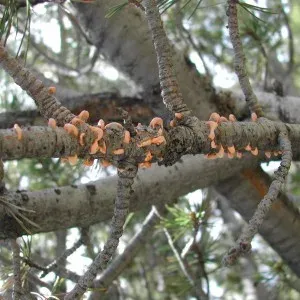
The most diagnostic sign of Cronartiaceae infection is the formation of conspicuous, bright yellow to orange aecia erupting through the bark of branches or main stems of coniferous trees. These pustules are often preceded by localized swellings or cankers.
Resinosis, or excessive sap flow, is a common defensive response of the pine host to fungal penetration. This resin exudation often causes the bark to appear darkened or wet, which is a clear indicator of physiological distress in the affected area.
On alternate hosts, symptoms appear as small spots or fungal mats on the underside of leaves or needles. These structures produce different spore types, which serve as the inoculant for the next phase of the life cycle, typically involving the re-infection of conifers.
Chronic infections often result in distorted stem growth, such as the formation of galls or localized thickening of the trunk. In severe cases, the tree may exhibit "witches' brooms" or top-kill, where the crown dies back due to restricted nutrient flow.
Eventually, the bark in infected zones becomes necrotic and brittle. Deep longitudinal fissures may develop, exposing the underlying wood to secondary invaders such as wood-boring insects and decay fungi.
Pathogen
Cronartiaceae is a family of rust fungi within the order Pucciniales. These organisms are obligate parasites that typically require two unrelated host plant species to complete their complex life cycle, a phenomenon known as heteroecism.
The primary hosts for most species in this family are conifers, especially members of the genus Pinus (pines). The alternate hosts are diverse, ranging from woody shrubs like Ribes (currants) to various herbaceous plants and even other trees such as oaks.
The fungus produces several distinct types of spores (e.g., aeciospores, urediniospores, teliospores) throughout the growing season. This multi-stage reproductive strategy allows the pathogen to adapt to different environmental conditions and disperse efficiently across vast landscapes.
The fungal mycelium colonizes the vascular tissues, specifically the cambium and bark of the host plant. By extracting essential nutrients, the parasite disrupts the normal physiological processes of the tree, leading to significant growth retardation and physical damage.
Systematic studies continue to refine the classification of Cronartiaceae. While historically focused on morphology, modern genomic approaches have highlighted the high degree of host specificity inherent to members of the Cronartium genus.
Conditions for development
High relative humidity is the primary driver for infection. Spore germination and colonization require a film of water on the plant surface, making damp conditions, heavy dews, or prolonged rainy periods ideal for disease development.
Temperature plays a crucial role in regulating the rate of fungal growth. Moderate temperatures throughout the spring and early summer provide an optimal environment for the rapid development of reproductive structures and the spread of spores.
Densely planted stands or areas with stagnant air flow significantly increase disease risk. The lack of air movement allows moisture to persist longer on needles and leaves, facilitating the success of fungal infection.
The geographical proximity of primary and alternate hosts is the critical factor for epidemic development. If the two host types are located within a few hundred meters, the probability of successful cross-infection increases exponentially.
Trees already compromised by environmental stress, such as drought, nutrient deficiency, or existing pest infestations, are significantly more susceptible to successful colonization by Cronartiaceae fungi.
Why it matters
The primary economic impact of Cronartiaceae involves reduced timber production and diminished wood quality. Cankered stems are physically weakened, making them susceptible to wind-breakage, snow-damage, and reduced commercial value.
In forest nurseries, these fungi can be devastating, causing the death of a large percentage of seedlings. This high mortality rate disrupts reforestation efforts and increases the financial burden on nursery operations.
The presence of diseased trees creates a liability for secondary pests and diseases. Bark beetles and other wood-boring insects are frequently attracted to stressed trees, leading to faster degradation of the forest stand.
Ecologically, heavy infestations can shift forest composition and destabilize local habitats. This loss of biodiversity and the decline of mature conifers can have long-term negative effects on the structure of forest ecosystems.
Furthermore, in recreational areas, the aesthetic value of the forest is severely impaired. The presence of dead or dying trees requires costly intervention, including sanitation logging and site reclamation.
Protection
The most effective management strategy is spatial separation between the conifer hosts and the alternate hosts. Eliminating alternate host species from the immediate vicinity of pine plantations is a primary preventive measure.
Regular sanitation programs are vital, particularly in nurseries and young plantations. Infected plants should be identified, removed, and destroyed immediately to prevent the spread of airborne spores to healthy trees.
Chemical control using systemic fungicides can be effective in nursery settings if applied at the optimal time relative to the fungal life cycle. However, this is generally not feasible for large-scale forest applications.
Breeding and selecting rust-resistant varieties of coniferous trees remains the most sustainable long-term solution. Encouraging genetic diversity within plantations can significantly mitigate the impacts of these pathogens.
- Implement strict quarantine for nursery stock.
- Conduct regular pruning of infected limbs.
- Ensure appropriate tree spacing to improve air circulation.
- Prioritize the use of certified, disease-free seedlings.
Discussion
No discussions yet — be the first.