
Crocynia
Crocynia
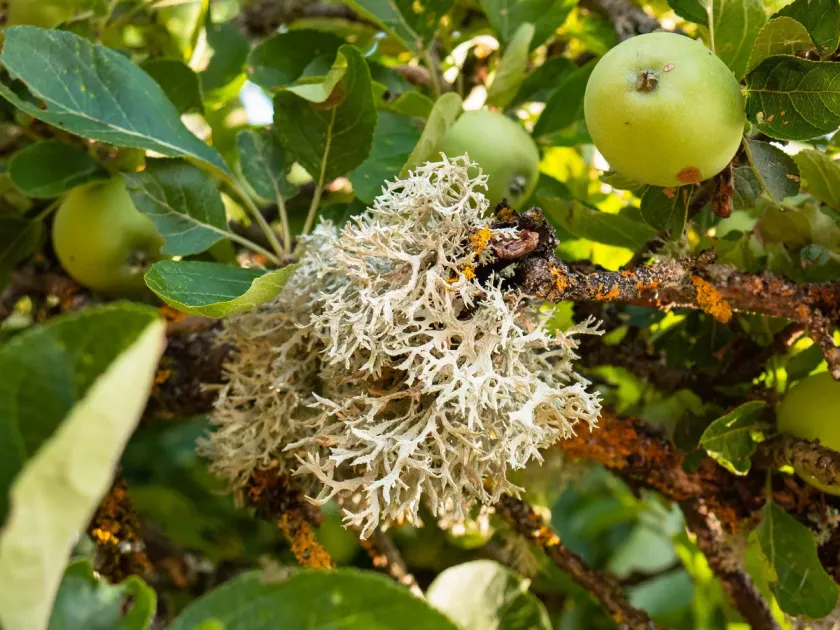
Description
Symptoms
The primary identification sign is the formation of white, grey, or greenish crust-like patches on the trunks and branches of fruit and ornamental trees.
These patches often have a grainy or powdery appearance and are firmly attached to the tree bark, becoming more visible in humid or rainy weather conditions.
Growth usually begins as small circular colonies that eventually merge together, covering large areas of the tree during periods of stable environmental humidity.
The presence of Crocynia is usually most noticeable on the shaded sides of the trunk, where moisture persists for a longer duration after precipitation.
Unlike parasitic fungi that cause tissue death, Crocynia does not penetrate deep into the phloem but creates a physical layer on the outer bark surface.
Pathogen
Crocynia is a genus of lichens that belongs to the group of epiphytic organisms inhabiting the bark of various woody plants and orchard species.
These organisms are a symbiotic partnership between fungi and algae, which do not parasitize the tree's tissues but utilize the bark as a stable structural substrate.
Biologically, Crocynia organisms are adapted to survive in environments where they obtain nutrients and water from the atmosphere and dust particles.
The organism grows through the expansion of its thallus, forming characteristic layers that cover the bark surface as the lichen matures over several years.
While not a direct pathogen causing internal rot, Crocynia is often studied in plant pathology as an indicator of the tree's overall environmental health status.
Conditions for development
High relative humidity and poor air circulation are the primary factors that facilitate the colonization of trees by Crocynia lichen species.
Orchards with dense canopy structures that lack adequate sunlight penetration provide the ideal shaded microclimate for this organism to thrive.
Poor orchard maintenance, including the lack of thinning and pruning, creates stagnant air conditions that encourage the buildup of moisture on tree bark.
Accumulated dust and organic debris on the bark serve as an initial anchor point for lichen spores, allowing them to establish a foothold on the plant.
Cooler temperatures with frequent fog or persistent morning dew significantly accelerate the growth rate of lichen layers on host tree surfaces.
Why it matters
Although it does not directly feed on the tree, the thick crust of Crocynia creates a physical barrier that restricts gas exchange through bark lenticels.
The dense structure of the lichen provides a protective micro-habitat for various pests, including scale insects and mites, which hide from natural predators.
Large infestations can lead to decreased bark flexibility, potentially causing cracks during extreme cold weather or significant temperature fluctuations.
A heavy coverage of Crocynia is a visual indicator of an aging or stressed tree, often signaling that the plant is not receiving sufficient maintenance.
In terms of agricultural productivity, trees heavily covered in epiphytic lichens often exhibit reduced vigor compared to clean, well-maintained specimens.
Protection
Mechanical removal of lichen layers using wire brushes or blunt scrapers in early spring is the most effective way to restore the bark's surface health.
Proper pruning and thinning of the canopy are essential to improve air circulation and light penetration, making the environment unsuitable for lichen growth.
Whitewashing tree trunks with a lime mixture containing copper sulfate is a traditional and highly effective method for preventing new lichen infestations.
Spraying with dilute iron sulfate solutions can help dehydrate and remove existing lichen crusts without causing damage to the tree's underlying bark.
Maintaining optimal tree vigor through balanced fertilization and correct watering practices is the best long-term strategy for preventing lichen colonization.
Discussion
No discussions yet — be the first.