
Cordyceps militaris
Cordyceps militaris
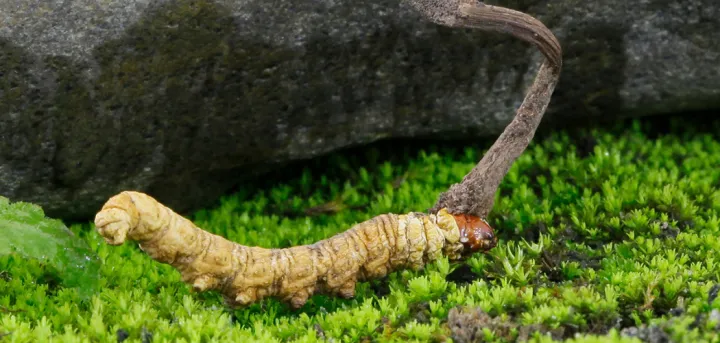
Description
Pathogen
Cordyceps militaris is an entomopathogenic fungus belonging to the family Cordycipitaceae. It is strictly an insect parasite and not a plant pathogen, meaning it does not infect, decay, or damage the tissues of agricultural crops.
The life cycle begins when fungal spores attach to the cuticle of an insect host. The fungus then penetrates the exoskeleton and grows within the insect's body, utilizing its nutrients for survival and reproduction.
After the insect host dies, the fungus produces striking, club-shaped, bright orange fruiting bodies. These emerge from the host's body and release spores into the environment to find new hosts.
In modern agronomy, Cordyceps militaris is studied for its potential in integrated pest management. Its ability to specifically target insect populations makes it a focus for developing eco-friendly biocontrol agents.
Unlike phytopathogens that disrupt plant physiology, this fungus maintains ecological equilibrium by regulating insect populations within the soil and leaf litter.
Conditions for development
This fungus requires high humidity, typically above 80 percent, to thrive and produce its fruiting bodies. It prefers habitats with stable moisture levels and protection from direct, intense sunlight.
The optimal temperature range for the development of the fungal biomass is between +18°C and +25°C. Outside this range, growth slows down, although the organism can survive as dormant spores.
A high density of insect hosts, such as larvae or pupae, is necessary for the fungus to establish a significant presence in a specific area. Rich, organic-matter-laden soils often provide the best conditions.
The acidity level of the soil is less critical, but a neutral to slightly acidic pH is generally conducive to the spreading of its mycelial network. Excessive soil water retention acts as a primary catalyst for its growth.
Spores are dispersed through the air and via water splashes during rainfall, enabling the fungus to colonize new areas where host insects are present.
Why it matters
Cordyceps militaris poses no threat to crops and is not considered a plant disease. It does not produce toxins that affect plant health, nor does it cause necrosis or wilting.
Any damage observed on plants near where the fungus is found is unrelated to the fungus itself. Farmers should not confuse this beneficial organism with pathogenic fungi that cause root or stem rot.
The presence of Cordyceps militaris can be viewed as an indicator of an active soil ecosystem where natural biological processes are regulating insect populations.
Its role is strictly limited to the entomological sphere. Consequently, it does not reduce crop yield or quality, and no economic thresholds for "infestation" are established for this organism.
Treating this fungus as a plant disease is a common misconception that can lead to unnecessary and harmful applications of broad-spectrum fungicides.
Protection
No protection measures against Cordyceps militaris are required, as it is not a threat to agricultural productivity. It is a naturally occurring component of healthy soil biodiversity.
If its development is undesirable in controlled environments, such as insectaries, the primary intervention is to lower ambient humidity and improve air circulation to disrupt the fungus's lifecycle.
Good agricultural practices, including effective soil drainage, help prevent the excessive moisture that might favor the overgrowth of any fungus, including this species.
Crop rotation and integrated pest management practices naturally regulate the insect population, which in turn keeps the presence of the fungus within its normal ecological bounds.
Focusing on plant health through balanced fertilization and robust crop management is the best way to ensure that any fungal activity remains beneficial or neutral to the farming operation.
Discussion
No discussions yet — be the first.