
Conifer root rot
Coniferiporia weirii
Description
Symptoms
Early stages of the infection are often asymptomatic as the disease is located entirely below ground. One of the first visible signs is excessive resin flow at the base of the trunk.
As the disease progresses, needles may become pale or yellow, followed by a noticeable thinning of the tree crown. Growth rates of the terminal leaders often decrease significantly.
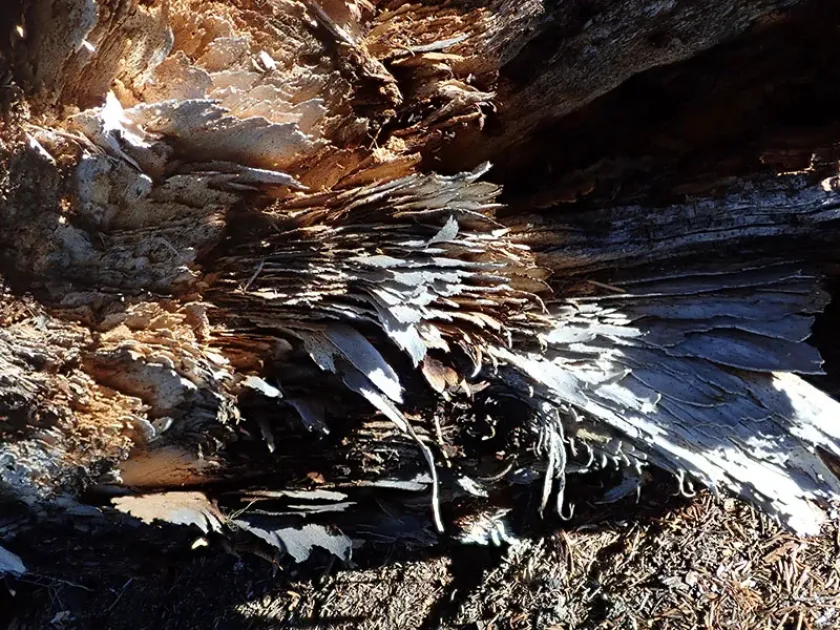
Below the bark, particularly at the root collar, one can find thick, white mycelial mats or layers. These structures are diagnostic of the presence of the pathogen.
Conks or fruiting bodies of the fungus may appear at the base of the tree, usually flat, leathery, and brown in color. However, their absence does not confirm the tree is healthy.
A classic symptom is windthrow; because the root system is structurally compromised, affected trees are frequently toppled by moderate winds during storms.
Pathogen
The disease is caused by the fungus Coniferiporia weirii, formerly classified as Phellinus weirii. It is a serious forest pathogen that specifically targets the root systems and the lower trunk area of coniferous tree species.
The fungus spreads primarily through root contact, where the mycelium travels from an infected root to a healthy one. It can persist in the soil for decades, surviving on woody debris and old root fragments.
This pathogen causes severe root and butt rot, leading to the destruction of the wood's structural components, specifically lignin and cellulose. It is considered one of the most destructive diseases in coniferous forests.
The life cycle of the pathogen is closely tied to the density of the forest stand. Once established, the fungus expands through root connections, creating large "infection centers" that grow progressively over time.
Its ability to remain active in stumps and dead root systems makes it a long-term threat to any new trees planted in the same location following timber harvesting.
Conditions for development
The disease thrives in dense forest stands where root systems are physically intertwined, allowing for easy transmission of the mycelium. High-density planting increases the risk of rapid spread.
Moist soil conditions and moderate temperatures favor fungal development. The pathogen is less active in very dry or poorly aerated soils but causes severe damage in typical temperate forest environments.
The presence of fresh stumps after harvest is a critical factor, as these stumps act as reservoirs for the fungus, providing the energy needed for the pathogen to attack nearby living trees.
Older stands are generally more susceptible, as their natural resistance may decline over time due to environmental stressors or physiological aging.
Disturbances to the forest ecosystem, such as improper thinning or logging, can inadvertently stress the remaining trees, making them more vulnerable to infection.
Why it matters
The impact of Coniferiporia weirii is profound, as it kills trees in groups rather than individually, often creating large gaps in the forest canopy known as "mortality centers."
The wood affected by this rot loses all structural integrity, becoming soft, spongy, and brittle. This renders the timber useless for construction or any high-value industrial purposes.
Economic losses include not only the loss of potential timber yield but also the high costs associated with site sanitation, stump removal, and the necessity of reforesting affected areas.
It severely limits natural forest regeneration because young seedlings planted in infected soil often contract the disease shortly after their roots make contact with old, infested debris.
There is no practical cure for an infected tree; once the fungus reaches the root collar, the tree will inevitably die and must be removed to prevent further spread to neighbors.
Protection
Sanitation is the most effective management strategy. This involves removing infected trees and their root systems to break the chain of transmission between roots.
Stump removal (stumping) is highly recommended in high-risk areas to eliminate the primary food source of the fungus and reduce the infection pressure in the soil.
During reforestation, using a mix of less susceptible species (such as hardwoods) can help prevent the rapid spread of the disease and improve soil health over time.
In managed landscapes and nurseries, biological control agents can be used to suppress fungal growth in the soil, though results depend on correct application and timing.
- Monitor forest stands for signs of thinning crowns.
- Promptly remove diseased trees and their stumps.
- Avoid high-density planting to reduce root contact.
- Favor the planting of resistant or tolerant species.
- Practice site-specific forest management.
Discussion
No discussions yet — be the first.